















Texas Border Business




By Roberto Hugo González / Texas Border Business
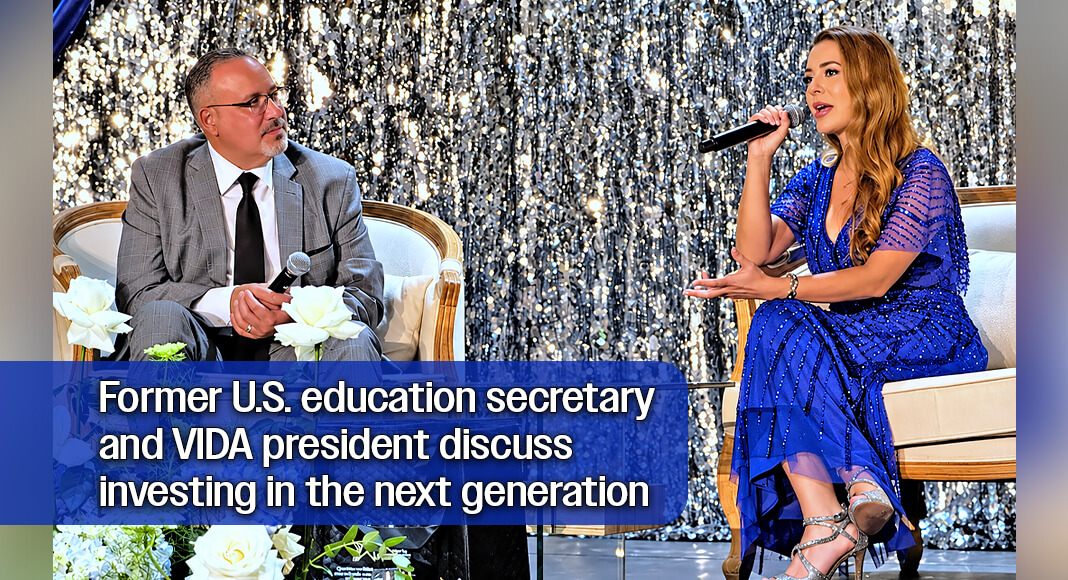
McALLEN, Texas — Dr. Miguel A. Cardona’s conversation with VIDA President and CEO Felida Villarreal moved quickly beyond education policy and into something more personal — what happens when students stop viewing where they come from as a disadvantage.
The 12th U.S. Secretary of Education joined Villarreal for a fireside conversation during Valley Initiative for Development and Advancement’s 31st Anniversary Gala Sept. 24 at the McAllen Convention Center.




Cardona, who grew up in a working-class Puerto Rican family in Connecticut, told the audience that students should not believe they must change who they are to succeed.
“You don’t have to change your stripes to make it,” Cardona said. “If anything, it’s a superpower to be able to code-switch, different cultures, different languages.”
Villarreal connected Cardona’s experience to VIDA students, many of whom are first-generation college students and adult learners balancing education, employment and family responsibilities.
She said VIDA encourages students to embrace characteristics they may initially view as limitations.
Cardona said those challenges can develop qualities that become valuable later in life.
“What you see now as a deficit is a superpower emerging,” he said. “Those challenges are making you stronger, making you a leader.”
Their discussion covered workforce training, college completion, childcare, transportation, financial barriers, and the importance of connecting education with careers that provide economic mobility.
Villarreal said VIDA measures that connection through an economic impact study and told Cardona that every dollar invested in the organization generates more than $15 in return to the community.
Cardona responded that this return shows why workforce programs should be considered part of broader community and economic development.
“This is not a nice to have, folks,” Cardona said. “The return on investment here is too big to ignore. This is community development. This is economic development.”
He also challenged educational institutions, government, philanthropy, employers, and community organizations to work together instead of operating independently.
“It takes a village,” Cardona said. “We are the village elders.”
Villarreal asked what message he would leave with leaders who have opportunities to invest in the next generation.
“Education is a great equalizer,” Cardona responded.
He said organizations such as VIDA provide the “connective tissue” between K-12 education, higher education and employment, particularly for students who may otherwise leave school because of financial or personal obstacles.
That emphasis on investing in people continued as VIDA presented its Legacy Award to Alonzo Cantú, one of the organization’s founding board members.
Cantú was unable to attend. Julian Alvarez, VIDA board member and senior vice president of Lone Star National Bank, accepted the recognition on his behalf.
Alvarez said Cantú has viewed education as more than earning a degree or securing employment.
“It’s about creating opportunity, the kind of opportunity that can change the trajectory of a family for generations,” Alvarez said.
He said developing a highly skilled workforce strengthens businesses and the regional economy, but its effects also reach individual households.
“We are not simply preparing them for a job,” Alvarez said. “We are giving them the tools to build a better life, become self-sufficient, provide for their families and contribute to the prosperity of this entire region.”
His final words brought the evening’s discussion back to the central theme of investing in people.
“The legacy we celebrate tonight is not simply what we leave behind,” Alvarez said. “It is what we make possible for those who come after us.”
See related stories: