














Texa Border Business


Texas Border Business
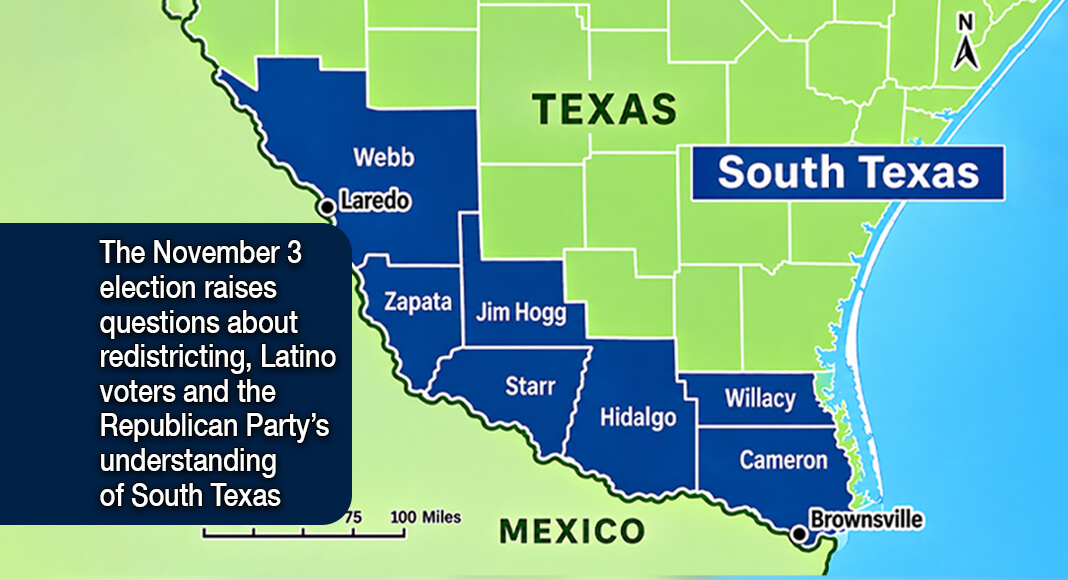
The November 3, 2026, election delivered a significant political setback to Republicans in South Texas. After years of making gains among Hispanic voters, the party lost a congressional seat it had captured in 2022 and failed to defeat two established Democratic incumbents.
The results raise an important question. What changed between the Republican advances of 2024 and the 2026 election?



The answer deserves examination beyond the familiar explanations of party loyalty and national political trends.
In Congressional District 15, Democrat Bobby Pulido defeated Republican incumbent Monica De La Cruz, receiving approximately 62.3% of the vote compared with her 37.7%.
In District 28, Democratic Congressman Henry Cuellar defeated Republican Tano Tijerina, receiving about 65.8% of the vote to Tijerina’s 29.6%.
In District 34, Democratic Congressman Vicente Gonzalez defeated Republican Eric Flores, receiving approximately 55.6% compared with Flores’ 39.8%.
These preliminary results show that Republicans encountered substantial resistance in districts they had identified as opportunities to maintain or expand their congressional representation.
But election results tell us who won. They do not, by themselves, explain why voters made their decisions.
One possible explanation involves the Republican Party’s interpretation of the 2024 presidential election.
President Donald Trump made substantial gains among Hispanic voters in South Texas, carrying communities that had historically supported Democratic presidential candidates.
Republican leaders subsequently pursued congressional redistricting designed to improve their prospects in several South Texas districts.
However, voting for Trump in a presidential election did not necessarily mean those same voters would support Republican congressional candidates two years later.
Research published before the election in The Washington Post found that South Texas voters often split their ballots between candidates from different political parties.
That distinction may have been underestimated.
Another factor was the redrawing of congressional boundaries.
In District 15, De La Cruz faced an electorate substantially different from the one that originally elected her. The Washington Post reported that more than 60% of her constituents were new to her district following redistricting.
That presented a challenge for an incumbent seeking reelection.
Meanwhile, Cuellar and Gonzalez retained their seats despite Republican efforts to make their districts more favorable to GOP candidates.
Their victories suggest that congressional candidates’ individual relationships with voters can remain important even when district boundaries and presidential voting patterns change.
The economy also deserves consideration.
South Texas families confront concerns involving housing costs, healthcare, wages, education, and the price of everyday necessities.
National political debates may influence elections, but voters also evaluate candidates according to their personal circumstances and expectations for the future.
It would be premature to conclude that any single issue caused the Republican losses without examining voter surveys, turnout figures and precinct-level results.
Immigration policy raises another question that requires careful examination.
Border security has long been a major issue in South Texas. Yet the region’s economic and family connections with Mexico make immigration enforcement a subject with consequences extending beyond national political arguments.
Some voters may support stronger border security while disagreeing with particular enforcement practices.
Those positions are not necessarily contradictory.
Republicans also invested considerable political attention in South Texas.
President Trump, House Speaker Mike Johnson and other prominent Republicans supported congressional candidates and participated in efforts to strengthen the party’s regional presence.
Nevertheless, those endorsements did not produce victories in Districts 28 and 34 or prevent the Republican defeat in District 15.
The results offer a broader lesson about South Texas’s changing political character.
Hispanic voters should not be treated as a permanent voting bloc belonging to either political party.
Their political preferences vary by candidate, economic circumstances, public policies, and local concerns.
The Republican Party’s recent advances were significant, but those gains did not guarantee lasting electoral support.
Likewise, Democratic victories in 2026 do not establish that South Texas voters have permanently returned to their previous voting patterns.
Both conclusions would oversimplify a complicated electorate.
For Republicans, the immediate question is whether their campaign strategies adequately reflected the concerns of the communities they sought to represent.
For Democrats, the challenge is demonstrating that their electoral victories can translate into effective representation and measurable results.
South Texas voters have delivered their decisions in three important congressional contests.
Elected officials now have the responsibility to address the needs of the communities they represent.
The most important conclusion from November 3 may be that political support in South Texas must be earned repeatedly.
No party should assume otherwise.
See related stories: