
















Texas Border Business




By Roberto Hugo González / Texas Border Business
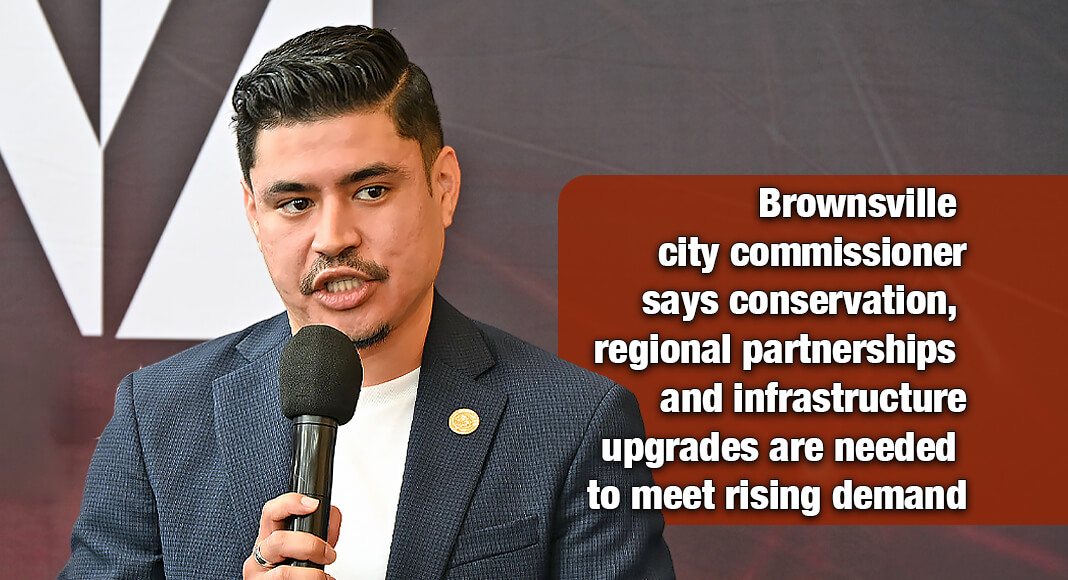
BROWNSVILLE, Texas — Brownsville City Commissioner Bryan Martinez said regional collaboration, conservation, and long-term planning will be essential to address growing water demands in the Rio Grande Valley as development accelerates and drought conditions persist.
Speaking during the RGV Connect Water Forum on April 15, 2026, Martinez said municipalities cannot rely on a single water source and must continue diversifying supply strategies to support future growth.



“The Port of Brownsville, as well as the city of Brownsville and its surrounding entities, are starting to see unprecedented growth of industries coming to our backyard, and with that growth comes those strains as well on our local resources,” Martinez said.
The panel discussion, moderated by Colin McDonald of the Texas Water Foundation, focused on water security challenges across the Rio Grande Valley. Participants from municipal, agricultural, county, and public utility sectors discussed drought, infrastructure, economic impacts, and long-term solutions.
Martinez emphasized the importance of public-private partnerships and regional cooperation, saying cities must work together rather than compete for resources. “These regional challenges will require regional solutions,” Martinez said. “It’s going to take all of us working together — not competitively, but collaboratively — finding ways to ease overall water demand.”
He said the City of Brownsville has taken steps within its authority to address conservation concerns. During the 2024 drought, the city approved ordinances establishing distance requirements for car washes and increased standards for water recycling systems in new facilities to reduce strain on local supplies.
Martinez also pointed to Brownsville’s use of multipurpose infrastructure, including parks designed to support flood mitigation while improving quality of life. He highlighted the city’s Water Plant Park as an example of how public spaces can serve environmental and recreational purposes simultaneously.
“It’s ways that we can address the issue, but at the same time help modernize and beautify a lot of our city where the residents don’t really see that happening,” Martinez said.
Martinez said education also plays an important role in conservation. He noted that monthly utility bills create opportunities to encourage residents to reduce consumption through small behavioral changes.
“Each one of us has that responsibility of contributing to how we can each take a part in it,” Martinez said. “Whether you’re a water user or you’re an entity or you’re a state legislator.”

Marilyn Gilbert, general manager and CEO of the Brownsville Public Utilities Board, echoed the importance of collaboration and diversified water sources. Gilbert said communities benefit when neighboring systems reduce dependence on shared river supplies.
“If another community develops a project that reduces its dependence on the shared water system, that leaves more water behind the dam for everyone else to use,” Gilbert said.
Martinez said one challenge over the next decade will be modernizing local and state water policies to support regional priorities while maintaining economic growth.
He cited the South Texas Alliance of Mayors as an example of cities working collectively to advocate for regional interests before state leaders.
“We’re no longer speaking as individual cities,” Martinez said. “We’re speaking as a region, and this is what we need.”
RGV Connect forums are organized by the Rio Grande Valley Partnership to bring together business leaders, elected officials, and community stakeholders to discuss regional priorities and shape legislative advocacy efforts.
See related stories: