
















Texas Border Business




By Roberto Hugo González / Texas Border Business
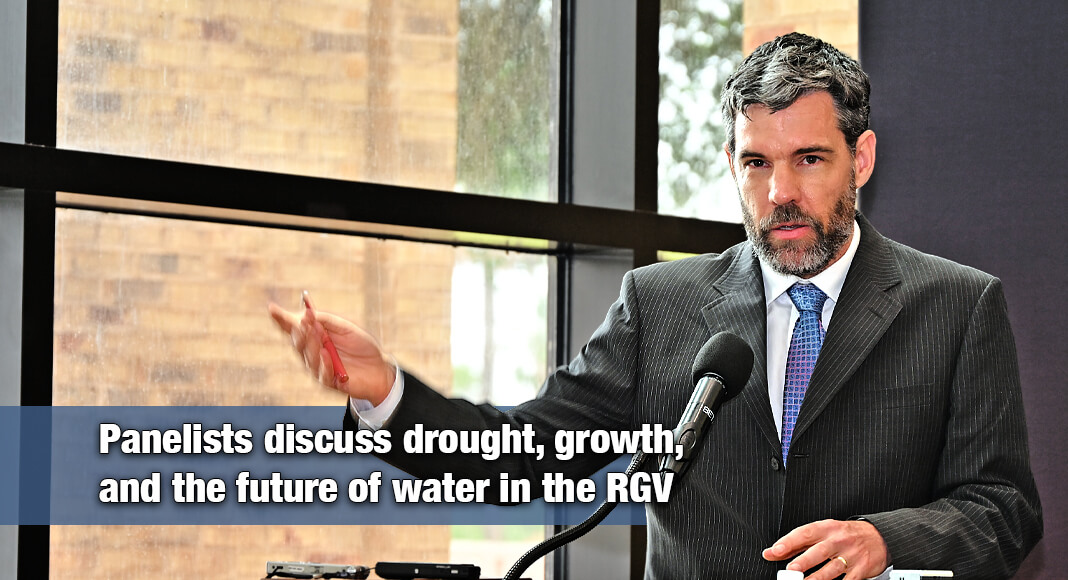
Brownsville, Texas — Water security, drought, and regional growth took center stage at the RGV Connect Water Forum hosted by the Rio Grande Valley Partnership at Texas Southmost College on April 15, 2026.
Moderated by Colin McDonald, director of strategic partnerships for the Texas Water Foundation, the forum brought together public officials, utility leaders, agriculture representatives, and regional stakeholders to discuss water challenges facing the Rio Grande Valley.



McDonald said the Valley is not running out of water but is facing a shift in the reliability of the resource that fueled its growth. “You’re not going to run out of water down here in the Valley, but the water that the Valley was built on … is not what it once was,” he said.

Paco Sanchez, president and CEO of the Rio Grande Valley Partnership, said water remains one of the region’s most urgent issues and requires regional coordination.
“Water’s not an isolated resource. What happens upstream impacts those downstream and vice versa,” Sanchez said. He described RGV Connect as a platform for gathering community input and shaping legislative priorities for Austin and Washington, D.C.
Panelists included Hidalgo County Commissioner David Fuentes, Texas Farm Bureau State Director Brian Jones, Brownsville City Commissioner Bryan Martinez, and Brownsville Public Utilities Board General Manager and CEO Marilyn Gilbert. Dr. Jesús Roberto Rodríguez, president of Texas Southmost College, also participated in the event.
McDonald said state and federal agencies can support water efforts, but solutions must come from the region. “They’re there to help, they are not there to solve the problem,” he said. “That’s going to have to come from the local efforts.”
The discussion highlighted the impacts of drought on agriculture, including the 2024 closure of the Rio Grande Valley Sugar Mill. Jones called it “a permanent loss of 500 jobs” and “a $100 million annual industry.” He said water shortages continue to affect citrus and vegetable production, forcing farmers to shift crops and adapt operations.
Fuentes discussed Hidalgo County’s water reclamation project, which aims to convert drainage runoff into a usable water source while supporting flood control.
Martinez said Brownsville has implemented conservation measures, including updated standards for water recycling systems at car washes during drought conditions.
A recurring theme was regional cooperation. McDonald said the Valley stands out because groups that traditionally compete for water are working together. “There’s no other place in Texas where entities that would traditionally compete are working together like this,” he said.
Panelists agreed that long-term water security will require a combination of infrastructure investment, conservation, desalination, reuse, agricultural adaptation, and regional planning.
Sanchez said feedback gathered during RGV Connect forums will help shape future legislative priorities for the Rio Grande Valley.
The RGV Connect series is organized by the Rio Grande Valley Partnership to bring together business leaders, elected officials, and community stakeholders to address regional challenges and strengthen advocacy efforts.
See related stories: