
















Texas Border Business




By Roberto Hugo González / Texas Border Business
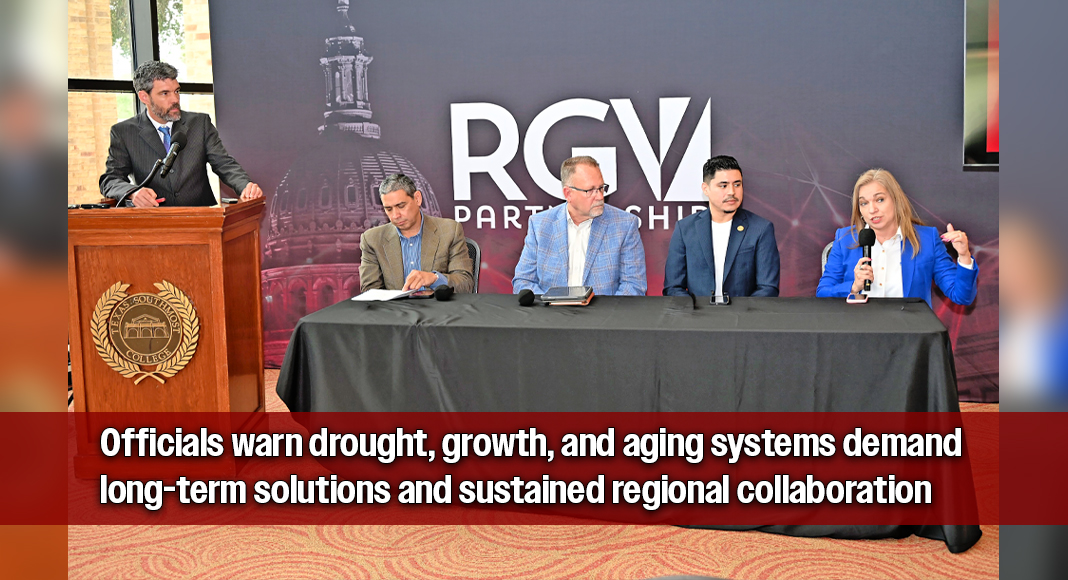
BROWNSVILLE, Texas — Regional leaders from government, agriculture, and public utilities gathered for an RGV Connect forum to discuss water security challenges in the Rio Grande Valley, emphasizing the need for coordinated action as drought conditions persist and demand continues to rise. The event was hosted by the Texas Southmost College in Brownsville, Texas.
The discussion, moderated by Colin McDonald of the Texas Water Foundation, focused on declining water availability in the Rio Grande, infrastructure limitations, and the economic impact on key industries. McDonald said the region is facing a “human-induced mega drought,” noting that river flows near Brownsville are “about a third to a tenth of what they would be without upstream diversions and groundwater pumping.



Panelists described significant economic consequences tied to water shortages. Brian Jones, a farmer and Texas Farm Bureau state director, said the closure of the Rio Grande Valley sugar mill in 2024 resulted in “a permanent loss of 500 jobs and a $100 million annual industry.” He added that reduced water availability is forcing farmers to shift to less water-intensive crops, often with lower economic value.
Local officials outlined strategies to adapt. Bryan Martinez, a Brownsville city commissioner, said municipalities must diversify water sources and work with partners to reduce demand. He pointed to local ordinances passed during the 2024 drought that raised water-recycling standards for new car wash facilities. “We can’t override state legislation,” Martinez said, “but we can take meaningful steps within our authority.”
Marilyn Gilbert, general manager and CEO of the Brownsville Public Utilities Board, detailed long-term investments in desalination, reservoir expansion, and water reuse. She said Brownsville has worked for decades to reduce reliance on the Rio Grande, including producing about one-third of its supply from brackish groundwater desalination. “It’s a complex system that a lot of people don’t really see every day,” Gilbert said.
Hidalgo County Commissioner David Fuentes highlighted a water reclamation project that would convert drainage runoff into potable water. He said the system could produce up to 18 million gallons per day and has required legislative changes to qualify for state funding. “We’ve been fighting this whole system,” Fuentes said, describing regulatory challenges, “but we’ve been successful in changing legislation.”
Panelists repeatedly emphasized the criticality of regional collaboration. Fuentes said differing priorities among irrigation districts, cities, and other entities can slow progress. “Without a common plan, we might be pulling in different directions,” he said, adding that all parties share the goal of increasing water access.
Jones noted that recent policy changes, including new water accounting methods tied to the Rio San Juan, are helping stabilize supplies, but warned that long-term solutions require sustained investment. He said aging irrigation infrastructure, much of it over a century old, contributes to water losses and needs modernization.
Speakers also stressed the importance of maintaining momentum even during periods of increased rainfall. “A storm comes in, fills the reservoirs, and suddenly South Texas is no longer a priority,” Jones said. “We can’t allow this issue to fade into the background.”

The forum was organized by the Rio Grande Valley Partnership as part of its RGV Connect series, which aims to gather stakeholder input and shape regional policy priorities. Paco Sanchez, the organization’s CEO, served as the official presenter for RGV Connect. Participants agreed that addressing water scarcity will require a combination of infrastructure upgrades, conservation efforts, policy reforms, and continued coordination across local, state, and federal levels.
See related story: