
















Texas Border Business




By Roberto Hugo González / Texas Border Business
WESLACO, Texas — Mayor Adrian Gonzalez said Weslaco’s strategy for reducing flooding centers on expanding a network of retention and detention facilities designed to capture stormwater before it reaches homes and neighborhoods.
In an exclusive interview, Gonzalez said the city has moved beyond temporary drainage improvements by investing in engineered retention and detention facilities, commonly referred to as RDFs, that temporarily store stormwater and gradually release it into the drainage system after major rain events.




According to Gonzalez, one of the city’s principal projects is converting Pablo Peña Park into a dual-purpose retention facility that will continue functioning as a public park during dry conditions while providing flood protection during heavy rainfall.
He said approximately 90% of the Pablo Peña project has been completed, with the remaining work focused on connecting the facility to the Sinclair drainage system.
Another major project is the B. Garza-Kleckler retention facility, developed in partnership with a local school district. Gonzalez said the facility successfully stored large volumes of water during recent storms, preventing floodwaters from entering nearby homes.
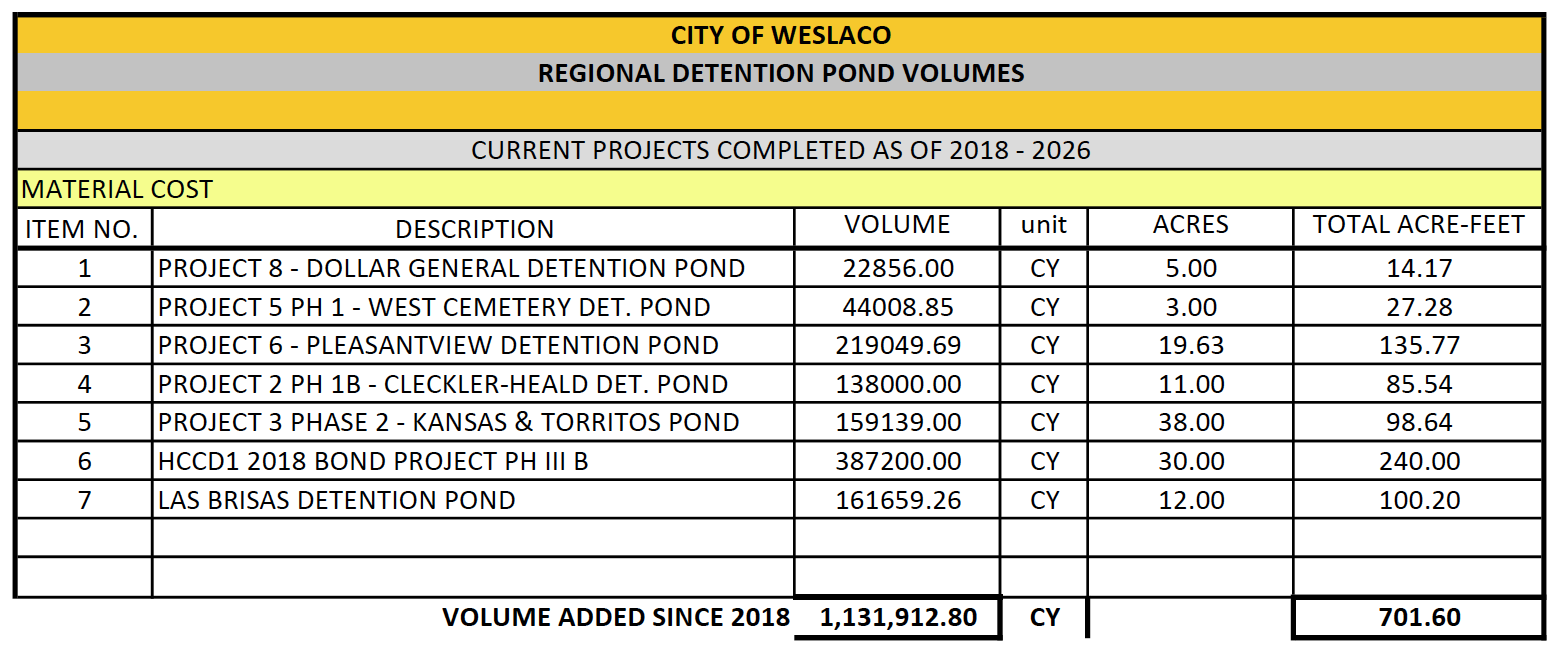
The mayor said Weslaco currently operates four municipal retention facilities: Pablo Peña Park, the B. Garza-Kleckler RDF, the Family Dollar RDF and the Cemetery RDF. He added that Hidalgo County has constructed additional regional facilities, including projects at Mile 5 and 88, Las Brisas and Pecan Grove, which work together with the city’s infrastructure to move stormwater out of residential areas.
Gonzalez said the combined system has produced measurable results. According to information provided by his team, flooding has declined from approximately 2,500 homes and properties affected in 2018 to fewer than a handful during the city’s most recent major storm.
The mayor said the city’s objective is not to eliminate water from streets immediately during intense rainfall but to prevent floodwaters from entering homes.
He explained that heavy storms producing 7 to 10 inches of rain within a short period can temporarily overwhelm streets and intersections. Under those conditions, he said, water accumulating along curbs and roadways is expected until the drainage system has time to move it through the network of retention facilities, canals and drainage channels.
“The goal is to keep the water out of houses,” Gonzalez said.
He said future drainage improvements will continue to focus on neighborhoods with recurring flooding while integrating new retention projects into the city’s infrastructure plan.
Gonzalez also emphasized the importance of regional cooperation, noting that city facilities work alongside county retention projects to improve flood control throughout the area.
He said the city’s approach is based on long-term engineering and infrastructure investments intended to strengthen Weslaco’s resilience as development continues and rainfall patterns become more challenging.
This article is Part 2 of Building a Resilient Weslaco, a Texas Border Business special series examining the city’s long-term investments in drainage, infrastructure and economic development through exclusive interviews with Mayor Adrian Gonzalez.
See related stories: