
















Texas Border Business



By Roberto Hugo González / Texas Border Business
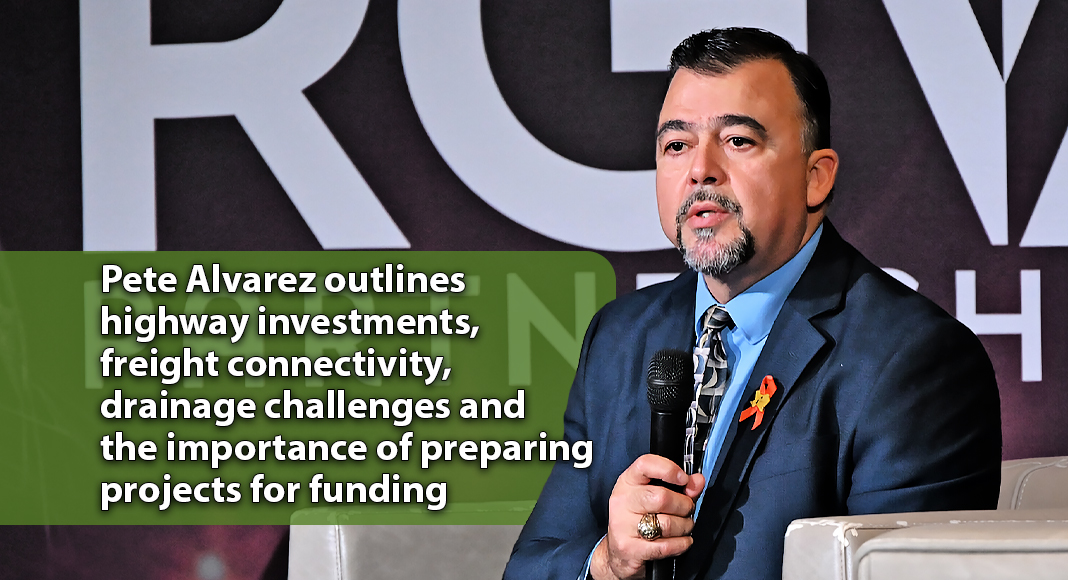
MISSION, Texas — Pedro “Pete” Alvarez, district engineer for the Texas Department of Transportation’s eight-county Pharr District, urged Rio Grande Valley leaders to coordinate transportation priorities, prepare projects for construction and address drainage challenges during an infrastructure summit held October 20, 2026, at the Mission Event Center.
Alvarez participated in a panel organized by the Rio Grande Valley Partnership alongside Texas Transportation Commissioner Alex Meade and Brian R. Barth, TxDOT’s deputy executive director for program delivery.





Alvarez said cooperation among cities, counties, regional mobility authorities and TxDOT has helped advance major transportation investments.
He reported approximately $800 million in construction along the U.S. Highway 77 and U.S. Highway 281 corridors, which support freight movement and international trade.
He also emphasized improving east-west connections.
“What happens in Cameron County affects Hidalgo County and Starr County,” Alvarez said.
Discussing the Valley’s transportation network, Alvarez pointed to 14 land ports of entry, seaports and airports that depend on interconnected highways.
He identified Interstate 2, Military Highway, U.S. Highway 281 and the I-69E and I-69C corridors as important routes for moving goods.
Additional projects include the 365 Tollway, International Bridge Trade Corridor, State Highway 68 and Cameron County’s proposed Outer Parkway.
Alvarez also addressed overweight commercial vehicles, explaining that designated routes must account for where shipments originate and reach their destinations.
He said many farm-to-market roads were constructed during the 1950s and 1960s and were not designed for today’s heavy commercial traffic.
According to Alvarez, approximately 95% of Texas’ designated overweight and oversize corridors are located in the Rio Grande Valley.
He explained that permit revenues help repair roadway damage caused by heavy trucks.
Flooding was another major concern.
“If we’re building roads, we’re affecting drainage,” Alvarez said.
He described drainage challenges along the proposed State Highway 68 corridor, where officials have been advised that portions could be underwater during a 10-year rainfall event.
Alvarez said drainage planning must extend beyond individual roadway projects to consider how water travels through communities toward its ultimate discharge point.
He urged local governments to involve TxDOT early when developing transportation proposals.
Projects with completed environmental studies, engineering plans, right-of-way acquisition and utility relocation are better positioned to compete for construction funding, he explained.
Alvarez also called for regional agreement on transportation priorities rather than separate lists from individual communities.
Commissioner Meade reinforced that position.
“Finding funding is easy. Finding consensus is hard,” Meade said.
Asked what Valley leaders should accomplish over the next five years, Alvarez recommended comprehensive planning.
“Develop a master plan,” he said, urging communities to identify future needs and anticipate conflicts between industrial development and residential neighborhoods.
Alvarez maintained that coordinated planning and early communication are essential to advancing transportation projects throughout the region.
See related stories: