













Texas Border Business



By Roberto Hugo González / Texas Border Business
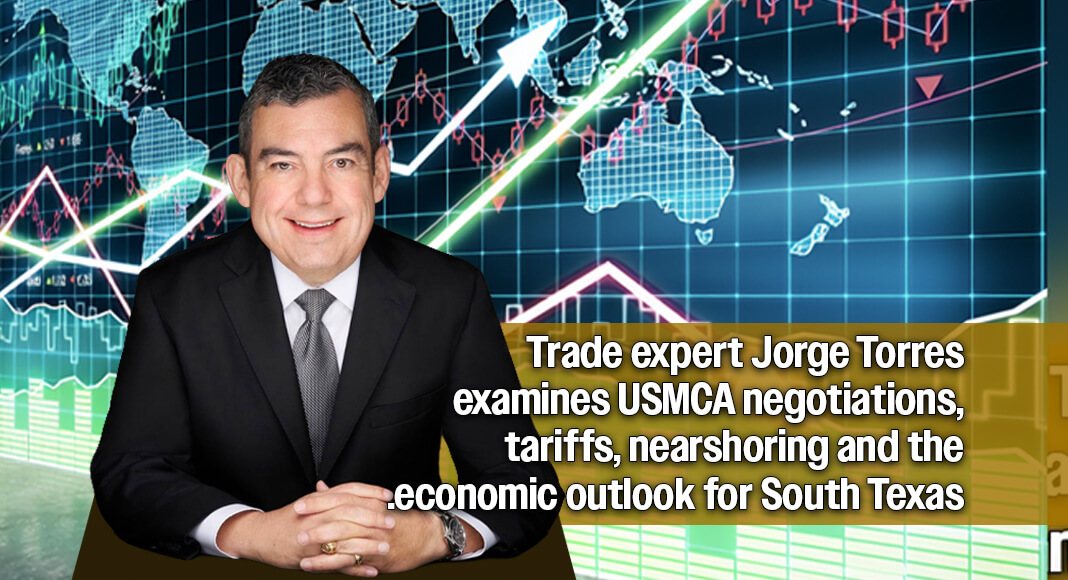
The Democratic Party’s return to control of Congress following the November 3 midterm elections could influence U.S.–Mexico trade relations, although President Donald Trump will retain substantial authority over trade policy, according to Jorge Torres, president of Interlink Trade Services.
Torres said congressional Democrats could seek legislation restricting the president’s ability to impose tariffs, but such measures would face potential presidential opposition.



“Congress will try to pass legislation to limit the executive on imposing tariffs, and if there is bipartisan support, they might be successful, although the president will probably veto,” Torres said.
Regarding the upcoming United States–Mexico–Canada Agreement (USMCA) negotiations, Torres identified a potential U.S. withdrawal as the greatest risk for Mexico and Canada.
He said Trump could adopt a more confrontational negotiating position following the election results, complicating discussions among the three countries.
Nevertheless, Torres expressed confidence in Mexico’s economic relationship with the United States.
“Mexico is a strategic partner to the U.S., and it will be foolish to cut ties,” he said.
Torres also identified possible changes in labor enforcement under Democratic congressional leadership. He said Democrats supported USMCA partly because it incorporated labor provisions they favored and could now push for more aggressive enforcement of the agreement’s Rapid Response Labor Mechanism against Mexican manufacturers.
On foreign investment, Torres expects continued manufacturing expansion in Mexico, although tariff uncertainty could slow its pace through 2029.
He also anticipates growth in both nearshoring to Mexico and reshoring to the United States, particularly in the automotive industry.
For South Texas communities, including McAllen, Pharr, Brownsville and Laredo, Torres sees opportunities arising from their proximity to Mexican manufacturing operations.
“Being close to Mexico makes it more attractive for dual production to comply with USMCA and other trade policies,” he said.
Regarding Mexico’s negotiating priorities, Torres pointed to Economy Secretary Marcelo Ebrard’s efforts to secure fairer treatment under U.S. Section 232 tariffs affecting automobiles and metals.
Torres noted that Japan faces a 15% automotive tariff compared with 25% for Mexico, emphasizing the need to improve Mexico’s competitive position.
Looking toward 2030, Torres identified continued USMCA cooperation and stronger regional supply chains as essential to North American competitiveness.
“The continuity of the USMCA is critical for our region to be stronger at a global level,” he said.
He also emphasized reducing North America’s dependence on Asian suppliers, particularly China, to strengthen regional manufacturing resilience.
Jorge Torres is president of Interlink Trade Services and an international trade expert specializing in U.S.–Mexico commerce, customs regulations, and cross-border supply chains. He analyzes trade policies, tariffs, and manufacturing trends affecting North American businesses.