















Texas Border Business




By SADDIE SMITH for VITAL RECORD
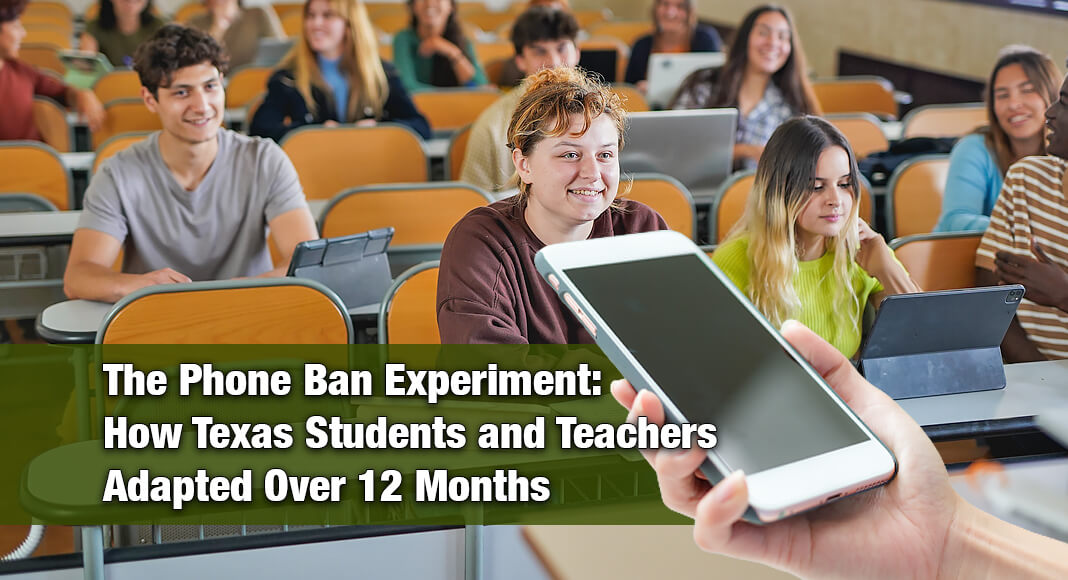
BRYAN-COLLEGE STATION, Texas — The school bell rings. Students settle into their seats. And then, instead of reaching for their phones during a quiet moment, they reach for a deck of cards.
That’s one of the changes 11th grade U.S. history teacher Rachel Bailey has noticed since Texas schools began restricting students’ use of personal communication devices during the school day.



At College Station ISD, cards that had sat untouched in a classroom game box are now shuffled across desks during downtime. Sudoku printouts and coloring sheets are disappearing from Bailey’s shelves. And students who once spent free moments absorbed in their phones are more likely to turn to their classmates, talk about the day’s lesson or simply get to know one another.
“They want to learn more, do more and they’re willing to have fun,” Bailey said.
The change came as Texas schools navigated the first year of House Bill 1481, which requires school districts to adopt policies prohibiting students from using personal communication devices during the school day, with limited exceptions.
For Bailey, the difference isn’t simply an attentive classroom. It’s a classroom where students are looking up, talking to one another and finding new ways to fill the moments that used to belong to their phones.
As schools enter their second year with the policy, those small moments raise a bigger question: What happens to students, teachers and classroom culture when smartphones are no longer part of the school day?
Digital withdrawal and a phantom buzz
The few weeks prior to the new policy were not peaceful, Bailey observed.
“There was this palpable anxiety on campus for weeks leading up to the school cellphone ban about how we were going to enforce it, but by the end of day one, it was just a total breath of fresh air,” she said.
In years prior, Bailey and fellow teachers had a full plate, figuring out the logistics of phone caddies and incentives to keep students focused during lessons. But since HB 1481 policies have been implemented, Bailey said teachers feel more free to focus their energy on educating instead of rule enforcement.
School psychologist and assistant research scientist at the Texas A&M Health Telehealth Institute, Israel Arevalo, PhD, LSP, affirmed that when the ban took effect, he saw baseline anxiety in teachers, students and parents spike, plateau and then begin to drop.
The initial anxiousness students experienced could be attributed to “digital withdrawal,” Arevalo said.
According to a study over digital detox strategies and mental health, it’s common for people to experience a pervasive restlessness fueled by the fear of missing out (FOMO) immediately after dialing back their smartphone use. In a world where roughly 11% of children ages 3 to 17 already live with a diagnosed anxiety disorder, cutting off a primary social lifeline felt, initially, like an upheaval for many students.
“Just like with anything, when you disrupt a routine or stop an activity you engage in multiple hours a day, there will be an increase in anxiety,” Arevalo said.
He compared the phone ban to tough New Year’s resolutions.
“We’ve all experienced this in one way or another. We become very used to engaging in certain patterns of behavior, and when those patterns are abruptly taken away, we can feel uncomfortable or anxious,” Arevalo said.
For children who may not yet have a large repertoire of coping mechanisms, those feelings can be incredibly difficult to manage and can become all-consuming.
Normalizing face-to-face interactions
With screens entirely out of the picture, students faced what was, for some, an uncomfortable reality: They had to talk to each other.
“We are meant to be social—not through screens but through face-to-face interactions where language and communication can be truly conveyed,” Arevalo said. “Research has shown that increased screen time is associated with a greater likelihood of children developing socioemotional difficulties as well as decreased social skills.”
Even in high school, the new dynamic is resurrecting a need for basic lessons in social interaction. Bailey said she still needs to remind teenagers of classroom expectations and how to maintain respect.
“It’s like the basics of classroom interaction called for a kind of brain reset,” Bailey said. “They forgot how to interact in a classroom appropriately because they hadn’t really been doing it.”
The benefits of reduced screen time ripple across all age groups, though the impact varies depending on developmental stage, Arevalo said, explaining that when attention moves from devices to peers, younger children gain opportunities to learn essential social skills, such as taking turns, labeling feelings and reading body language. For teenagers, face-to-face interaction encourages them to tap back into and refine the social skills they learned as young children, while developing more complex social and emotional skills they’ll use as adults.
The school cellphone ban encourages a return to primary social development. The goal, Arevalo noted, is to encourage opportunities for learning and growth, socially, emotionally and educationally.
More than social benefits
The ripple effects of the ban have quickly extended beyond social skills into physical and mental health.
When you clear out the digital clutter that consumes a student’s mental bandwidth during the day, you reduce their overall cognitive load, Arevalo said.
Less daytime anxiety translates directly to better sleep at night, according to the Cleveland Clinic. And as education data shows, better sleep acts as a massive domino effect, improving academic performance and focus.
In addition, positive mental health improves academic performance, according to a longitudinal study with elementary students, aligning with Bailey’s own professional experience teaching high school students for four years.
“Across our entire U.S. history teaching team, every single one of us saw better test scores across all learning levels once the ban took effect,” Bailey said.
This relationship also works bidirectionally. Achieving academic goals can improve self-worth and a better self-image, according to the American Psychological Association.
Bailey noted that her students who complied with the new rule seemed more jovial and energetic overall—but not all students fully bought in.
“I can’t help but notice that the particular student with extreme negative feelings was also the only one always sneaking her phone after the ban,” Bailey said.
Arevalo noted the compounding effect of both compliance with device-free time and resistance to it. Just as a healthy self-image drives academic success, Arevalo said that when devices compromise a student’s mental space, they stop “engaging in the curricula,” driving a downward loop that negatively impacts both their grades and behaviors.
Bailey said she has witnessed the effects of freeing up that mental space firsthand.
“Now, in the classroom, there are fewer physical fights, less hallway drama, and the students who diligently put their phones away are just visibly brighter, happier and less worn down,” Bailey said.
Evenings at home can undermine the day’s work
However, school districts are only partially responsible for the benefits of reduced screen time, Arevalo said. He acknowledged the concern that students—starved of screen time for eight hours at school—could attempt to cram a day’s worth of heavy usage into their evening hours, trying to play a game of social and cultural catch-up in the digital sphere.
“You can tell which parents are definitely more supportive of it outside of school, because their kids reach for their phones less,” Bailey said.
If a child leaves a phone-free campus only to spend five uninterrupted hours on a device at home, some of the benefits gained from limiting phone use during the school day may be diminished, according to Arevalo.
“We can make those policy changes in the schools, but accountability is on the parents once the child goes home,” Arevalo said. “Whenever we are trying to change a behavior or implement an effective intervention, we want to make sure those efforts are consistent across settings.”
Monitoring evening screen time and protecting the hours leading up to bedtime is essential, according to the Mayo Clinic. National resources, such as the National Association of School Psychologists (NASP) and the American Psychological Association (APA), provide clear guidelines on what constitutes healthy, age-appropriate digital consumption.
Desire for data
Because bills like HB 1481 are relatively new, long-term data is sparse. Some critics point to studies claiming of scientific evidence that no-phone policies lack an effect on mental health.
But as Arevalo pointed out, research takes time.
“I would argue that it’s pretty soon to be able to establish a solid evidence base to make a statement that there is or isn’t an effect,” he said. “Just like any kind of science we publish, especially that which informs policy at this scale, we have to conduct years and years of study to make sure that it is validated and replicable.”
Building off the reported success of HB 1481, Gov. Abbott recently proposed further limiting the overall use of technology like laptops and tablets in the classroom. The proposal has not yet been fully outlined and would need to be considered by the Legislature when it convenes next year.
But beyond the data, the legislation and the regional metrics, the first year of the school cellphone ban in action has delivered a simple, immediate result: opportunities to reclaim lost attention.
Arevalo encourages parents, in the meantime, to enjoy and lean into the benefits of reduced screen time.
“Spend time with your child and really take the time to enjoy and be present in the moments you have together,” he said.
Information source: TEXAS A&M HEALTH