
















Texas Boroder Business




By Roberto Hugo González / Texas Border Business
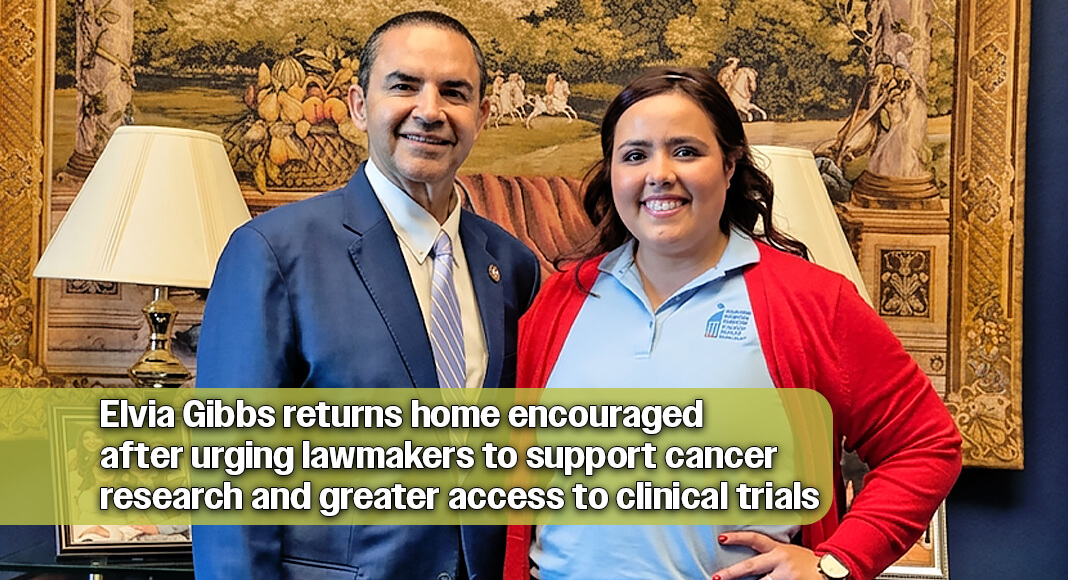
McALLEN, Texas — For breast cancer survivor Elvia Gibbs, traveling from McAllen to Washington, D.C., was about more than advocating for legislation. It was an opportunity to tell lawmakers firsthand that cancer research and access to clinical trials can mean more time, hope, and quality of life for patients.
Gibbs traveled to the nation’s capital as an American Cancer Society Cancer Action Network volunteer, meeting with lawmakers and advocating for increased federal support for cancer research and prevention and improved access to clinical trials.



“I want them to truly understand how important these asks are,” Gibbs said. “For a cancer patient, research, progress, and equal access to quality care aren’t just words; they can mean the difference between surviving and having the opportunity to truly live.”
Her message comes directly from experience. Gibbs survived an aggressive form of breast cancer and now takes medication developed through the clinical trial process. She said that without further treatment, she was given an 80% chance that her cancer could return within five years or less.
“This medication gives me my best fighting chance,” Gibbs said. She credits medical research and the patients who participated in clinical trials before her with giving her an opportunity to enjoy life with her family.
“Because of that research and this medication, I am able to have a quality of life I may not otherwise have,” she said. “I am able to be present with my family, love on my husband, and look forward to another day of life.”
That connection became especially emotional when Gibbs met Ashlynn, a fellow ACS CAN volunteer who had participated in the clinical trial associated with the medication Gibbs takes.
“All I could do was tear up and say, ‘Thank you,’” Gibbs recalled. “Her courage became part of the research that gave someone like me a fighting chance.”
In Washington, Gibbs also advocated for the Clinical Trial Modernization Act, legislation designed to address financial and geographic barriers that can prevent patients from participating in clinical research.
Those barriers can be particularly difficult in the Rio Grande Valley.
Gibbs said some South Texas patients must travel approximately 3½ hours to San Antonio or as much as five hours toward Houston to participate in clinical trials. For patients undergoing treatment, transportation, lodging, and other expenses can make participation difficult.
The Clinical Trial Modernization Act includes provisions addressing some costs associated with trial participation, including travel, lodging and other expenses.
Gibbs said lawmakers she met committed to cosponsoring the legislation. She and other advocates intend to follow up through district meetings, telephone calls and emails.
She returned to McAllen encouraged by the experience and with a message for other patients and survivors.
“Our voices matter,” Gibbs said. “There is no voice too small to speak up, share a story, and help create change.”
For Gibbs, every clinical trial participant and research breakthrough represents another opportunity for someone facing cancer.
“Every voice has the potential to make a difference,” she said, “and every breakthrough can give someone more time.”