












Texas Border Business



Texas Border Business presents an exclusive six-part editorial series exploring Project Organic, an ambitious 71-acre mixed-use development planned for Harlingen’s Medical District, with an estimated $97 million in private construction investment. Based on an extensive exclusive interview with Orlando Campos, chief executive officer of the Harlingen Economic Development Corporation, and architectural information provided by Alamo Architects, the series examines the vision, planning, and economic opportunities behind this award-winning master plan.
Published daily for six consecutive days, the series will provide readers with a comprehensive understanding of the project’s infrastructure financing, business opportunities, job creation, residential development, architectural design, and anticipated construction timeline. Its purpose is to inform residents, entrepreneurs, investors, and business leaders throughout the Rio Grande Valley about Project Organic and its potential contribution to Harlingen’s long-term economic growth. Texas Border Business
By Roberto Hugo González / Texas Border Business



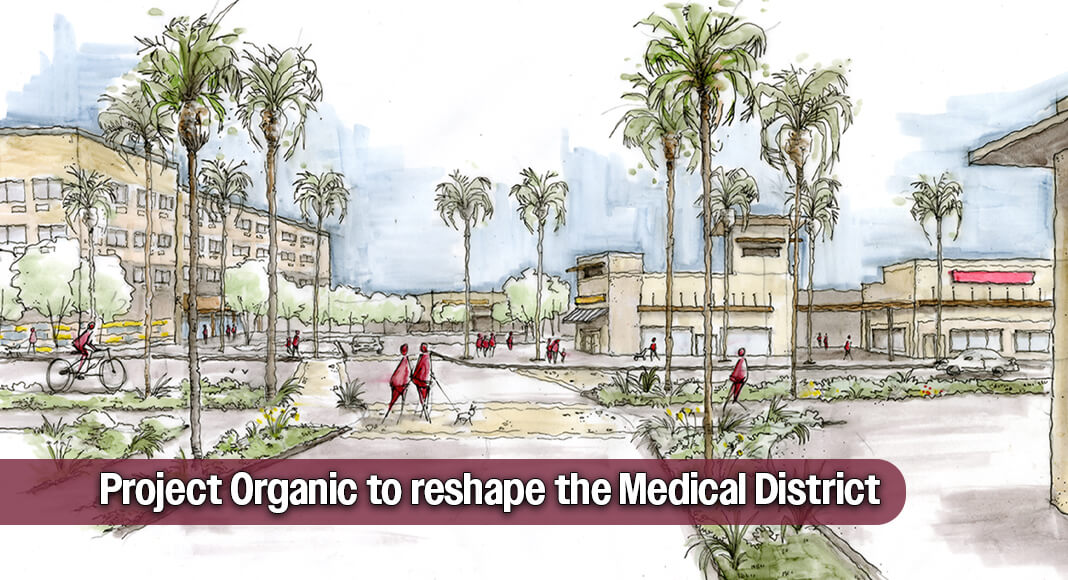
HARLINGEN, Texas — A proposed 71-acre development in Harlingen’s Medical District represents a new approach to urban development, with an estimated $97 million in private construction investment envisioned through Project Organic, a master plan commissioned by the Harlingen Economic Development Corporation (HEDC).
In an exclusive interview with Texas Border Business, Orlando Campos, HEDC chief executive officer tor, explained how the development would create an urban environment where residential, commercial, hospitality, and entertainment facilities coexist in a pedestrian-friendly community.
“The overall vision is to create a new urbanist environment that promotes walkability and connectivity through mixed uses,” Campos said. “These land uses include retail/restaurant, multi-family development, hotels, entertainment venues, and office uses.”
The project seeks to introduce a development pattern that differs from traditional suburban commercial centers, where businesses are often separated by extensive parking areas. Instead, Project Organic proposes a network of interconnected streets and public spaces designed to make walking between destinations easier.
“All these uses will be developed in a dense environment that makes it easy for people to explore on foot,” Campos said. “This type of environment aligns well with existing medical uses within walking distance of the planned project.”
Alamo Architects completed the master plan in 2023, establishing a comprehensive framework for development within a designated Tax Increment Reinvestment Zone. The plan identifies land development opportunities while establishing priorities for the public infrastructure needed to support private investment.
A central feature is a proposed pedestrian-oriented commercial corridor connecting Ed Carey Drive, Camelot, and Hale Street. The corridor would improve access throughout the development and provide a framework for commercial establishments facing interconnected streets and public spaces.
According to Alamo Architects, the master plan was designed to capitalize on the property’s location within Harlingen and the Rio Grande Valley. Its approach incorporates destination-oriented commercial development and a combination of land uses intended to support activity throughout the day.
The estimated $97 million represents the potential value of construction once the development is fully realized, not money already committed by investors.
“The $97 million is the estimated vertical construction value of the project once fully developed,” Campos said. “Private developers will make all of this investment.”
Campos explained that architects hired to evaluate the property and identify its most appropriate and productive uses determined the estimated construction value. Public-sector participation would focus on providing the infrastructure needed to enable private development.
The master plan also establishes a potential model for future development elsewhere in Harlingen, introducing planning principles that connect commercial activity, residential neighborhoods, and existing employment centers.
For Campos, cooperation between local government and private developers is essential to turning the architectural vision into a functioning community.
“The EDC, city, and county will focus on the investment needed to develop the public infrastructure that will catalyze full private investment,” Campos said. “Without the city and county’s participation in developing the public infrastructure, the project could not be developed.”