













Texas Border Business



By Texas Border Business
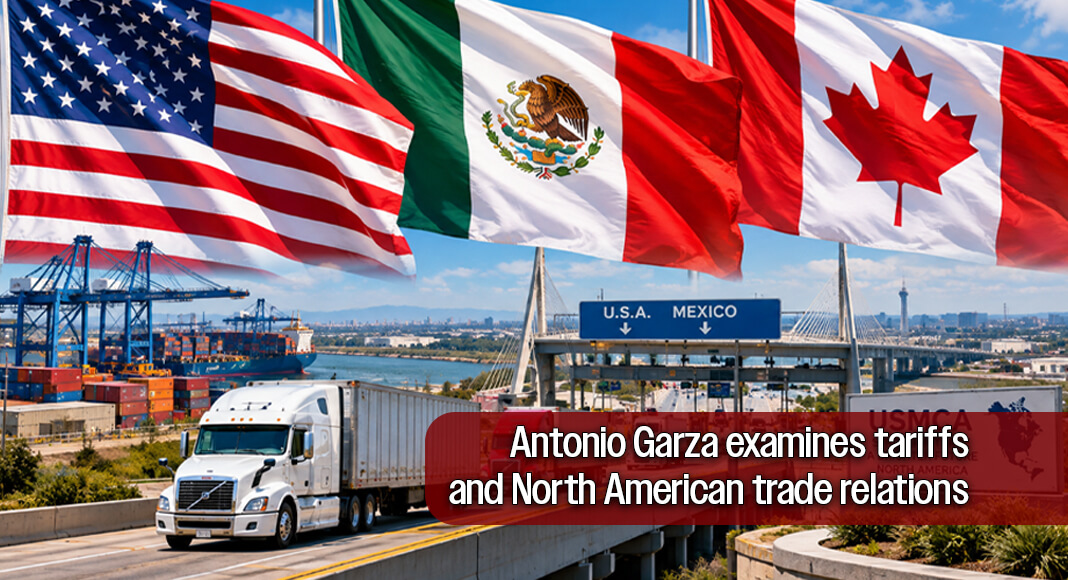
Former U.S. Ambassador to Mexico Antonio Garza says Mexico and Canada face difficult trade decisions as the United States considers tariffs, industrial policy, and the future of the United States-Mexico-Canada Agreement (USMCA).
In a November 17, 2026, commentary published on LinkedIn, titled “A Blue Wave, Geopolitical Tides, and a North American Anchor.”


Garza examined how recent U.S. political developments could influence negotiations among the three North American trading partners.
Garza, a senior adviser at White & Case LLP and chairman of Vianovo Ventures, said Mexico must decide whether to pursue an immediate agreement on U.S. tariffs affecting automobiles and steel or wait for possible congressional action.
“Mexico City may find itself facing a tactical dilemma: take an interim compromise on auto and steel duties now or hold out as a newly empowered Democratic House prepares to challenge executive tariff authority,” Garza wrote.
His assessment follows the November 3 U.S. midterm elections, which he said changed Washington’s political environment and could shape future trade discussions.
Garza also addressed uncertainty surrounding the USMCA, saying Washington had declined an automatic 16-year extension, creating additional questions about the agreement’s long-term future.
In Canada, Prime Minister Mark Carney is pursuing trade diversification while continuing negotiations with Washington, according to Garza.
He reported that Canada had concluded free-trade negotiations in Manila and that Carney had said he was willing to seek European and Asian automotive partners if the United States maintained its 25% sectoral tariffs.
Despite those efforts, Garza said the United States remains Canada’s principal focus in trade negotiations.
He cited U.S. Trade Representative Jamieson Greer’s confirmation that bilateral discussions had intensified without an established deadline for reaching an agreement.
Garza described the negotiations as a gradual process involving individual disputes over industrial tariffs, manufacturing supply chains and trade regulations rather than a comprehensive agreement reached immediately.
He also pointed to the upcoming G20 summit in Miami as an opportunity for the three North American leaders to address their differences.
Although Canada is exploring alternative trading relationships, Garza argued that the economic connections among the United States, Mexico and Canada remain substantial.
He maintained that North America’s integrated manufacturing and industrial supply chains make a complete economic separation impractical.
“Political tides will continue to test the architecture, but North America’s integrated industrial base is too deeply anchored to cut loose,” Garza wrote.
His commentary concludes that continued economic cooperation remains essential to the three countries despite disagreements over tariffs, trade policies, and political priorities.
Link to Amb. Antonio Garza commentary