













Texas Border Business



By David Vergun, Pentagon News | US Department of War
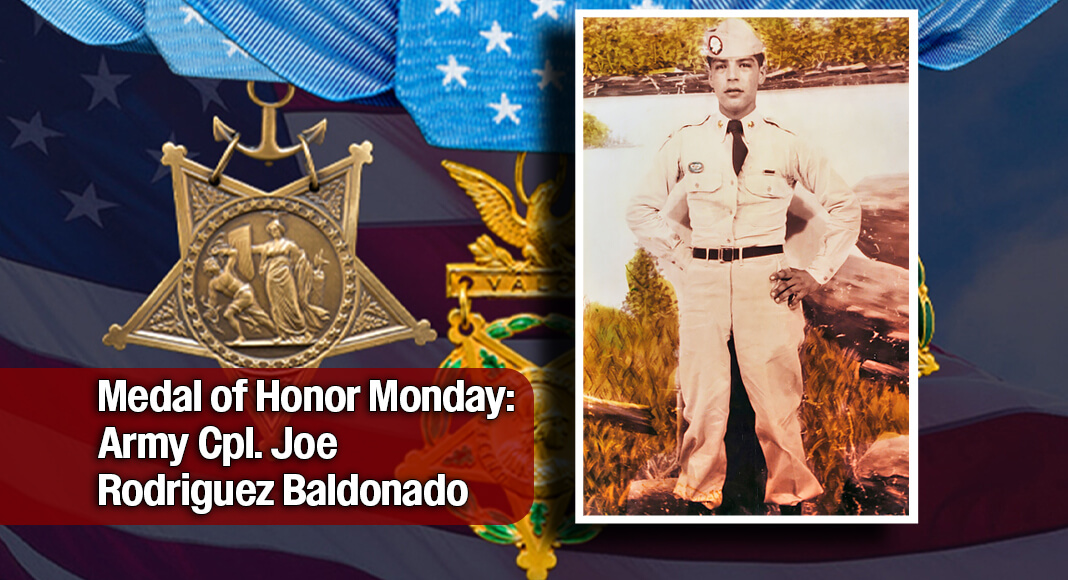
Army Cpl. Joe Rodriguez Baldonado served as an airborne infantryman and acting machine gunner during the Korean War, and 64 years after displaying extraordinary selflessness, he posthumously received the Medal of Honor.
Baldonado was born Aug. 28, 1930, in Colorado. His parents, Ramon and Rebecca Baldonado, were Mexican migrant farmworkers. He was the eldest son, and he had eight siblings.



He grew up playing guitar and singing, and he helped his parents and siblings work in the fields. He never attended high school, and in 1944, the family moved to Gilroy, California, where they continued farm labor. Baldonado enlisted in the Army in 1948; he was 17.
After basic combat training and airborne qualification, he was assigned to Company B, 187th Airborne Infantry Regiment at Camp Campbell, Kentucky, in 1949, which became Fort Campbell the following year.
In September 1950, Baldonado’s unit was reorganized as the 187th Airborne Infantry Regimental Combat Team and sent to Japan, where it prepared to deploy to Korea.
The Chinese People’s Volunteer Army entered North Korea on Oct. 19, 1950, and the next day, Baldonado and nearly 3,000 paratroopers assigned to the 187th conducted an airborne assault near Sunchon, North Korea, which was part of the larger Battle of Yongyu against the Korean People’s Army.
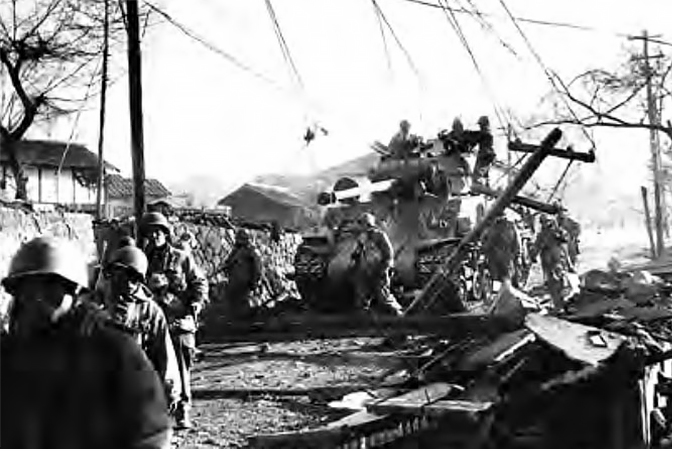
During the morning of Nov. 25, 1950, Baldonado was in Kangdong, near Pyongyang, North Korea, serving as an acting machine gunner when the enemy launched a strong attack in an effort to seize the hill occupied by his company.
His Medal of Honor citation states that the platoon had expended most of its ammunition in repelling the enemy attack, and the platoon leader decided to commit Baldonado’s squad, with its supply of ammunition, to the defensive action.
There was no time to dig in because the enemy had advanced to within 25 yards of the platoon’s position, so Baldonado placed his machine gun in an exposed position and delivered a withering stream of fire on the enemy forces, causing them to fall back.
The enemy forces then concentrated all of their fire on him and rushed his position, hurling hand grenades that exploded extremely close to Baldonado. However, they failed to interrupt his continuous fire.
The enemy forces withdrew after making a final assault on Baldonado’s position, during which a grenade landed near his machine gun, killing him instantly.
His body was recovered and buried in a temporary grave in the U.N. Cemetery in Pyongyang. However, the city fell back into enemy control in December 1950, preventing the recovery of his remains.
Baldonado is one of the nearly 7,500 Americans still unaccounted for from the Korean War.
Since 2005, no recovery operations have been permitted at Kangdong or other North Korean battlefield sites. The U.S. and North Korea have periodically engaged in efforts to repatriate the remains of unaccounted-for service members.
Baldonado was among 24 service members who received the Medal of Honor in 2014, after their military records were reevaluated, resulting in medal upgrades.
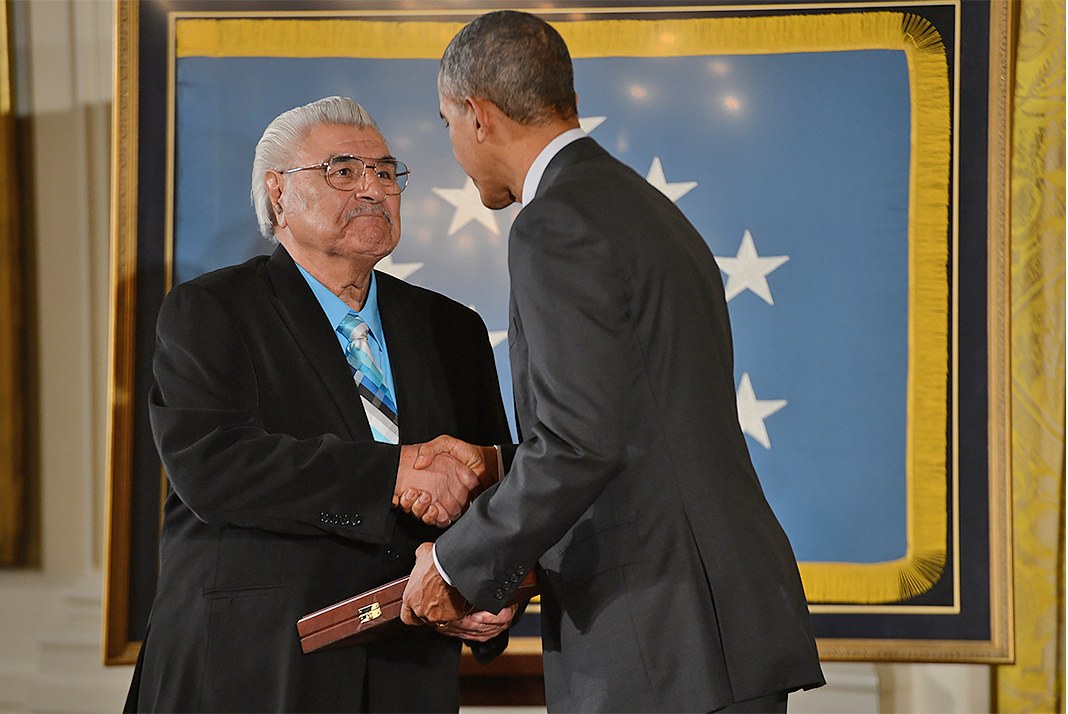
His younger brother, Charles Baldonado, a retired Army officer, accepted the Medal of Honor on behalf of his late brother from President Barack Obama during a ceremony at the White House on March 18, 2014.
During the ceremony, Obama spoke about Baldonado, the only unaccounted-for recipient among the group of two dozen heroes.
“Of the 24 American soldiers we honor today, 10 never came home. One of them — Cpl. Joe Baldonado, from the Korean War — is still missing, reminding us that, as a nation, we have a sacred obligation to keep working to give the families of our missing service members from all wars a full accounting of their loved ones,” he said.
During a 2014 interview with Baldonado’s hometown newspaper, the Gilroy Dispatch, Charles Baldonado said that, while he was proud to posthumously receive his brother’s award, he still hopes to bring his brother home one day.
“The next one on the bucket list is to bring him back and have him buried here on American soil,” Charles Baldonado said during the 2014 interview. “Hopefully one day they will find him. The fact that we don’t have closure, it still hurts. It’s been 64 years, and we’re still looking for him.”
In 1959, the Cpl. Joseph R. Baldonado Pool opened and was dedicated at Fort Campbell, Kentucky, in his honor.