
















Texas Border Business




Texas Independent Producers & Royalty Owners Association
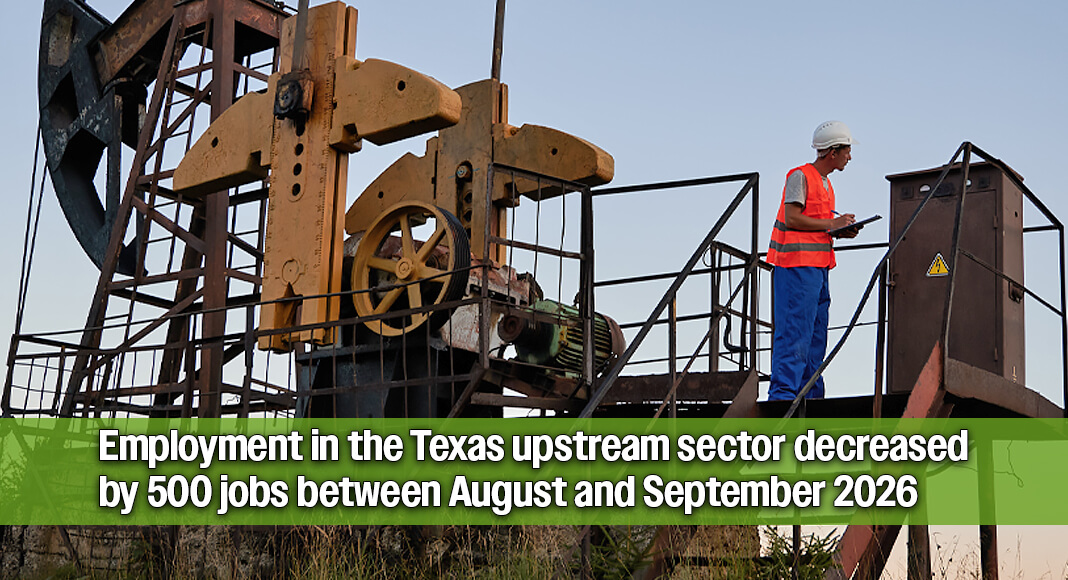
AUSTIN, Texas – Citing the latest Current Employment Statistics (CES) report from the U.S. Bureau of Labor Statistics (BLS), the Texas Independent Producers and Royalty Owners Association (TIPRO) highlighted new employment figures for the Texas oil and natural gas industry. According to TIPRO, employment in the Texas upstream sector decreased by 500 jobs between August and September 2026, reflecting a decline of 100 jobs in oil and natural gas extraction (62,600) and a decline of 400 service sector jobs (133,800), subject to revisions.
Texas upstream employment ended September higher than where it started the year, explains TIPRO. Employment rose from 192,400 jobs in January to a peak of 197,300 in May, says TIPRO, then declined in June and July to 195,500 before increasing to a revised 196,900 in August and then declining to 196,400 in September. That September total is 900 jobs, or 0.5 percent, below the May peak. Measured against the January starting point, upstream employment is up 4,000 jobs, or 2.1 percent, for the year. That net gain reflects a much larger increase of 5,800 jobs from a February low of 191,500 to the May peak of 197,300, following an early-year decline of 900 jobs in February. The June and July losses of 300 and 1,500 jobs, respectively, subsequently gave back a portion of that spring gain. August’s revised 1,400-job increase restored part of the July decline. September’s 500-job decline partially offset the August gain. July figures, initially reported as a 1,200-job decrease to 195,800, have since been revised and now reflect a 1,500-job decline from June to 195,500. Month-to-month fluctuation of this kind is common in upstream employment data over the course of a year, adds TIPRO, and this period has been no exception, with declines in four of the eight monthly changes recorded so far, including the 900-job drop in February and the 1,500-job drop in July, the steepest monthly decline of the year.




TIPRO’s workforce analysis continues to indicate strong job postings for the Texas oil and natural gas industry. According to the association, there were 12,719 unique industry job postings in Texas during the month of September and 5,418 new job postings added during the month. In comparison, the state of California had 3,688 unique job postings in September, followed by Pennsylvania (3,552), Ohio (2,986) and New York (2,696). TIPRO reports a total of 73,739 unique job postings nationwide during the month of September within the oil and natural gas industry, including 30,639 new postings.
Among the 19 specific industry sectors TIPRO uses to define the Texas oil and natural gas industry, Support Activities for Oil and Gas Operations led in the ranking for unique job listings in September with 2,883 postings, followed by Gasoline Stations with Convenience Stores (2,240), Petroleum Refineries (1,054) and Pipeline Transportation of Natural Gas (881). The leading four cities by total unique oil and natural gas job postings were Houston (3,216), Midland (938), Dallas (586) and Odessa (583), notes TIPRO.
The top four companies ranked by unique job postings in September were Loves (619), Energy Transfer (348), Star Market Company (336), and Murphy USA (327), according to the association. Of the top ten companies listed by unique job postings in September, four companies were in the services sector, three gasoline stations with convenience stores, one in the midstream sector, one refining company and one fully integrated oil and natural gas company. Top posted industry occupations for September included heavy and tractor-trailer truck drivers (580), cashiers (316), maintenance and repair workers general (315) and first-line supervisors of retail sales workers (311).
Top qualifications for unique job postings in September included valid driver’s license (2,579), commercial driver’s license (CDL) (405) and transportation worker identification credential (TWIC) card (288). TIPRO also reports that 37 percent of unique job postings required a bachelor’s degree, 33 percent had no education requirement listed, and 31 percent required a high school diploma or GED. There were 2,991 advertised salary observations (24 percent of the 12,719 matching postings) with a median salary of $58,200. The highest percentage of advertised salaries (31 percent) were in the $84,000 to $500,000 range.
Additional TIPRO workforce trends data:
-A list of unique job postings by state in September can be viewed here.
-A sample of industry job postings in Texas for September can be viewed here.
-The top three posting sources in September included www.indeed.com (5,125), www.simplyhired.com (3,745) and www.diversityjobs.com (1,447).
Texas oil and natural gas producers continue to deliver significant tax revenue to state coffers, TIPRO also highlights. According to recent figures released by the Texas comptroller of public accounts, state oil production tax collections totaled $507 million last month, marking a 14 percent increase compared to September 2025. In September, state natural gas production tax revenue also grew to $290 million, reflecting a sharp 30 percent year-over-year surge. Together, these tax dollars paid by the oil and natural gas industry provided nearly $800 million in a single month to help fund vital Texas public services, public schools, infrastructure projects and more.
Furthermore, TIPRO points to the latest federal production forecasts showing record oil and natural gas output for 2026 and 2027, supported by gains in new well productivity and higher operational efficiency. In its October Short-Term Energy Outlook, the U.S. Energy Information Administration (EIA) projects U.S. crude oil production will reach a record average of 13.87 million barrels per day in 2026 before rising to 14.30 million barrels per day in 2027, representing an estimated yearly growth rate of 3.1 percent between 2026 and 2027. The EIA also forecasts U.S. marketed natural gas production will hit record highs this year, topping 123.538 billion cubic feet per day in 2026 and then growing to 127.95 billion cubic feet per day in 2027, reflecting an estimated yearly growth rate of 3.6 percent from 2026 to 2027. The Lone Star State remains the primary engine driving this domestic energy growth, with leading contributions in oil and natural gas output coming from the Permian Basin, Eagle Ford and Haynesville shale formations.
The following statement can be attributed to Ed Longanecker, president of TIPRO:
“September’s modest 500-job decline leaves Texas upstream employment well above its January level, and job postings for the industry remain strong. Texas production continues to set the pace for U.S. output and serves as the primary buffer against global supply disruptions.
Producers are operating with greater efficiency even as costs remain elevated. Sustaining this performance requires reliable energy infrastructure and a regulatory framework that allows capital to move at the pace of the resource. TIPRO will keep pressing for those conditions so the industry can maintain its workforce, support state revenues and deliver the energy security the nation requires.”
Information source: Texas Independent Producers & Royalty Owners Association