








Home Blog Page 511

DFW Chosen for Groundbreaking Aviation Center After Cruz Push

Sec. Duffy announces testing hub for new drones, air taxis, and other advance aircraft will be based in DFW with statewide footprint. Image: formulanone, CC BY-SA 2.0 https://creativecommons.org/licenses/by-sa/2.0, via Wikimedia Commons

DALLAS, Texas – U.S. Senate Commerce Committee Chairman Ted Cruz (R-Texas) applauded Secretary of Transportation Sean Duffy’s announcement that the Texas A&M System will lead a new Center for Advanced Aviation Technologies (CAAT) with laboratory and testing locations in the Dallas-Fort Worth Metroplex and across the Lone Star State.

Sen. Cruz authored and championed a provision in the bipartisan FAA Reauthorization Act of 2024 authorizing the creation of a new federal research and testing center for emerging aviation technologies like drones, air taxis, and supersonic and hypersonic aircraft. With its thriving aviation sector, strong business environment, and robust state university system, Texas was the logical home for such a center. Under the Texas A&M System’s leadership, a consortium of Texas universities, private organizations, and the FAA will advance the research, development, and integration of innovative aviation technologies.

Upon the announcement, Sen. Cruz said, “When I authored the bipartisan FAA Reauthorization Act of 2024, I wrote the language creating the Center for Advanced Aviation Technologies with the express intention of bringing that Center to the Dallas-Fort Worth area because of the groundbreaking innovation occurring there. I’m confident this new research and testing center will help the private sector create thousands of high-paying jobs and grow the Texas economy through billions in new investments. I am thankful to Secretary Duffy for recognizing the value of placing the new center in Texas, and I’m grateful to see the Texas A&M System leading this initiative and cultivating the next generation of aviation leaders. This is a significant win for Texas that will impact communities across our state, and I will continue to pursue policies that create new jobs and ensure the Lone Star State continues to lead the way in innovation and the manufacturing of emerging aviation technologies.”

Secretary Duffy said, “Texas is the perfect place for our new Center for Advanced Aviation Technologies. Under Senator Cruz’s leadership, the state has already established itself as a leader in commercial drone safety testing. From drones delivering your packages to powered lift technologies like air taxis, we are at the cusp of an aviation revolution. The CAAT will ensure we make that dream a reality and unleash American innovation safely.” 

Texas A&M University System Chancellor John Sharp said, “We’re thrilled the Department of Transportation has selected The Texas A&M University System to lead the Center for Advanced Aviation Technologies in Fort Worth. The Texas A&M System will support DOT and the Federal Aviation Administration to facilitate the integration of advanced air mobility and drive innovation of cutting-edge aviation technologies. And we will do it by harnessing the power and expertise of A&M System members — such as Texas A&M-Corpus Christi’s Autonomy Research Institute, the Texas A&M Engineering Experiment Station and George H.W. Bush Combat Development Complex — and leveraging partnerships throughout the country. We thank Chairman Cruz for his vision in establishing this Center.”

BACKGROUND

The CAAT Laboratory will be located at Texas A&M Fort Worth and led by Texas A&M Corpus Christi utilizing their Autonomy Research Institute (ARI), which was designated by the Federal Aviation Administration (FAA) as an unmanned aircraft systems (UAS) test site.

 As an FAA-designated UAS test site, ARI is allowed to test UAS technologies, better known as drones, in a controlled environment, including those not permitted for general use. ARI also benefits from expedited access to Certificates of Waiver or Authorization (COAs) for experimental and developmental purposes. These COAs, along with proposed Demonstration Zones at the University of North Texas (UNT), will increase available airspace for testing the integration of new technologies, particularly autonomous aircraft, into the nation’s airspace.

 The program will bring together all 19 members and institutions of the Texas A&M System, as well as University of North Texas (UNT), Southern Methodist University (SMU), University of Texas at Dallas (UTD), University of Texas Arlington (UTA), Virginia Tech’s Mid-Atlantic Aviation Partnership (MAAP), Louisiana State University (LSU), and a consortium of private organizations and government entities.

Last year, Sen. Cruz hosted a roundtable discussion featuring leaders from the ARI at Texas A&M University-Corpus Christi and various representatives from across the aviation industry to advocate for Texas to be chosen as the center’s location.  

To learn more about the project from the Department of Transportation’s announcement, click HERE.

America’s Manufacturing Power Surges as Global Giants Invest Billions

April 2025- The United States is experiencing a significant influx of manufacturing investments as companies seek to boost domestic production capabilities. This trend is driven by evolving trade policies, technological advancements, and a focus on supply chain resilience. Logos; Public Domain. Bgd for illustration purposes

Texas Border Business | 
April 2025– The United States is experiencing a significant influx of manufacturing investments as companies seek to boost domestic production capabilities. This trend is driven by evolving trade policies, technological advancements, and a focus on supply chain resilience.

Johnson & Johnson Commits Over $55 Billion

Healthcare giant Johnson & Johnson has announced plans to invest more than $55 billion in the U.S. over the next four years. This investment includes constructing four new manufacturing plants, with the first located in Wilson, North Carolina. The initiative aims to enhance the company’s production capacity and is expected to have an annual economic impact exceeding $100 billion. Read the official press release

Regeneron Expands U.S. Manufacturing with $3 Billion Deal

Regeneron Pharmaceuticals has entered into a strategic partnership with FujiFilm Diosynth, valued at over $3 billion, to enhance its U.S. manufacturing capacity. The agreement involves producing biologic medicines at a North Carolina facility, which is anticipated to become operational later this year. Additionally, Regeneron is investing approximately $3.6 billion to expand its Tarrytown, New York facility, aiming to double its manufacturing capabilities nearly. Read the official press release

GE Aerospace Plans Nearly $1 Billion Investment

GE Aerospace plans to invest nearly $1 billion in its U.S. factories and supply chain in 2025. This investment aims to strengthen manufacturing and increase the use of innovative new parts and materials needed for the future of flight. The initiative is expected to benefit more than two dozen communities across 16 states and create around 5,000 jobs. Read the official press release

Toyota Boosts Investment in North Carolina Battery Plant

Toyota has pledged an additional $8 billion investment in its battery manufacturing plant in North Carolina. The facility, set to open in 2025, will focus on producing battery packs for electric vehicles and is expected to employ over 5,000 people upon reaching full operational capacity.  Read the official press release

Clarios Unveils $6 Billion U.S. Manufacturing Expansion

Clarios, a leader in advanced energy storage solutions, has announced a $6 billion plan to expand U.S. manufacturing. The strategy includes building new facilities and expanding existing operations to enhance energy and critical mineral independence. Read the official press release

These substantial investments emphasize a trend of reshoring manufacturing operations to the United States, driven by strategic considerations and the evolving global economic landscape.

Approximately 4.2 Tons of Suspected Cocaine were Seized in Two Maritime Operations in the Waters off Guerrero

Navy personnel led the operation in coordination with the Mexican government’s Security Cabinet. During the current administration, the Navy has led maritime events that have seized over 36 tons. Image Source: X

Texas Border Business

Navy personnel led the operation in coordination with the Mexican government’s Security Cabinet. During the current administration, the Navy has led maritime events that have seized over 36 tons.

Image source; X

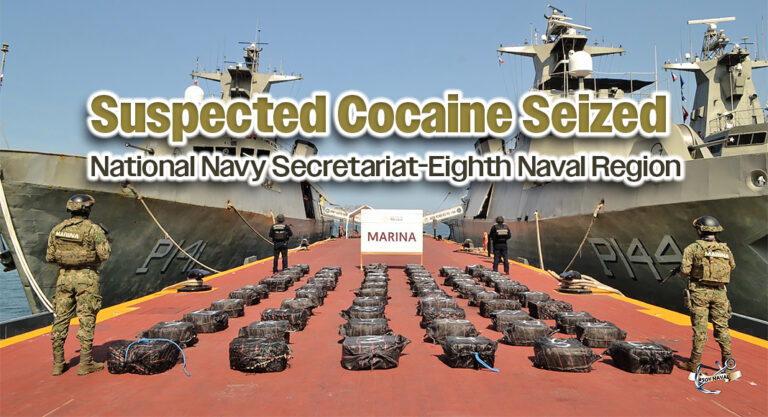
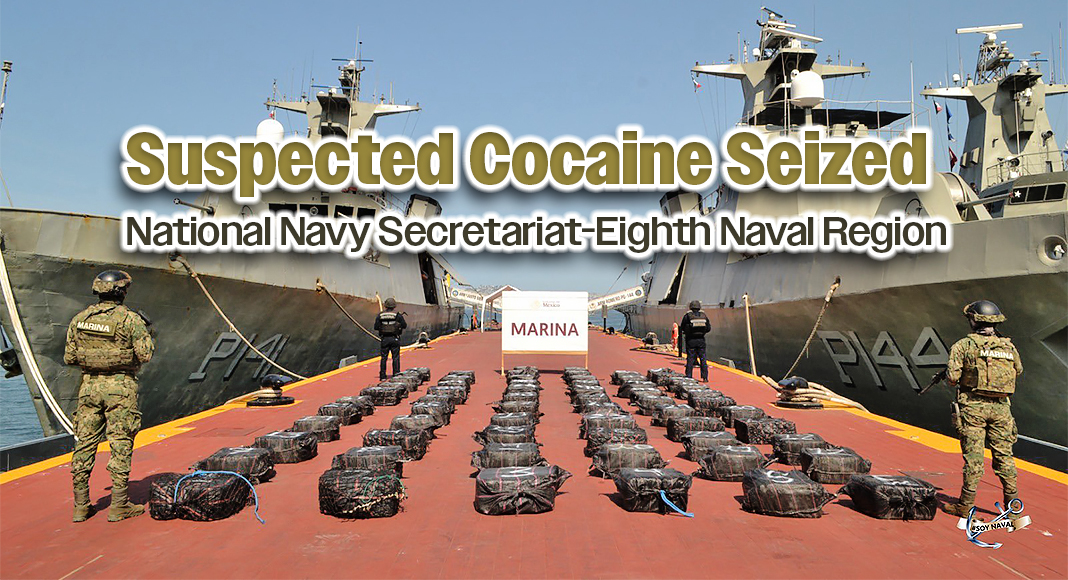
As part of the National Security Strategy, in recent days, during maritime operations led by personnel from the Secretariat of the Navy (Semar) through the Mexican Navy acting as Coast Guard, and in coordination with the Secretariat of National Defense (Defensa), the Attorney General’s Office (FGR), the National Guard (GN), and the Secretariat of Security and Citizen Protection (SSPC), approximately 4.2 tons of suspected cocaine were seized in two separate incidents off the coast of Guerrero.

Image Source: X

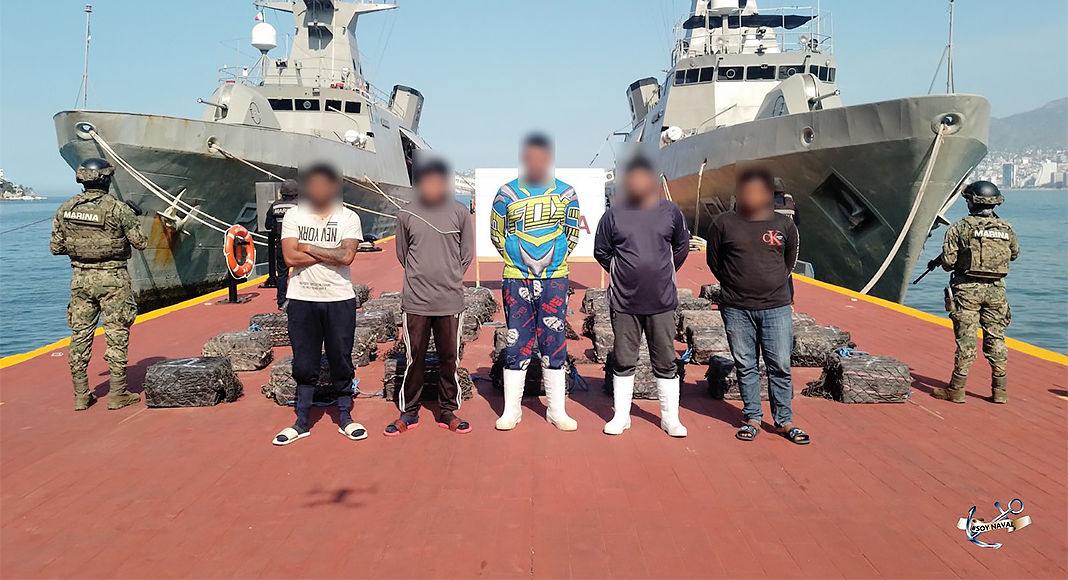
The first action took place during aerial surveillance patrols aboard a Panther-type helicopter belonging to the institution. Navy personnel spotted a GoFast-type vessel with five male individuals on board, transporting 38 bundles resembling sacks, each containing brick-shaped packages filled with a white powder with characteristics similar to cocaine hydrochloride, with an estimated gross weight of approximately 1.8 tons.

The five detained individuals, the suspected drugs, and the vessel were seized and transported by sea to the dock of the Eighth Naval Region and turned over to the Attorney General’s Office to begin the corresponding investigation files.

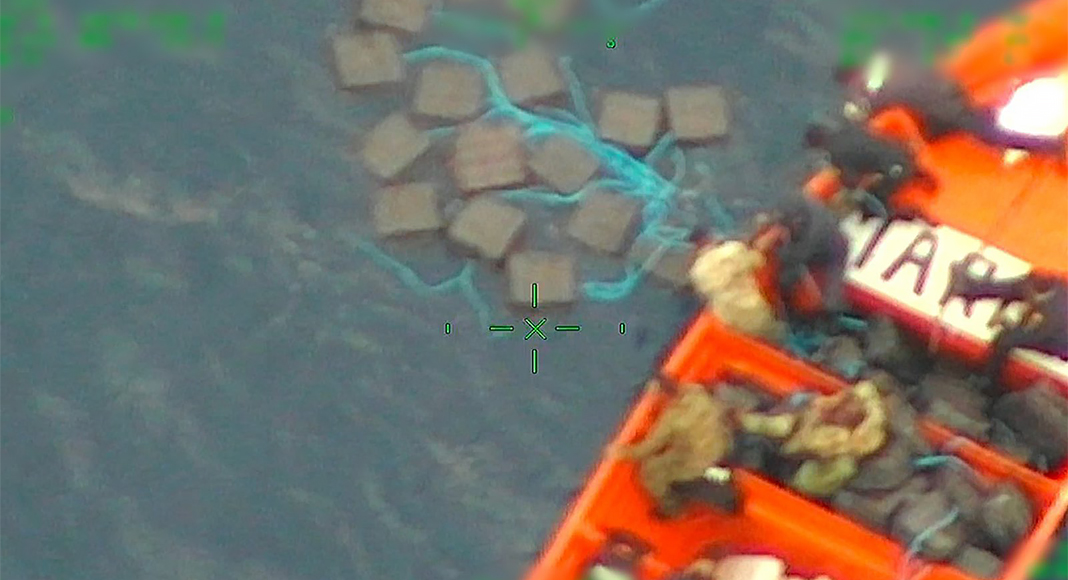
In a second incident, Navy personnel secured 64 bundles, resembling sacks, found floating in the sea off the coast of Guerrero. Each bundle contained brick-shaped packages filled with white powder with characteristics similar to cocaine, with an estimated gross weight of approximately 2.4 tons.

The cargo was seized and handed to the Attorney General’s Office to open the corresponding investigation files.

It is worth noting that during the current administration, more than 36 tons of cocaine have been seized in maritime events, resulting in an estimated impact of approximately 9 billion pesos.

These actions are part of maritime, aerial, and land surveillance operations conducted by the Secretariat of the Navy through the Mexican Navy in national waters, aimed at deterring criminal activity and ensuring the rule of law in Mexico’s maritime zones.

This information was issued through an official press release by the National Navy Secretariat, Eighth Naval Region.

See more on the story at the link below:

Literal Lifetime Literacy Liability in Texas

 The Texas data provides insights into reading levels. In fourth grade, reading scores are only slightly below the national average. However, in eighth grade, scores are far below peer states. In fact, they are significantly lower than they were in 1998. Image for illustration purposes
The Texas data provides insights into reading levels. In fourth grade, reading scores are only slightly below the national average. However, in eighth grade, scores are far below peer states. In fact, they are significantly lower than they were in 1998. Image for illustration purposes
Dr. M. Ray Perryman, President and Chief Executive Officer of The Perryman Group. Courtesy Image

It is impossible to overstate the importance of literacy from a personal, professional, economic, or societal perspective. Texas has quite a bit of work to do!

The National Assessment of Education Progress (NAEP) is a test given to students in grades four and eight. It provides a snapshot of how things are going by state, with comparisons to both other areas and past performance. The Texas data provides insights into reading levels. In fourth grade, reading scores are only slightly below the national average. However, in eighth grade, scores are far below peer states. In fact, they are significantly lower than they were in 1998. 

There are encouraging statistics related to Texas student performance in some areas. The state’s young people score significantly higher than most places in Grade 4 math and Grade 8 science, for example. However, the reading challenges are a persistent problem. 

A major difficulty for Texas schools is the substantial percentage of students identified as English learners – more than 24% in both Grade 4 and Grade 8. The test is given only in English; thus, it is not surprising that it is difficult to compare well relative to states with smaller populations of students facing that additional challenge. Nonetheless, it is certainly worth identifying and investing the resources necessary to ensure that students receive the reading skills they need, as it is an enduring skill that has profound consequences in many areas. 

The Department of Education also measures patterns in adult literacy around the country. Texas ranks near the bottom among the states, with more than 28% of individuals having “Level 1” literacy or less (essentially meaning being able to read sufficiently to perform simple tasks (at best)). Only about 40% of Texans have achieved “Level 3” literacy, meaning they are considered proficient in working with information and ideas in text (approximately 8th grade level ability). Note that these tests are also conducted in English, thus contributing to the low scores in the state. 

In addition to having profound effects on quality of life and even basic sustainability, insufficient literacy also affects job opportunities, social mobility, and lifetime earnings. Many of the fastest growing (and highest paid) occupations in the US at present require Level 3 reading proficiency, and it is very difficult to perform most jobs without being at least at Level 1. 

Enhancing reading skills can be extremely helpful to financial stability from an individual perspective. At the same time, a well-prepared workforce is essential to ongoing economic growth and prosperity. In addition to the critical tasks of adequately funding public schools, career training, and universities, supporting adult literacy and language programs can be enormously beneficial. In fact, our future depends on it. Stay safe!

__________________________

Dr. M. Ray Perryman is President and Chief Executive Officer of The Perryman Group (www.perrymangroup.com), which has served the needs of over 3,000 clients over the past four decades.

U.S. Military Granted Authority Over Border Land in New Mexico to Detain Migrants

Soldiers assigned to 3rd Platoon, Bravo Company, 1st Battalion, 12th Infantry Regiment, conduct a dismounted squad patrol along the southern border outside of Sierra Blanca, Texas, March 31, 2025. Credit: Army Pfc. Malik Waddy-Fiffee. VIRIN:250331-A-NC965-1089

Texas Border Business

April 23, 2025– In a significant policy shift, President Donald Trump has authorized the U.S. military to assume control over a 170-mile stretch of federal land along the U.S.-Mexico border in New Mexico. This move, announced by U.S. Northern Command, transfers jurisdiction from the Department of the Interior to the Department of Defense, effectively designating the area as part of Arizona’s Fort Huachuca.

The reclassification allows military personnel to operate outside the constraints of the Posse Comitatus Act, which traditionally limits the military’s involvement in domestic law enforcement. Under the new directive, service members are permitted to temporarily detain individuals suspected of illegal border crossings, provide medical assistance, and implement crowd control measures until they can transfer custody to U.S. Customs and Border Protection agents.

A 45-day trial period has been initiated to assess the effectiveness of this approach. During this time, the Army will establish additional fencing and signage to delineate the controlled perimeter. The administration has indicated plans to extend similar authority to parts of Texas, further expanding the military’s role in border security operations.

The White House maintains that the measure is necessary to respond to what it describes as an ongoing national emergency at the southern border. The administration asserts that the military’s enhanced role is crucial for deterring illegal immigration and ensuring national security.

As the situation develops, further assessments will determine the long-term implications of this policy change on border enforcement and civil-military relations within the United States.

See below supporting documents: 

https://www.whitehouse.gov/remarks/2025/02/press-briefing-by-press-secretary-karoline-leavitt-deputy-chief-of-staff-stephen-miller-national-economic-council-director-kevin-hassett-and-national-security-advisor-mike-waltz

https://comptroller.defense.gov/Portals/45/documents/cfs/fy2003/FY2003Army.pdf

https://prhome.defense.gov/Portals/52/Documents/RFM/Readiness/docs/srr2007.pdf

https://www.defense.gov/News/News-Stories/Article/Article/4156956/interagency-land-agreement-strengthens-military-border-mission

Pax­ton Defends Tex­ans’ Pri­va­cy Amid 23andMe Bank­rupt­cy

Attorney General Ken Paxton has filed a motion to appoint a Consumer Privacy Ombudsman in the 23andMe bankruptcy case to ensure that the highly sensitive personal and genetic information of Texans is safeguarded throughout the bankruptcy proceedings. Image: Coolcaesar, CC BY-SA 4.0 https://creativecommons.org/licenses/by-sa/4.0, via Wikimedia Commons. Logo; Public Domain via wikimedia Commons

Attorney General Ken Paxton has filed a motion to appoint a Consumer Privacy Ombudsman in the 23andMe bankruptcy case to ensure that the highly sensitive personal and genetic information of Texans is safeguarded throughout the bankruptcy proceedings. 

“The importance of safeguarding Texans’ genetic data and preserving their privacy rights cannot be overstated,” said Attorney General Paxton. “We have robust state privacy laws that include data deletion rights, and I would encourage any Texan concerned about their data to exercise the right to have their data securely deleted. I will continue to stand up for Texans’ privacy rights, which is why I’m fighting to have a Consumer Privacy Ombudsman appointed in this case.”  

23andMe, a company whose services include direct to consumer genetic testing, recently filed for Chapter 11 bankruptcy in the Eastern District of Missouri. According to pleadings filed in the case, 23andMe seeks to sell unspecified assets that potentially include the sensitive genetic data of adults and children, health information, and other personally identifiable information.   

Attorney General Paxton’s motion asserts that this case presents an unprecedented situation at the intersection of bankruptcy law, consumer data rights, and genetic data privacy rights, and the appointment of a Consumer Privacy Ombudsman serves the interests of consumers and creditors.   

Under the Texas Direct-to-Consumer Genetic Testing Act and the Texas Data Privacy and Security Act, Texas consumers have the right to request that their data be deleted from 23andMe’s database and that the genetic sample or results be destroyed. Texans may exercise their rights by going to the 23andMe website where they can request deletion of their data, opt to have test samples destroyed, and revoke permission for their data to be used for research: click here to download or request deletion of your 23andMe data.  

Texans who experience problems in exercising their rights, do not receive a response from the company, or have other concerns related to their 23andMe data may file a complaint at the Office of the Attorney General’s website.   

Roche Leads $50 Billion U.S. Manufacturing Surge in the Middle of Tariff Pressures

Swiss pharmaceutical giant Roche announced a $50 billion investment in U.S. manufacturing and research over the next five years. Image: Public Domain

Texas Border Business

Swiss pharmaceutical giant Roche announced a $50 billion investment in U.S. manufacturing and research over the next five years, marking one of the largest foreign direct investments in American history. The move is widely seen as a strategic response to potential tariffs under the Trump administration’s trade policies.  

Roche’s investment will span multiple states, including Indiana, Pennsylvania, Massachusetts, California, Kentucky, New Jersey, and Oregon. Key projects encompass a 900,000-square-foot facility dedicated to next-generation weight-loss drugs, a gene therapy center in Pennsylvania, a glucose monitoring device plant in Indiana, and a cardiovascular research hub in Massachusetts. The company anticipates creating over 12,000 jobs, with 1,000 directly at Roche and the remainder supporting new U.S. manufacturing capabilities.  

This significant investment aligns with a bigger trend of major corporations’ reshoring operations in response to evolving trade dynamics and policy incentives. Notable examples include: 

  • TSMC: The Taiwanese semiconductor leader plans to invest an additional $100 billion in U.S. chip manufacturing, bringing its total U.S. investment to $165 billion. This expansion includes three new fabrication plants and two advanced packaging facilities in Arizona.  
  • Eli Lilly: The pharmaceutical company is set to invest over $50 billion in U.S. manufacturing since 2020, with plans to build four new pharmaceutical manufacturing sites, enhancing domestic medicine production.  
  • Apple: The tech giant has committed to more than $500 billion in U.S. investments over the next four years. This includes constructing a 250,000-square-foot AI server manufacturing facility in Houston, Texas, to support its AI initiatives.  
  • NVIDIA: The company is partnering with Foxconn and Wistron to build AI supercomputer manufacturing facilities in Houston and Dallas, Texas. These plants are expected to commence mass production within the next 12–15 months.  
  • Hyundai Motor Group: The automaker has announced a $21 billion investment in the U.S. from 2025 to 2028, focusing on expanding automobile production, strengthening supply chains, and enhancing energy infrastructure.  

These substantial investments highlight a significant shift in global manufacturing strategies, driven by geopolitical factors and the desire to mitigate risks associated with international supply chains. As companies like Roche lead the charge, the U.S. will likely become a central hub for advanced manufacturing and innovation in the coming years.

Sources:

https://www.roche.com/media/releases/med-cor-2025-04-22?utm_source=chatgpt.com

https://pr.tsmc.com/english/news/3210?utm_source=chatgpt.com

https://investor.lilly.com/news-releases/news-release-details/lilly-plans-more-double-us-manufacturing-investment-2020?utm_source=chatgpt.com

https://www.apple.com/newsroom/2025/02/apple-will-spend-more-than-500-billion-usd-in-the-us-over-the-next-four-years/?utm_source=chatgpt.com

https://blogs.nvidia.com/blog/gh200-grace-hopper-superchip-powers-ai-supercomputers/?utm_source=chatgpt.com

https://www.hyundai.com/worldwide/en/newsroom/detail/hyundai-motor-group-commits-to-us-growth-with-usd-21-billion-investment-0000000918?utm_source=chatgpt.com

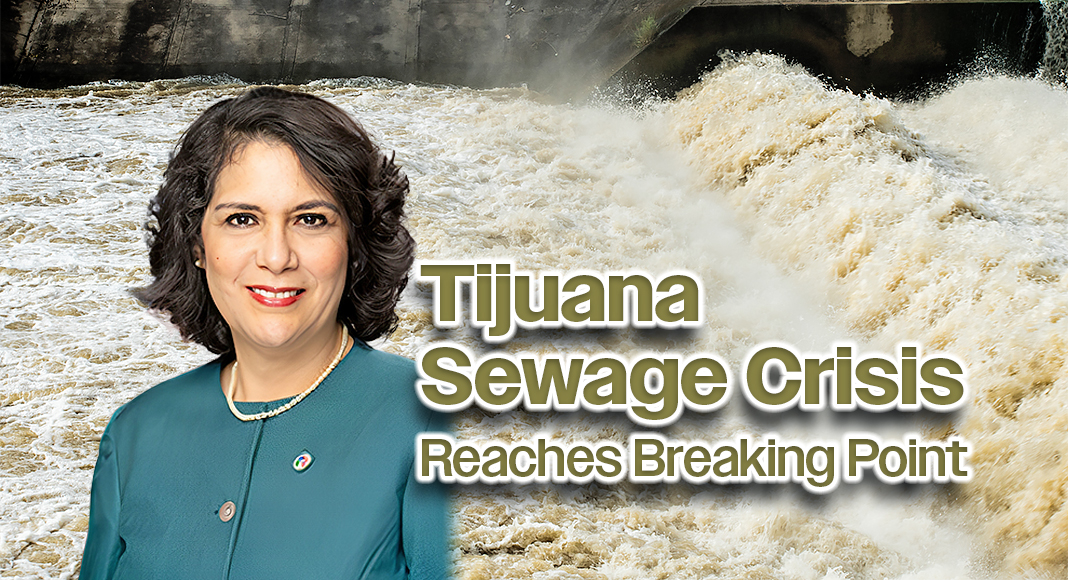
South Texas Water Crisis Advocate Maria-Elena Giner Resigns Under Trump Administration Pressure

Maria-Elena Giner, the U.S. Commissioner of the International Boundary and Water Commission (IBWC), has officially resigned following pressure from the Trump administration. Image: Public Domain via Wikimedia Commons. Bgd for illustration purposes

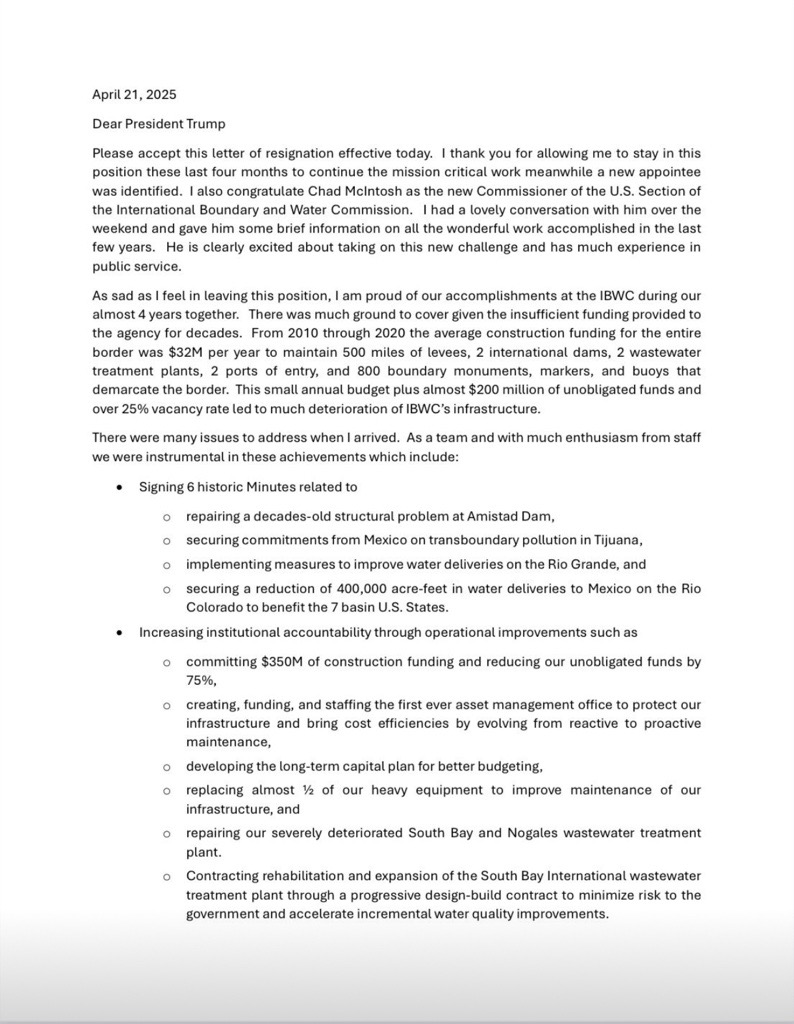
April 2025—Maria-Elena Giner, the U.S. Commissioner of the International Boundary and Water Commission (IBWC), has officially resigned following pressure from the Trump administration. 

Appointed by President Joe Biden in 2021, Giner had become a key figure in managing binational water issues affecting South Texas and northern Mexico. 

During her tenure, Giner helped negotiate five amendments to the 1944 U.S.-Mexico Water Treaty, expanded flood control initiatives, and secured increased funding for water infrastructure modernization along the Rio Grande. She was also credited with bringing greater transparency and urgency to the U.S.-Mexico water debt disputes that have plagued Texas farmers for years.

“Thank you to everyone for your support during my journey as Commissioner of the U.S. Section of the International Boundary and Water Commission.  It has been the honor of my life time.  The hardest job I have ever had but the most rewarding,”

Maria-Elena Giner via LinkedIN

Yet her departure comes during escalating controversy over a separate crisis — sewage-contaminated water flowing from the Tijuana River into southern California, which has led to environmental, public health, and diplomatic concerns.

In recent months, untreated sewage and industrial waste from Tijuana have poured into the Pacific Ocean, closing beaches in San Diego County for weeks. The crisis has been compounded by the failure of cross-border wastewater infrastructure and delays in funding allocations for repairs and upgrades to the aging International Wastewater Treatment Plant (IWTP) in San Ysidro, California.

Local officials and residents in California’s Imperial Beach, Coronado, and San Diego communities have called the situation a “public health emergency.” Despite prior federal commitments — including over $300 million authorized under the USMCA’s environmental provisions — progress has been delayed in legal, bureaucratic, and funding disputes. The Trump administration has not issued a formal explanation for forcing Giner’s resignation, 

With her resignation, leadership at the IBWC remains uncertain at a critical moment. The next commissioner will face a growing list of challenges, including a worsening drought in the Rio Grande basin, rising tensions over agricultural water use, and the ongoing sewage crisis in California.

See the YouTube videos below by NBC: 

EPA Administrator Lee Zeldin visited San Diego to address the Tijuana River sewage crisis. 

Watch the videos below for more information:

According to a report, more than 100 billion gallons of untreated sewage and industrial waste have spilled into the Pacific Ocean from the Tijuana River over the past five years. NBC News’ Steven Romo reports that the toxic waste may pose a health risk to kids, the elderly, and pregnant people in the San Diego area.

CBP Officers Seize Over $950K in Cocaine at Hidalgo International Bridge

Packages containing 71 pounds of cocaine seized by CBP officers at Hidalgo International Bridge. USCBP image

HIDALGO, Texas — U.S. Customs and Border Protection, Office of Field Operations officers at the Hidalgo International Bridge, intercepted $950,100 in alleged cocaine concealed within a vehicle.

“It has been a busy week for us with narcotics seizures, but our CBP officers never let down their guard,” said Port Director Carlos Rodriguez, Hidalgo/Pharr/Anzalduas Port of Entry.

On April 17, CBP officers assigned to the Hidalgo International Bridge encountered a black Dodge sedan making entry from Mexico. A CBP officer referred the vehicle for further inspection, which included utilizing nonintrusive inspection equipment and a canine team. Physical inspection led to the discovery of 27 packages of alleged cocaine with a combined weight of 71.16 pounds (32.28 kg) concealed within the vehicle.

CBP OFO seized the narcotics and vehicle. Homeland Security Investigations arrested the vehicle occupants and initiated a criminal investigation.