
















Texas Border Business




The number of unmarried women who gave birth in the United States declined to about 1.2 million in 2023, a decrease of roughly 15% over just more than a decade, according to a recent report from the U.S. Census Bureau.
In 2023, 30.9% of the 4 million women ages 15 to 50 who gave birth in the previous year were unmarried. By comparison, in 2011, 35.7% of the 4.1 million women in the same age group who had recently given birth were unmarried, totaling about 1.5 million.
The report found that most states reflected the national decline in unmarried women giving birth. In states where the number did not fall, levels remained statistically unchanged.



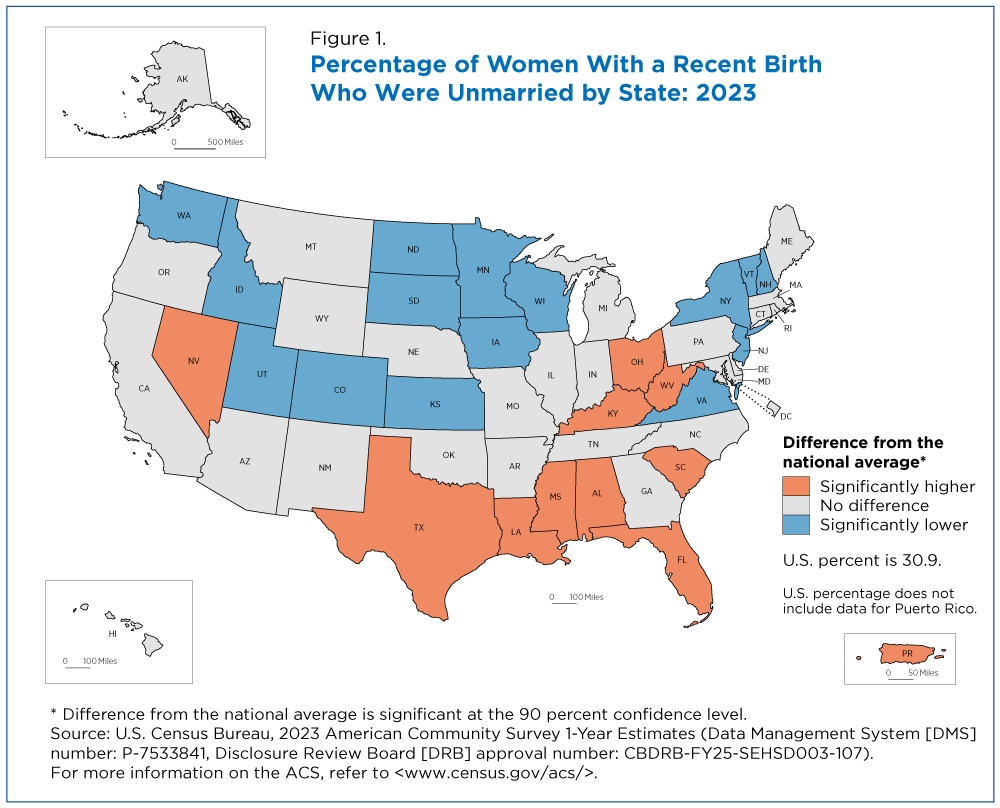
Eight Southern states — Alabama, Florida, Kentucky, Louisiana, Mississippi, South Carolina, Texas, and West Virginia — recorded higher shares of recent births to unmarried women than the national average in 2023.
By contrast, six Midwestern states — Iowa, Kansas, Minnesota, North Dakota, South Dakota, and Wisconsin — along with four Northeastern states — New Hampshire, New Jersey, New York, and Vermont — and four Western states — Colorado, Idaho, Utah, and Washington — reported lower shares than the national average. Virginia was the only Southern state with a lower-than-average share of recent births to unmarried women.
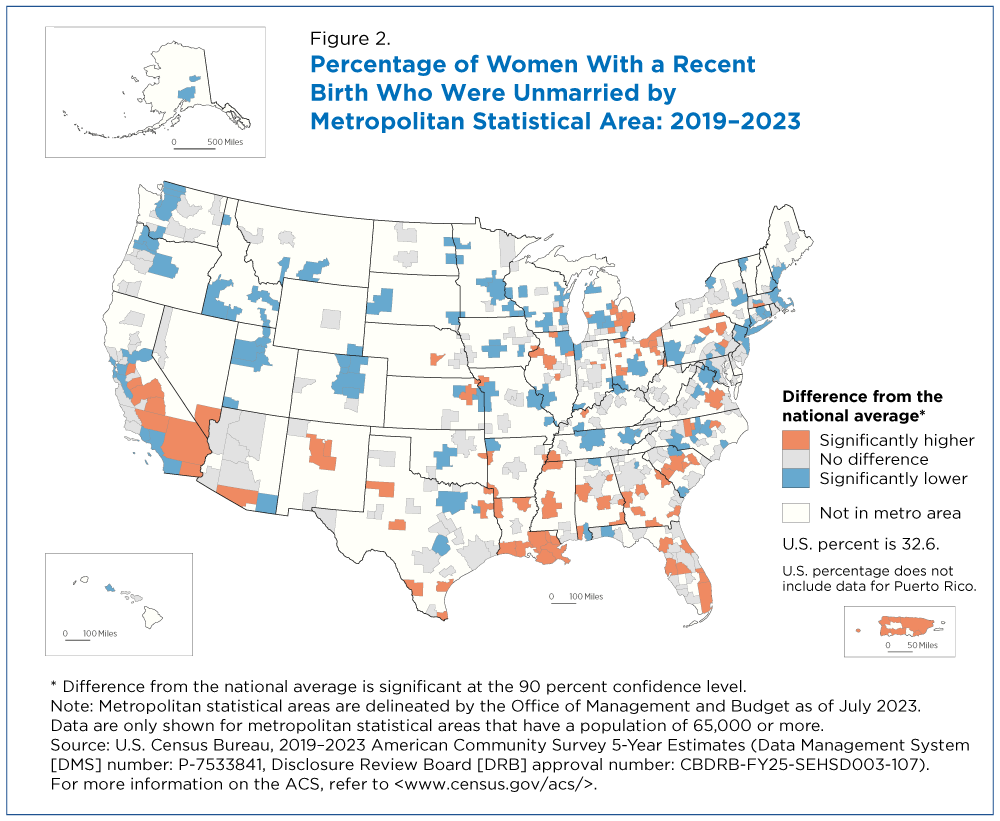
At the metropolitan statistical area level, geographic patterns were more varied. Areas with higher-than-average shares of unmarried women who had recently given birth were located across the South, parts of the Midwest, California, and Puerto Rico. Brunswick–St. Simons, Georgia, reported one of the highest shares at 70.7%.
Metropolitan areas with lower-than-average shares were distributed across the country, with higher concentrations in the Northeast, parts of the Midwest, and the West. Pocatello, Idaho, recorded one of the lowest shares, at 6.2%.
According to the report, geographic differences may be linked to socioeconomic factors that vary by state and county, including poverty and income. The report found a strong positive correlation between the share of women with a recent birth who were unmarried and the percentage of households living below the poverty line.
Marriage rates also varied by location. In 2022, Washington, D.C., Colorado, and Nebraska had among the nation’s highest marriage rates, while New Mexico and Puerto Rico had among the lowest.
Several metropolitan areas with low shares of unmarried recent births are home to large public universities, including Amherst–Northampton, Massachusetts; Logan–Idaho, Utah; Provo–Orem–Lehi, Utah; Ames, Iowa; and Lawrence, Kansas. The report stated that this pattern aligns with previous research showing that women with higher levels of education or greater economic advantages are more likely to be married.
Recent Census Bureau research also found that women who had a first birth between 2020 and 2024 and held a bachelor’s degree were more likely to be married than women without a degree.
The report noted that national percentages differ between state and metropolitan data because state figures are based on 2023 American Community Survey one-year estimates, while metropolitan figures are based on five-year estimates.