
















Texas Border Business




By Joey Gomez
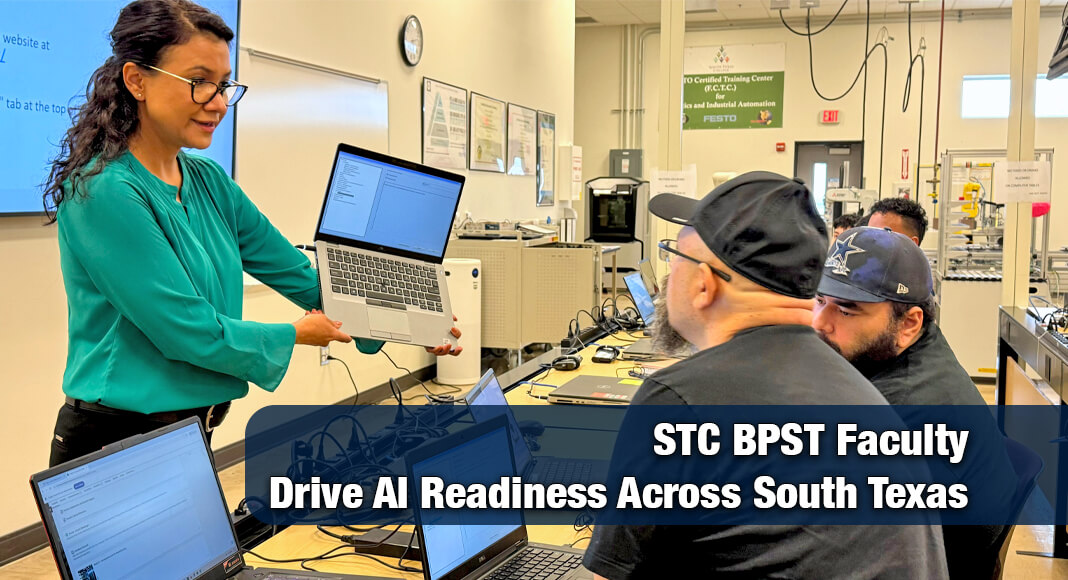
McALLEN, Texas – South Texas College faculty comprising the Division of Business, Public Safety and Technology (BPST) are making a collective effort to prepare students for an economy increasingly shaped by artificial intelligence (AI).
Faculty recently presented during BPST’s fall meeting at Mission Event Center, where employees gathered ahead of the fall semester, which begins Aug. 24. The meeting also served as the latest update for the division-wide initiative for AI, launched more than a year ago by BPST interim dean Joe Vela




The result: BPST is expanding the use of AI across its curriculum, with 15 departments and 33 faculty members now incorporating the technology into 55 courses.
The division has also identified 10 general AI tools and 18 industry-specific applications currently in use by faculty.
“They have made some tremendous progress in incorporating AI into their programs,” Vela said. “They are getting really innovative on different approaches and things we could do, which is exactly what we wanted.
The initiative grew from STC’s AI in Manufacturing course, developed through grant support from Intel and now serving as a foundation for the expanding AI curriculum among other programs in the division.
Presentations by faculty highlighted how programs including Business Management, Automotive Technology, Law Enforcement, Construction Management, Architecture and Cosmetology are using AI to strengthen instruction and prepare students for changing industry demands.
Advanced Manufacturing Technology Program Chair Erika Guerra, who serves as the division’s AI liaison, said each department’s approach is different. Some may use generative AI in the classroom, while others train students on specialized systems already used by employers.
Across every presentation, however, Guerra said one principle remained constant: AI supports, but does not replace, the knowledge and professional judgment of STC instructors and students.
“That’s one of the main things we are stressing throughout this initiative. It’s a recurring theme,” Guerra said. “This is not going to replace instructor expertise, research or any kind of verification.
AI makes an impact
Whether it’s a future automotive technician learning to diagnose advanced driver-assistance systems, an architecture student transforming an early sketch into a realistic model or a cosmetology student creating a personalized consultation for a client, faculty say they are meeting the challenge set by Vela.
Jose Cruz, Business Administration faculty, demonstrated how students in his Communications in Management course collaborate with AI to analyze data, recognize patterns and develop evidence-based recommendations for a hypothetical company.
AI can generate insights, but students remain responsible for verifying the information, weighing possible decisions and translating the results that people can understand, Cruz said.
“It’s the human element that we still need to teach our students,” Cruz said. “It’s about knowing the culture, knowing the context and knowing the environment.”
Automotive Technology Department Chair Rogelio Camarillo discussed preparing students to service AI-powered advanced driver-assistance systems (ADAS), which support functions including automatic emergency braking, adaptive cruise control, lane-keeping assistance, blind-spot detection and pedestrian recognition.
The program will implement a new ADAS training system this fall, giving students hands-on experience diagnosing faults, analyzing sensor data and performing system calibrations.
In Law Enforcement education, Police Academy instructor Jennifer Rosillo is using AI to help simplify complex legal concepts, create realistic scenarios and revise test questions for students with different learning needs, while emphasizing that information generated through AI must always be checked against Texas law and other authoritative sources.
Construction Management faculty member Israel Medrano described how AI-supported platforms can help supervisors plan projects, schedule materials and workers, track costs, improve job-site safety and communicate more efficiently with contractors.
Medrano said those efficiencies can help companies secure more work, support employees and vendors and ultimately contribute to economic growth across the region.
“When we use AI, we schedule our lumber, we schedule our materials, our labor and our workforce,” Medrano said. “AI is just something we cannot do without anymore.”
Vela said he is now challenging more programs to identify practical applications, including those in which AI’s role may not be immediately apparent.
As employees continue adopting the technology, he said STC must ensure graduates arrive with the skills to use it responsibly; not as a substitute for human expertise, but as another tool to help them lead their industries forward.
“The idea is not necessarily to replace the careers they have,” Vela said. “It’s how do we enhance what we can do and make us more efficient.”