
















Texas Border Business




By Roberto Hugo González / Texas Border Business
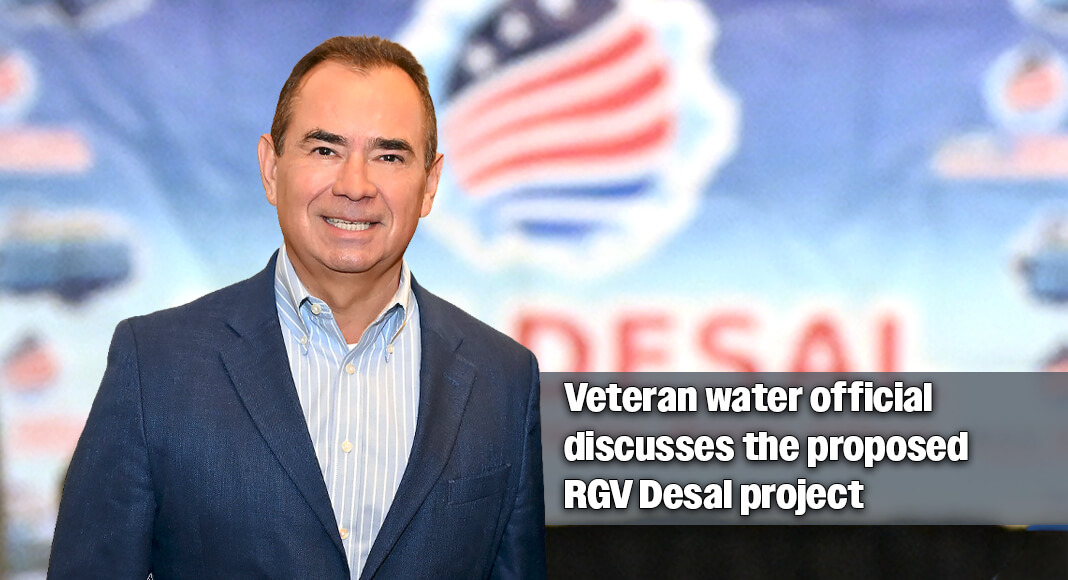
McAllen, Texas — Roel “Roy” Rodriguez, P.E., interim general manager of the Harlingen WaterWorks System, said the proposed RGV Desal marine desalination project should become part of the Rio Grande Valley’s long-term water strategy, citing the need for a diversified water portfolio to meet the region’s future water demands. Rodriguez shared his views in response to questions following the June 24, 2026, RGV Desal press conference hosted by the RGV Hispanic Chamber of Commerce.
During the event, Cynthia Sakulenzki, president of the RGV Hispanic Chamber of Commerce, welcomed elected officials, community leaders, business representatives, and members of the media. The presentation was delivered by Albert Escobedo, South Texas Government Affairs Director for RGV Desal and a Los Fresnos city commissioner, and Doug Allison, managing partner of RGV Desal and founder and president of U.S. Desalination.



Rodriguez described his overall impression of the presentation as positive, stating, “I have been an advocate for a diversified water portfolio for a very long time, including the need for ocean desal.”
He said the Rio Grande Valley’s current water situation is significant and requires a long-term plan that includes alternative water sources. “We must ensure that we have a water plan for our region that includes this type of alternative,” Rodriguez said. “No one source of water will be the solution for our long-term future; instead, it will have to include alternative sources of water. Ocean desalination provides an unlimited amount of water for our future.”
When asked whether desalination should be part of the region’s long-term strategy, Rodriguez responded, “Ocean desal must be a part of our long-term water strategy.”
Rodriguez said the project team’s commitment stood out during Doug Allison’s presentation, describing it as the aspect that made the strongest impression on him.
Discussing potential challenges, Rodriguez said securing commitments from cities to purchase water will be critical. “They can build as big a plant as they desire, but without clients (cities) this will not get off the ground,” he said. He added that RGV Desal should secure contracts with cities to demonstrate demand to investors.
Rodriguez also said he believes the project should initially focus on Cameron County rather than extending immediately into western Hidalgo County or Starr County. He said a shorter distribution network would reduce infrastructure costs and lower energy requirements because communities farther west are at higher elevations. As an example, he noted that Harlingen sits at about 40 feet above mean sea level, while McAllen is about 100 feet above mean sea level, requiring significantly more energy to pump water farther west. Rodriguez also identified funding for water distribution infrastructure as a major challenge and said the State of Texas should fund that portion of the project. “I also see funding for distribution as a major challenge,” he said. “The State of Texas has announced new funding for new water sources. I can’t think of a better project for the RGV than this. Texas should fund the distribution-cost portion of this project.”
Addressing the project’s financing, Rodriguez said both private and public funding will be necessary. “Without a partnership between private and public funding, this project will not happen,” he said.
Rodriguez said cities and regional water providers must actively participate for the project to advance. “Cities need to come to the table and commit to taking water,” he said. “Too many cities take the ‘wait and see’ approach with these types of projects. The wait-and-see approach will never get this off the ground.”
On environmental and technical issues, Rodriguez said residents should rely on state agencies to evaluate and address those concerns. “Residents should rely on the State to ensure that all technical and environmental issues are evaluated and mitigated,” he said.
Rodriguez also emphasized the importance of cooperation among cities, water districts, and state agencies, stating, “Without regional cooperation, this will not happen.”
Offering advice to local leaders, Rodriguez urged decisive action. “Local leaders need to lead,” he said. “Let’s stop talking and start working.”
About Roy Rodriguez
Rodriguez serves as interim general manager of the Harlingen WaterWorks System, overseeing the city’s water and wastewater utility operations and infrastructure. His career includes service as Harlingen city engineer, assistant city manager, city manager, general manager of the McAllen Public Utility Board, and city manager of McAllen. His experience spans municipal engineering, water management, and public infrastructure planning across South Texas.
See related stories: