

















Texas Border Business



By Roberto Hugo González / Texas Border Business
McAllen, TX – Cynthia Sakulenzki, president of the RGV Hispanic Chamber of Commerce, welcomed elected officials, community leaders, business representatives, and media members to a press conference on the proposed RGV Desal marine desalination project.
Sakulenzki said water remains one of the Rio Grande Valley’s greatest challenges and called the project a potential long-term investment in the region’s future.





“Water is not simply a resource; it is the foundation of our quality of life, our public health, our agriculture, our economic development, and the future growth of our communities,” Sakulenzki said.
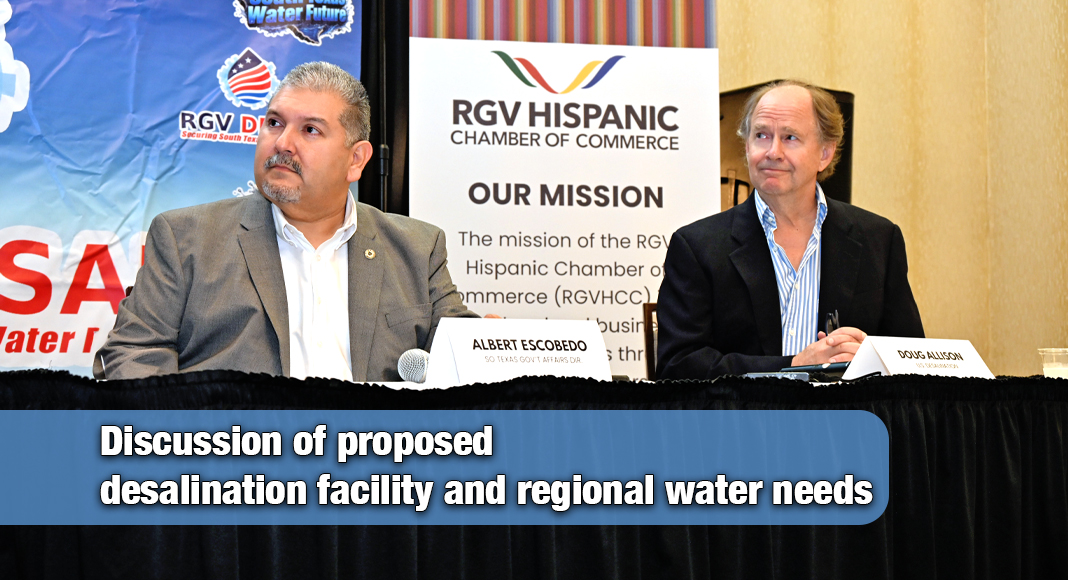
Albert Escobedo, South Texas Government Affairs Director for RGV Desal and a Los Fresnos city commissioner, said the project has grown from a local effort in Brownsville into a regional initiative to address water shortages across the Valley.
“RGV Desal is here to provide the water solutions to the Valley for our drought,” Escobedo said before introducing Doug Allison, founder and president of U.S. Desalination.
Allison said his team has spent approximately 18 months evaluating locations and project designs for a large-scale seawater desalination facility intended to serve the Rio Grande Valley.
“We can deliver the project in a way that’s environmentally sensitive, that is supporting our marine life and supporting the community and community growth with water and economic development,” Allison said.
According to Allison, the proposed facility would begin with a production capacity of 50 million gallons of water per day and could be expanded to 120 million gallons per day. He said the preferred location is north of South Padre Island, allowing both water intake and discharge systems to be placed offshore.
Allison said offshore intake and discharge provide operational and environmental advantages, including more predictable water quality and rapid dilution of the discharge stream.
He said the project would use reverse osmosis technology, the same process used at major desalination facilities worldwide. Allison noted that large-scale seawater desalination is widely used in countries including Israel, Saudi Arabia, and Australia, while only a limited number of large facilities operate in the United States.
Allison said U.S. Desalination has partnered with IDE Technologies, an international desalination company that has participated in projects worldwide, including the Carlsbad desalination facility in California.
Addressing environmental concerns, Allison said modeling and environmental studies conducted by the project team indicate the facility can operate without adverse impacts to marine populations. He said offshore discharge systems are designed to restore salinity levels to near-natural conditions within a short distance of the outfall.
Allison said the company is evaluating multiple options to transport water from South Padre Island to customers throughout Cameron and Hidalgo counties. Discussions have included coordination with TxDOT, regional water districts, and local governmental entities.
Asked about the cost of delivering water inland, Allison said the company has not completed a final engineering estimate. He said future pipeline data from a Corpus Christi desalination project may provide useful cost comparisons.
Allison estimated the desalination facility itself would cost approximately $1 billion for its initial 50-million-gallon-per-day capacity and said it would be privately funded.
“We’re not looking for any state money,” Allison said.
When asked about estimates that pipeline construction could cost $4 million to $5 million per mile, Allison said he had heard similar figures, although he noted he had also seen estimates closer to $2 million per mile.
Allison said reliable water supplies are essential for future economic growth and argued that seawater desalination provides a long-term source of water independent of drought conditions and traditional river supplies.
Sakulenzki closed by encouraging continued public engagement and discussion as the project moves forward.
See related story: