







Home Blog Page 479

Texas-Mexico Supercluster Meeting Emphasizes Regional Collaboration and Workforce Development

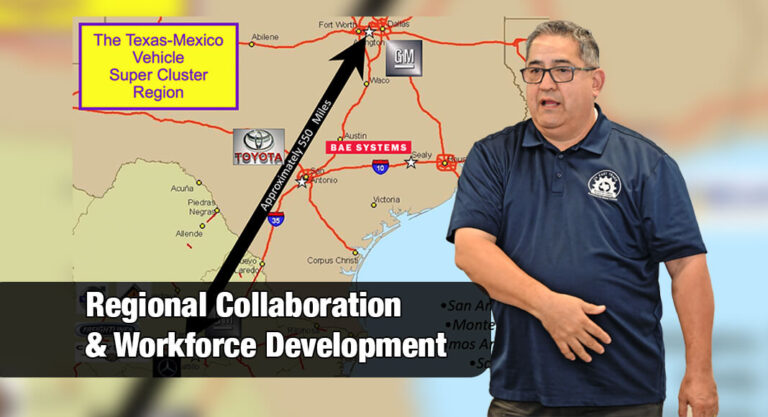
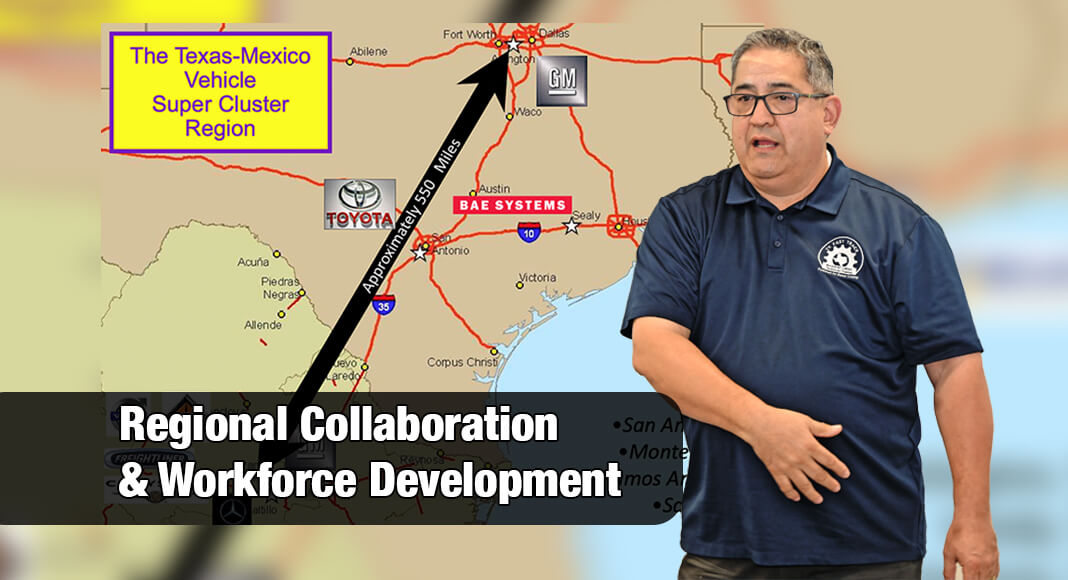
David Marquez presents the Texas-Mexico Vehicle Supercluster Region, emphasizing cross-border connectivity and regional growth, as the cluster map is displayed behind him. Photo by Roberto Hugo González

By Roberto Hugo González

The Texas-Mexico Automotive Supercluster (TMASC) Regional Economic Development Meeting was held on Monday, May 19, 2025, at the University of Texas Rio Grande Valley (UTRGV) Center for Innovation and Commercialization in Weslaco. The event convened economic developers, local officials, industry leaders, and workforce professionals to explore the evolution of advanced manufacturing in Texas and northern Mexico. David Marquez, Executive Director of Economic and Community Development for Bexar County in San Antonio, Texas, served as the keynote speaker and presented a comprehensive analysis of the region’s automotive and manufacturing ecosystem.

Marquez began by reflecting on the formation of Bexar County’s economic development office in 2005, stating, “We created the office in 2005 when Toyota arrived in San Antonio. My commissioners gave me one order: maximize the economic benefit.” He noted that while many Texas counties had individual staff members handling economic development, Bexar County was the first to establish a formal office. “It’s been a lot of fun,” he added, “because that’s what development’s all about.”
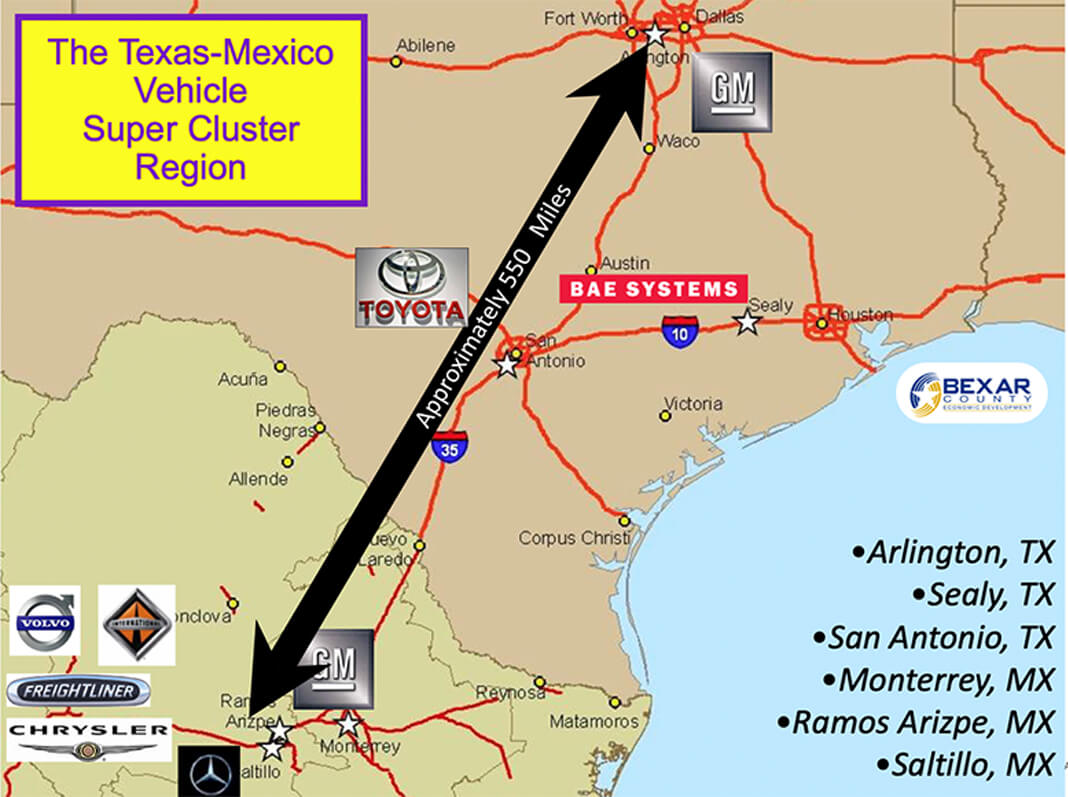
The Texas-Mexico Vehicle Supercluster Region.

The meeting centered on the concept of the automotive “supercluster”—a network of interconnected suppliers, assembly facilities, and supporting industries operating across geographic and political boundaries. “There’s no such thing in my view of an economic development strategy for this industry that revolves around one political subdivision,” Marquez said. “You have to think broader than that and collaboratively and collectively grow the industry in your region.”

According to Marquez, the Toyota plant in San Antonio played a pivotal role in shifting the regional economy. “We gave Toyota 2,300 acres in South County,” he explained. “It was their first-ever onsite supplier park, and to this day, it might still be the only one. But it came with risks. Toyota had to use all of its suppliers’ capacity. If the plant slows down, you can’t let your suppliers go out of business.”

Marquez emphasized the geography and logic behind regional supply chains. “A final assembly facility draws 80 percent of its components from within about 400 to 500 miles,” he said. “This is true for any final assembly facility in advanced manufacturing.” He added that the Texas-Mexico region functions similarly to other multi-state manufacturing zones in North America, despite the presence of a national border. “The industry has pretty well figured out how to work the border. It’s not ideal, but the benefits of proximity between northeastern Mexico and the U.S. market are impossible to ignore.”

Ron Garza, Associate Vice President for Workforce and Economic Development at UTRGV, opened the meeting by underscoring the importance of developing a clear understanding of the region’s supplier landscape. “We need our map and assessment of this,” Garza said. “We can’t advocate and talk very well about it if we can’t show it.”

Marquez agreed, citing Bexar County’s efforts to map its ecosystem through formal studies commissioned in 2008, 2012, and 2024. “This is all driven by data,” he said. “It’s not just about border crossings, but what items are crossing, what the tax regimes are, and how the supply chains are structured.”

During the presentation, Marquez walked the audience through the historical shifts in the U.S. automotive industry. “If my grandfather had bought a truck, it would’ve been made in the yellow dots around the Great Lakes. Then people moved south, and so did the industry. And starting in the 1990s, international companies—German, Korean, Japanese—entered North America and clustered in the southeast and into Mexico.” He added, “Our forecast in 2007 was that Texas and our area would be the next region for growth. That’s largely proven true.”

Marquez emphasized the importance of workforce readiness, describing Bexar County’s 10-week Fast Track training program. “Our program targets people who are unemployed, underemployed, reentry populations, and veterans,” he said. “We provide hands-on training to prepare them for maintenance technician roles. We have a 93 percent graduation rate and 85 percent placement rate, with wages averaging $27 per hour.”

He shared anecdotes illustrating the program’s impact. “We’ve had people come out of our homeless camp, and 10 weeks later, they’re making $60,000 a year. One of our graduates was a woman from Mexico who worked in the fast food industry. She joined the Fast Track program, and now she’s at Caterpillar, already climbing the ladder.”

Garza noted that UTRGV is evaluating ways to adopt similar models in the Valley. “We talked earlier about categorizing our suppliers not just by automotive but also by aerospace, healthcare, and other industries. That way, we can better understand our regional strengths.”

Throughout his remarks, Marquez repeatedly returned to the theme of collaboration. “When Tesla came to Austin, suppliers started showing up in Bexar County that we never even recruited,” he said. “That’s the nature of a cluster. They want to be near where the action is.” He emphasized that regional wins are not zero-sum. “Our wins are not your losses, and your wins are not our losses within this region. We lose when they go to Mississippi or Ohio or the central part of Mexico.”

He advocated for collective marketing strategies: “In the Southeast, four or five governors go overseas together to recruit companies. That’s a much stronger message. We need to fight together.”

Marquez also spoke frankly about infrastructure challenges. “We thought we built plenty of infrastructure around the Toyota plant, but we’re already struggling. It’s not on an interstate. And that’s something we have to address.”

In closing, he urged attendees to define their vision. “On the top of your page, write what your big win would be,” he told the audience. “And on the bottom, write what you have that could make that happen. That’s where your strategy begins.”

Marquez summarized the path forward: “If the region wants to win, you have to be intentional. That means understanding what your people can do, what the industry wants, and connecting those dots. Don’t get hung up on credentials—get them the skills.”

Garza added, “This meeting isn’t the end. It’s a launch point. We’re committed to building a more visible, more connected, and more competitive Valley.”
Governor Abbott Honors DPS Troopers at DPS Fallen Officers Memorial

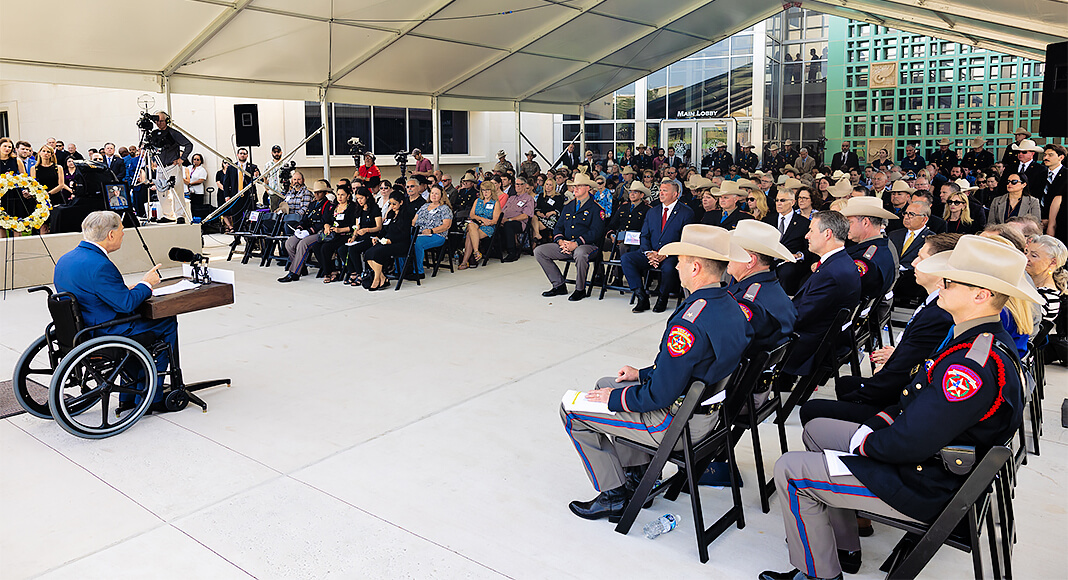
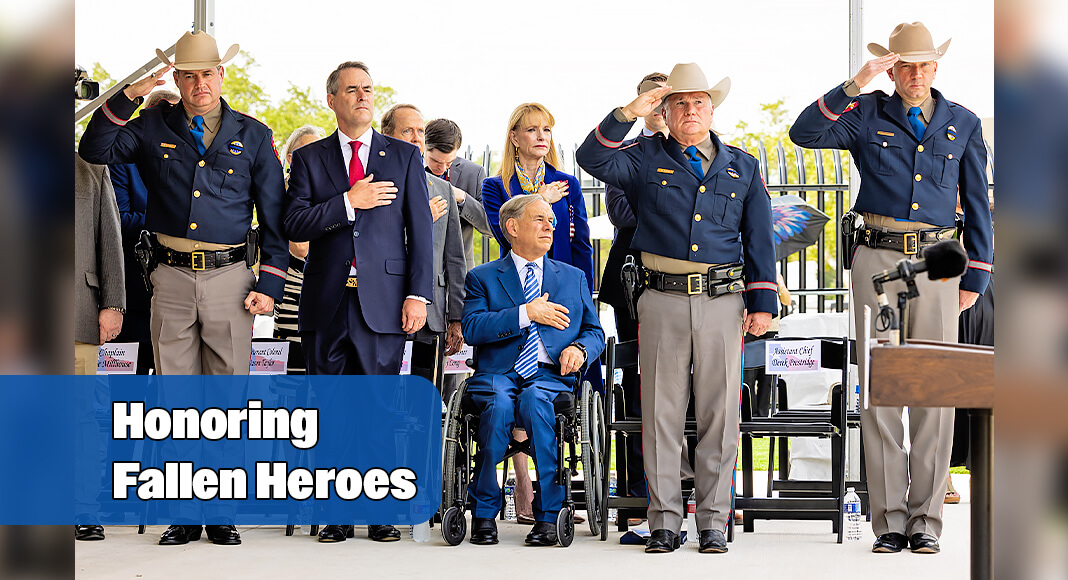
Governor Greg Abbott honored the Texas Department of Public Safety (DPS) troopers and Texas Rangers who made the ultimate sacrifice while serving in the line of duty during DPS’ annual Peace Officers Memorial Service. Photo: Office of The Governor

AUSTIN – Governor Greg Abbott honored the Texas Department of Public Safety (DPS) troopers and Texas Rangers who made the ultimate sacrifice while serving in the line of duty during DPS’ annual Peace Officers Memorial Service.

Photo: Office of The Governor

“In communities across our state, DPS troopers perform an often thankless duty,” said Governor Abbott. “They do it with a badge on their chest and a pledge in their heart to protect and serve. In Texas, we recognize the weight of that calling and the price that some are asked to pay. That is why we honor our fallen peace officers, who gave their lives so that others might live in safety and peace.”

The Governor was joined at the ceremony by Public Safety Commission Chairman Steven P. Mach, DPS Colonel Freeman F. Martin, the family of fallen DPS Trooper Kevin Ramirez Vasquez, who was tragically killed in September 2024, and other law enforcement officials and family and friends of fallen officers.

Photo: Office of The Governor

“The Peace Officers Memorial service is a critical reminder of why we, as DPS officers, wear the badge, why we train the way we do, why we must always be at the top of our game and how tomorrow is never promised,” said Colonel Martin. “Not only do we honor the fallen at today’s service, but we thank their families for all they sacrificed along the way—and we remind them that their heroes will never be forgotten.” 

Last year, Governor Abbott participated in the dedication ceremony for DPS’ new Fallen Officers Memorial at their headquarters in Austin.

Boys & Girls Club of Pharr – San Juan Summer 2025

Registration for BGCPSJ Summer 2025 is happening now at all club sites. Image for illustration purposes

Registration for BGCPSJ Summer 2025 is happening now at all club sites!

This summer will be an “Adventure Around the World” and we invite you to register your youth & teens!

Courtesy image
Courtesy image
Summer program hours are Monday – Friday, 8am – 5pm and include:
Continent Exploration
Learning
Arts & crafts
Physical Fitness & Recreation 
Behavioral Health & Support Services 
Game Room Fun
Teen Program 
Daily breakfast & lunch 
Field Trips

Visit your local BGCPSJ Club Site for more info or to register today! 

Main Unit:
1026 S Fir St. Pharr, TX
956.781.5437
 
South Pharr:
302 E Las Milpas Rd
Pharr, TX
956.787.6869
 
San Juan:
509 E Earling Rd
San Juan, TX
956.784.3504
 
Valley View:
1601 W AnayaRd.
Pharr, TX
956.223.1779

Record-Breaking $46.3 Million in Grants to Serve Veterans & Their Families

Governor Greg Abbott and the Texas Veterans Commission (TVC) have announced over $46.3 million in Fund for Veterans’ Assistance (FVA) grants will be distributed to 175 organizations across the state. Image for illustration purposes

AUSTIN – Governor Greg Abbott and the Texas Veterans Commission (TVC) have announced over $46.3 million in Fund for Veterans’ Assistance (FVA) grants will be distributed to 175 organizations across the state. Approved by TVC Commissioners at their meeting last week, FVA grants are awarded to nonprofit organizations and local government agencies throughout Texas that provide direct services to veterans and their families. The grants are expected to serve more than 40,000 veterans and their families.

“Texas is forever indebted to the brave men and women who answered the call to serve in our nation’s military,” said Governor Abbott. “The State of Texas is home to over 1.5 million veterans—more than any other state. This has shaped our mission to provide wide-ranging services for veterans and their families. Setting a new record with over $46.3 million in state grants, Texas will help thousands of veterans and their families access vital support and resources needed to thrive in our great state. Texas will always support our veterans and honor their sacrifices to our state and our nation.”

“Veterans receive vital services and assistance from these nonprofits and local governments across the state,” said TVC Chairwoman and Navy veteran Laura Koerner. “From clinical counseling to housing and financial assistance to legal services, these Fund for Veterans’ Assistance grants will help thousands of Texas veterans and their family members.”

The FVA grants help fund the following services and support:
Clinical counseling
Employment support
Financial assistance
Home modification
Homeless veteran support
Peer support services
Pro bono legal services
Referral services
Supportive services
Transportation programs and services
Veteran Treatment Courts

TVC awards grants in five categories: General Assistance, Housing for Texas Heroes, Veterans Mental Health Grants, Veterans Treatment Courts, and Veteran County Service Officers.

Texas veterans, their dependents, and surviving spouses in need of resources and assistance can find organizations that serve their area by county with the Grant Services Directory at tvc.texas.g

ov/fund.

Funding for these grants is generated primarily by the Texas Lottery Commission’s games designated for veteran support. Other sources of funding for the grants come from individual donation options on drivers’ licenses, licenses to carry a handgun, outdoor recreation licenses for hunting and fishing, and vehicle registrations.

Since 2009 through the current 2025-2026 grant cycle, over $359 million in grant funding has been awarded through 1,600 FVA grants.

The Texas Veterans Commission advocates for and provides superior services that will significantly improve the quality of life for all Texas veterans, their families, and survivors. The TVC assists veterans with receiving their benefits, provides funding to agencies which provide direct services to veterans and administers the Hazlewood Act education benefits.

Learn more at tvc.texas.gov. 

TAB Applauds Signing of Legislation to Enhance Dominance of Texas’ Business Environment

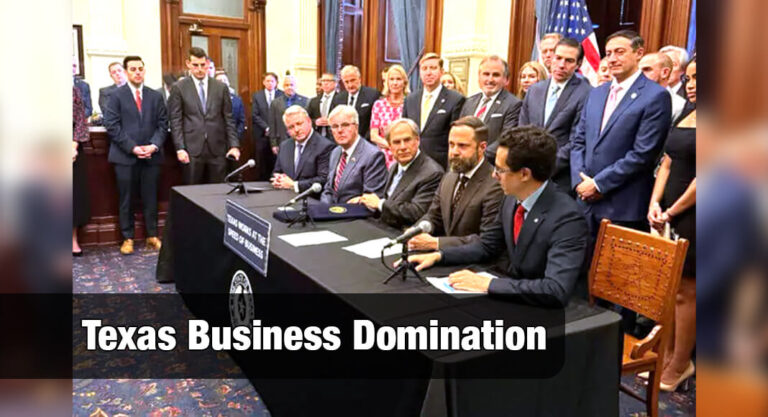
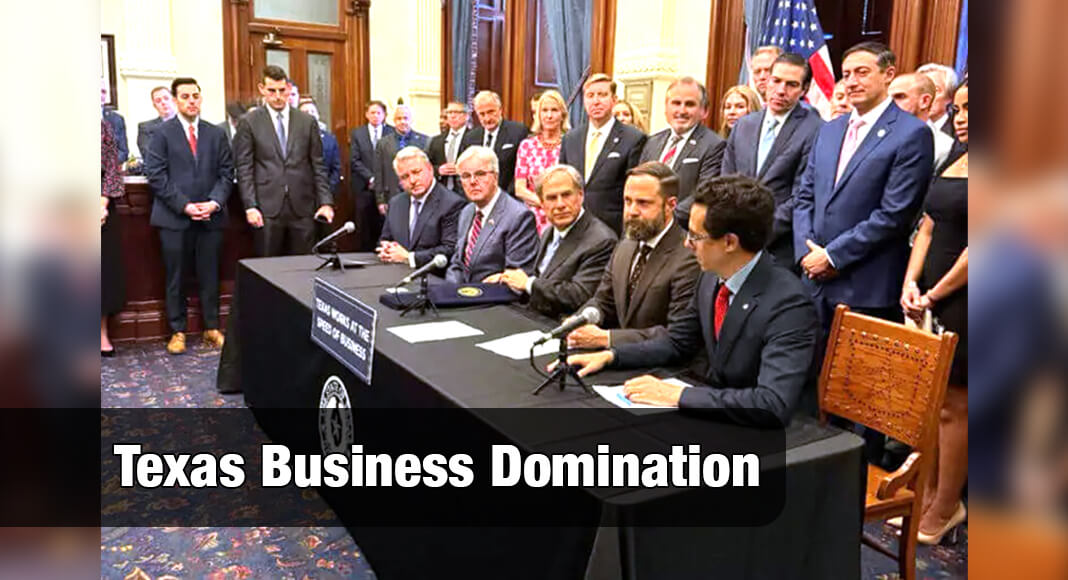
Texas Association of Business (TAB) CEO Glenn Hamer joined Governor Greg Abbott as he signed Senate Bill 29 – also known as “DExit” – to ensure Texas remains the unrivaled “Headquarters of Headquarters” by enhancing the state’s business courts system and solidifying Texas’ position as the leading state in the nation for business as many companies look to flee from the state of Delaware. Image courtesy of TAB

Texas Association of Business (TAB)

AUSTIN, Texas – Texas Association of Business (TAB) CEO Glenn Hamer joined Governor Greg Abbott as he signed Senate Bill 29 – also known as “DExit” – to ensure Texas remains the unrivaled “Headquarters of Headquarters” by enhancing the state’s business courts system and solidifying Texas’ position as the leading state in the nation for business as many companies look to flee from the state of Delaware.

At the invitation of Governor Abbott, Mr. Hamer made remarks at the signing ceremony, thanking Governor Abbott, Lt. Governor Patrick, House Speaker Burrows, Chairman Hughes and Chairman Meyer, for passing SB 29, providing business leaders with even greater confidence to make bold investment decisions in the best interest of their organizations, without fear of unnecessary and costly litigation:

“Senate Bill 29 is a game-changer for Texas businesses and our position as a global leader. This legislation will help further cement our position as the top state for business and will make Texas even more attractive for incorporation. SB 29 will bring new investment and jobs to remain the ‘Headquarters of Headquarters.’

“This bill sends a strong signal that Texas values efficient, fair, and predictable corporate governance by modernizing our corporate laws and codifying the business judgement rule. SB 29 further strengthens the legal protections for businesses and expedites the resolution of corporate disputes, among other pro-business provisions.

“We applaud Chairman Hughes, Chairman Meyer, Lt Governor Patrick, Speaker Burrows and Governor Abbott for their leadership and support. This bill is a major win for Texas.”

During the ceremony, Governor Abbott also signed SB 1058 into law, which will help support the establishment and operation of the Texas Stock Exchange (TXSE) – an important recognition that Texas has become a new epicenter for the financial services industry through the creation of the newest national stock exchange.

Additionally, HJR 4 – which will help further strengthen the TXSE – will be put before voters for approval as an amendment to the Texas Constitution during the upcoming November 5, 2025 Constitutional Amendment election.

Information source: Texas Association of Business (TAB)

Utilizing the Texas Beach Watch Program During 2025 Beach Season

Aerial footage of South Padre Island ahead of the 2025 Beach Season. Image courtesy of Texas GLO

AUSTIN, Texas – Texas Land Commissioner Dawn Buckingham, M.D., encourages Texans to utilize the General Land Office’s (GLO) Texas Beach Watch website during the 2025 Beach Season. As Texas residents and people from across the country plan their visits to the Texas coast for summer vacation, the GLO’s Beach Watch program continues to provide weekly updates on beach water quality.  

“As Texas Land Commissioner and as someone who grew up near the Texas coast and lived on Galveston Island for over a decade, I am committed to maintaining and safeguarding Texas beaches. A critical part of this effort is monitoring water quality for the well-being of beachgoers, coastal communities, and marine habitats,” said Commissioner Buckingham. “The Texas Beach Watch program is a vital resource Texans can use to stay informed as they visit our beaches this summer. The program’s outstanding water quality monitoring helps the GLO keep Texas beaches clean and informs visitors about the health of their favorite spots along the coast.” 

Click the button below to view water quality data for 172 sites along the Texas coast and sign up to receive weekly emails with water quality updates for your favorite beaches:

TBW WATER QUALITY DATA

The Texas Beach Watch network monitors water quality data and shares findings with beachgoers, agencies, and researchers. The program tests for Enterococcus bacteria, which indicates the presence of disease-causing organisms. Enterococcus bacteria originates from animals with hair, fur, or feathers. This bacteria is a natural part of coastal ecosystems but can also be correlated with rainfall and stormwater runoff.

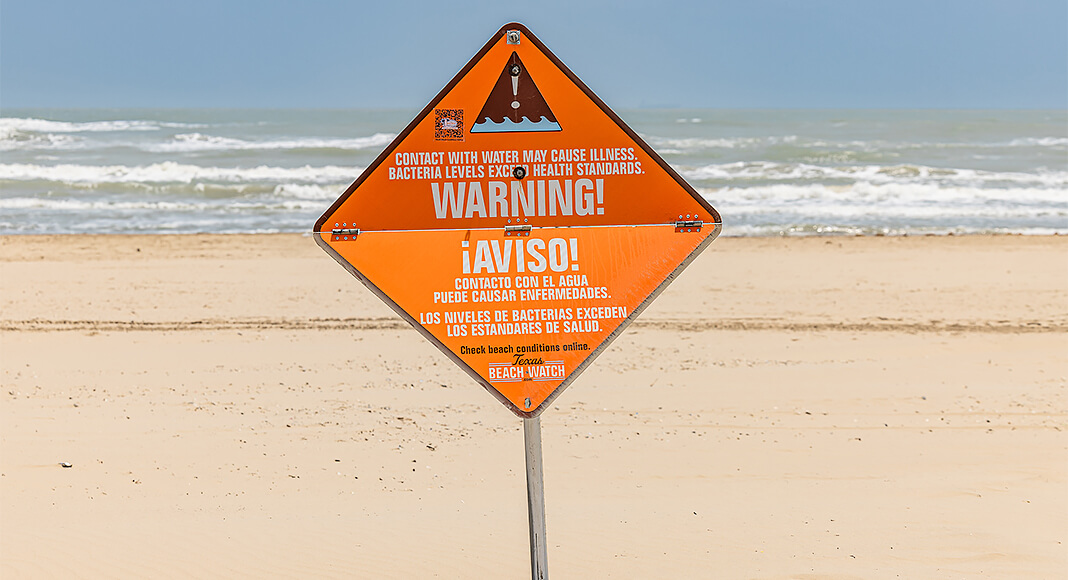
When a beach advisory has been issued, Texas Beach Watch (TBW) will post the advisory online and at the beach with this sign. Image courtesy of Texas GLO

A water quality advisory is issued when observed bacteria levels in the water indicate possible increased risks of illness. The GLO does not close beaches when a water quality advisory is in effect. Beach closures are issued by local authorities. In 2024, Texas Beach Watch collected 8,237 samples. Last year, 797 beach advisories, representing only 9% of all samples, were posted for the entire Texas coast. 

Texas Beach Watch urges all beach visitors to respect our beautiful beaches by picking up after pets, throwing trash into receptacles, and doing their part to take care of the Texas coast.

$989K Cocaine Seizure at Hidalgo International Bridge

Packages containing 74.07 pounds of cocaine seized by CBP officers at Hidalgo International Bridge. USCBP Image

HIDALGO, Texas—U.S. Customs and Border Protection, Office of Field Operations officers at the Hidalgo International Bridge this weekend intercepted $989,000 in alleged cocaine concealed within a vehicle. 

“Our frontline CBP officers continue to build on the steady enforcement activity from the previous week and intercepted yet another significant load of cocaine in a passenger vehicle,” said Port Director Carlos Rodriguez, Hidalgo/Pharr/Anzalduas Port of Entry. “These kinds of seizure underscore the reality of the drug threat and the importance of advancing our border security mission.”

On May 16, CBP officers at the Hidalgo International Bridge encountered a 2002 Ford Ranger driven by a 21-year-old male U.S. citizen entering the U.S. from Mexico. A CBP officer selected the vehicle for inspection, which included utilizing a nonintrusive inspection system and a canine team. Physical inspection led to the discovery of 28 packages of alleged cocaine with a combined weight of 74.07 pounds (33.60 kg) concealed within the vehicle. The cocaine has an estimated street value of $989,049.

CBP OFO seized the narcotics and vehicle. Homeland Security Investigations special agents arrested the driver and initiated a criminal investigation.

CBP Officers Seize $956k in Cocaine at Rio Grande City Port Of Entry

Packages containing 69.44 pounds of cocaine seized by CBP officers at Rio Grande City Port of Entry. USCBP image

RIO GRANDE CITY, Texas – U.S. Customs and Border Protection, Office of Field Operations officers at Rio Grande City Port of Entry this weekend seized more than $956,000 in cocaine in a single enforcement action. 

“This seizure illustrates the effective combination of CBP officer skill, experience and the utilization of all tools and resources, including our canines to zero in on hidden narcotics,” said Port Director Rogelio Olivares, Rio Grande City Port of Entry. “Seizures like these exemplify CBP’s commitment to advancing our border security mission while facilitating lawful trade and travel.” 

The seizure occurred on May 16 at the Rio Grande City International Bridge when a CBP officer referred a tractor-trailer for secondary inspection. CBP officers conducted a secondary examination that included utilization of a nonintrusive inspection system and CBP canines. Upon further physical examination, CBP officers discovered 31 packages containing a total of 69.44 pounds of alleged cocaine within the tractor. The narcotics had a street value of $956,070.

CBP turned the narcotics, tractor and trailer over to Starr County High Intensity Drug Trafficking Area officers who arrested the driver and initiated a criminal investigation.  

IDEA Public Schools Receives A- Credit Rating from S&P Global Ratings   

IDEA Public Schools is pleased to share that Standard & Poor’s Global Ratings (S&P) has affirmed our A- credit rating, highlighting our robust financial health and enduring creditworthiness. Image for illustration purposes

RIO GRANDE VALLEY, Texas  – IDEA Public Schools is pleased to share that Standard & Poor’s Global Ratings (S&P) has affirmed our A- credit rating, highlighting our robust financial health and enduring creditworthiness. We acknowledge S&P’s negative outlook, primarily influenced by the assignment of two Texas Education Agency conservators. We are actively collaborating with our conservators and anticipate exiting conservatorship no later than June 2026. This proactive approach underscores our commitment to transparency and sound governance in our ongoing efforts to strengthen our operational integrity and financial resilience.  

This independent rating reflects S&P’s confidence in IDEA’s fiscal management, operational strength, and ability to meet its financial commitments. Credit ratings like this are a critical tool for investors, lenders, and partners to assess risk and make informed decisions. The A- rating positions IDEA to secure favorable borrowing terms and maintain the financial flexibility needed to continue expanding access to high-quality public education across the communities it serves.  

“Our A- rating from S&P speaks to the stability of our financial model and our continued ability to deliver strong outcomes for students while managing resources responsibly,” said Kathleen Zimmermann, IDEA’s Chief Financial Officer. “It also reinforces the confidence that investors, donors, and community partners can place in IDEA as we pursue our mission to transform education by preparing graduates to succeed in college and life.”  

IDEA remains committed to transparency and strong fiscal stewardship as it strives to provide an excellent education and experience for its students and families. 

For more information on IDEA Public Schools visit ideapublicschools.org. 

Dean Senator Zaffirini’s First Bill of 89th Legislative Session Signed into Law

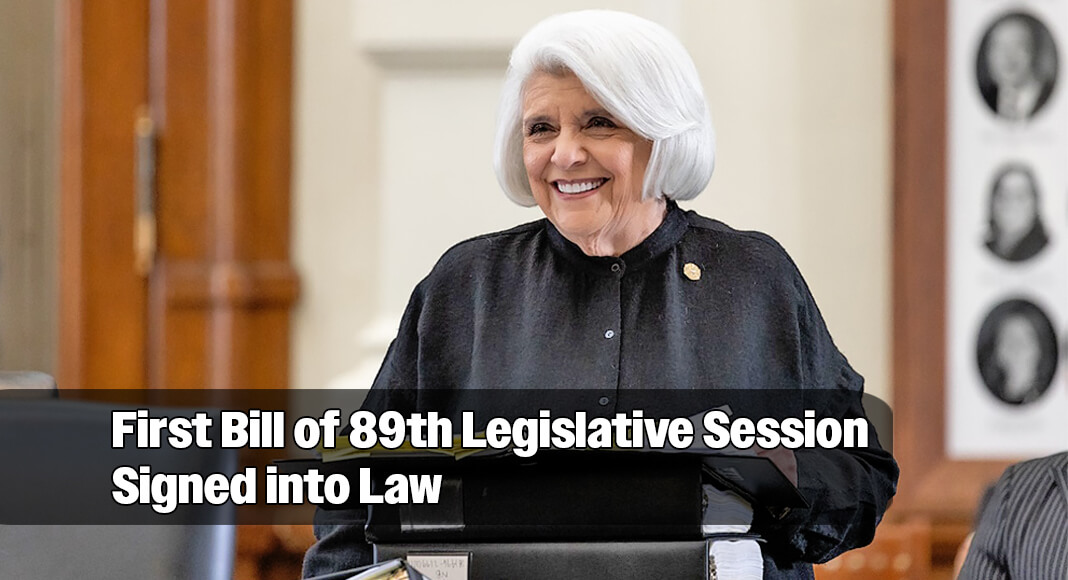
Dean Senator Judith Zaffirini prepares to consider legislation during the 89th Regular Session of the Texas Legislature. Photo Credit: Texas Senate Media Services

AUSTIN – Senate Bill (SB) 1697 by Dean Senator Judith Zaffirini, D-Laredo, became the first of her bills to be signed into law during the 89th Legislative Session after Gov. Greg Abbott approved it last Tuesday (May 13). The new law will help protect Texas consumers by requiring a best practices guide for those considering rooftop solar installations.

“This is a win for Texas consumers,” Dean Senator Zaffirini said. “My SB 1697 will ensure homeowners have the information they need to make informed decisions about residential solar energy.”

Under the new law the Public Utility Commission of Texas will be required to develop and maintain a standardized best practices guide for consumers considering rooftop solar installations. The guide must include questions to ask utility providers, technical and design considerations, financial factors like tax credits and maintenance costs and contact information for additional support. Electric providers must share the guide with their customers and make it easily accessible both online and through billing communications.

To read more about SB 1697, including the bill’s language, click here.

Dean Senator Zaffirini has passed 1,401 bills, more than any legislator in the history of the State of Texas. This session Lt. Gov. Dan Patrick appointed her to the Senate Committees on Business and Commerce; Finance; State Affairs; and Natural Resources, of which she is Vice Chair. She also is his appointee to the Texas Judicial Council and the Texas Access to Justice Commission.

The senator made history as the first woman Dean of the Senate on Dec. 31, 2023. She succeeds 24 men who held the title since 1909, when it was first assigned to the longest-serving senator. The seventh of only 25 women who have served with 954 male senators in 89 Texas Legislatures, she and Eddie Bernice Johnson joined Cyndi Krier in 1987, marking the first time more than one woman served in the 31-member body. Today there are eight women senators.