Stacks containing $177,500 in unreported currency seized by CBP officers at Hidalgo International Bridge. USCBP image
Texas Border Business
HIDALGO, Texas – U.S. Customs and Border Protection officers, conducting outbound examinations at the Hidalgo International Bridge, seized $177,500 in bulk, unreported U.S. currency.
“Our frontline CBP officers maintain strict vigilance whether they are conducting inbound or outbound examinations, and their attention to detail resulted in this significant currency seizure,” said Port Director Tater Ortiz, Brownsville Port of Entry. “Seizures of unreported bulk cash, often found to be proceeds of illicit activity, prevent profitmaking from such activity and help to secure our economy.”
The seizure took place on May 20 when CBP officers working at the Hidalgo International Bridge selected a 2011 Dodge for a routine outbound inspection. In secondary, CBP officers discovered five packages containing bulk U.S. currency totaling $177,500 hidden within the vehicle.
CBP officers seized the currency. Homeland Security Investigations special agents initiated a criminal investigation.
It is not a crime to carry more than $10,000, but it is a federal offense not to declare currency or monetary instruments totaling $10,000 or more to a CBP officer upon entry or exit from the U.S., or to conceal it with intent to evade reporting requirements. Failure to declare may result in seizure of the currency and/or arrest. An individual may petition for the return of currency seized by CBP officers, but the petitioner must prove that the source and intended use of the currency was legitimate.
Dr. Manish Singh walks the runway alongside Jennifer Ramirez, celebrating her remarkable transformation and the shared journey of patient and physician at DHR Health’s Bariatric Reunion and Fashion Show. Ramirez lost 167 pounds. Photo by Roberto Hugo González
Texas Border Business
By Roberto Hugo Gonzalez
On May 21, 2025, the DHR Health Bariatric and Metabolic Institute hosted a heartwarming reunion at the Edinburg Conference Center. The event brought together bariatric surgery patients, physicians, and supporters for an evening that celebrated the journeys of ten individuals who reclaimed their health through the institute’s comprehensive weight loss program. Part celebration, part fashion show, and wholly inspiring, the evening highlighted the lifelong support and community that DHR Health offers to its patients.
Ten former bariatric surgery patients took to the runway to share their stories and model new outfits by Macy’s, courtesy of DHR Health. Each patient walked the stage with a renewed sense of confidence, reflecting not only their physical transformations but also the mental and emotional growth that has defined their post-surgery journeys. Their stories were diverse, ranging from young adults fighting inherited health risks to parents hoping to live longer for their children and seasoned professionals discovering a new lease of life.
One of the evening’s first speakers, Juan Candanoza, recounted beginning his journey in 2022. Motivated by both physical and mental health challenges and a desire to be present for his family, Juan highlighted the unexpected gift of restored self-esteem and renewed energy. Others echoed this sentiment, including Minerva, who spoke candidly about a lifelong struggle with weight and the newfound joy she experiences through fitness and personal growth.
On May 21, 2025, Fort Brown Station agents encountered and arrested Jose Guadalupe Perez-Garza, a 53-year-old Mexican national, near Brownsville, Texas. Image for illustration purposes
Texas Border Business
EDINBURG, Texas – U.S. Border Patrol agents assigned to the Fort Brown Station apprehended a previously deported sex offender early Wednesday morning.
On May 21, 2025, Fort Brown Station agents encountered and arrested Jose Guadalupe Perez-Garza, a 53-year-old Mexican national, near Brownsville, Texas.
During processing at the Fort Brown Station, record checks revealed that Perez-Garza has an extensive criminal history in the United States, including a felony conviction for Aggravated Sexual Assault of a Child from the 197th District Court of Cameron County, Texas, for which he was sentenced to 10 years confinement in 2013.
Records also indicate that Perez-Garza has been previously removed from the United States on four separate occasions, most recently in January 2025 after serving 41 months in federal prison after being convicted in June of 2022 for illegally re-entering the U.S after having been previously removed (8 USC 1326).
“This arrest highlights the importance of our border security mission,” Gloria Chavez, Chief Patrol Agent of the Rio Grande Valley Sector. “Our agents remain vigilant in their efforts to prevent dangerous criminals from entering our communities.”
Perez-Garza has been referred for prosecution for illegal re-entry after deportation, a felony under Title 8 of the U.S. Code.
Two Corpus Christi residents have been ordered to federal prison for conspiracy to possess with intent to distribute methamphetamine and heroin. Image for illustration purposes
Texas Border Business
U.S. Attorney’s Office, Southern District of Texas
CORPUS CHRISTI, Texas – Two Corpus Christi residents have been ordered to federal prison for conspiracy to possess with intent to distribute methamphetamine and heroin.
Jesse Martinez, 51, and Gabriel Galindo, 46, both long-time Texas Syndicate gang members, pleaded guilty Jan. 2.
U.S. District Judge David S. Morales has ordered Martinez to serve 360 months, while Galindo was ordered to serve a 288-month-term of imprisonment. Both must also serve five years of supervised release following their sentences.
The court held Martinez responsible for over two kilograms of heroin and almost eight kilograms of methamphetamine. Galindo was held responsible for almost 10 kilograms of methamphetamine and over a kilogram of heroin. However, the court heard that throughout the investigation, authorities calculated that the Texas Syndicate drug trafficking organization was likely distributing approximately two kilograms of heroin and two kilograms of methamphetamine per month from September 2020 to May 2024.
The court also considered their criminal histories including convictions for theft, burglary, weapons and drug charges for Martinez. Galindo’s criminal history began at the age of 14 and includes burglary of a habitation, multiple cocaine convictions – with a federal conviction for possession with intent to distribute – and possessing a stabbing weapon while incarcerated.
Furthermore, the court heard Galindo was found with a shank, methamphetamine and suboxone strips while incarcerated for this offense and that he was dealing suboxone to other inmates.
The investigation began in 2020 when law enforcement was looking into the drug trafficking activities of the Texas Syndicate. They discovered Martinez was receiving kilogram amounts of methamphetamine and heroin. Galindo was one of his top distributors in the Corpus Christi area.
On May 21, 2024, law enforcement executed a search warrant on Martinez’s residence and found he was in possession of cocaine, heroin, methamphetamine, marijuana and synthetic marijuana as well as three unsecured firearms. Several children were also living in the home.
Galindo was also found in possession of almost a kilogram of methamphetamine, a kilogram of heroin and four firearms at the time of his arrest.
Both men have been and will remain in custody pending transfer to a Federal Bureau of Prisons facility to be determined in the near future.
The Drug Enforcement Administration, FBI and Bureau of Alcohol, Tobacco, Firearms and Explosives conducted the Organized Crime Drug Enforcement Task Forces (OCDETF) operation with the assistance of Immigration and Customs Enforcement – Homeland Security Investigations, U.S. Marshals Service and police departments in Corpus Christi and Robstown. OCDETF identifies, disrupts and dismantles the highest-level drug traffickers, money launderers, gangs and transnational criminal organizations that threaten the United States by using a prosecutor-led, intelligence-driven, multi-agency approach that leverages the strengths of federal, state and local law enforcement agencies against criminal networks. Additional information about the OCDETF Program can be found on the Department of Justice’s OCDETF webpage.
Assistant U.S. Attorneys Barbara J. De Pena and Brittany Jensen prosecuted the case.
The sorghum crop is at different stages of growth across Texas, with the Rio Grande Valley nearing harvest and the Panhandle finishing planting. (Photo: Laura McKenzie/Texas A&M AgriLife)
For much of the sorghum-growing regions of the state, the arrival of rain and the amount that fell have dictated this year’s outlook, according to a Texas A&M AgriLife Extension Service expert.
Ronnie Schnell, Ph.D., AgriLife Extension statewide cropping systems agronomist and associate professor in the Texas A&M Department of Soil and Crop Sciences, Bryan-College Station, said there is a wide range of growth stages and growing conditions across the state as the Rio Grande Valley prepares to begin harvesting sorghum and the Panhandle finishes planting.
“Going into the season, the weather was not good with conditions being very dry across most of the state, and then the prices also were not good,” Schnell said. “We are hoping to get some rain to make good yields and get through this season.”
Market outlook
Mark Welch, Ph.D., AgriLife Extension economist-grain marketing and policy and professor in the Department of Agricultural Economics, Bryan-College Station, said the 2024 marketing year is wrapping up with sorghum exports basically shut off to China due to tariffs and trade disputes. That disruption is limiting commodity movement and pushing the basis — the difference between the local cash price of grain and the futures price — lower.
“The basis is really what we talk about with sorghum because the price relative to corn is in a more negative position when we have limited export potential,” Welch said. “We see a situation of that export potential being cut off in the current environment.”
However, the U.S. Department of Agriculture in the World Agricultural Supply and Demand Estimates report for sorghum in May shows a strong rebound in sorghum export sales. That would be good news if that comes about for the 2025 sorghum crop, Welch said.
USDA’s prediction of sorghum production is expected to be higher in acreage and average yield in 2025, which means higher supplies. This will mean the export category of the market will be essential as the crop year moves forward.
Conditions around the state
Prices aren’t the only thing out of producers’ control. Schnell said while early growing conditions are shaping up nicely in some areas, timely rainfall will determine outcomes for many farmers.
Sorghum is more drought-tolerant than some other warm-season crops, Schnell said, and, for the most part, is progressing despite dry conditions to begin the season around much of the state.
While sorghum acres in the San Antonio region and south are very dry, in the bigger production zones around Corpus Christi, most stands look good after receiving timely rain, Schnell said.
The Rio Grande Valley is seeing mixed progress in sorghum stands, depending on planting dates. Without irrigation water this year, many fields did not establish until the region received heavy rainfall in March. Some producers planted fields immediately after the rain. So, while harvest typically starts in June, it will be delayed for many fields this year, he said.
Producers in Central Texas planted fewer sorghum acres this year, but what is there looks to be in fair condition, Schnell said. Near San Angelo, fields picked up some rain, and the crop is coming along, but most areas needed more rain.
In Northeast Texas, they have the opposite problem of most areas.
“If you move into the Hillsboro area and north and east of Dallas, there are areas where we’ve had a little too much rain, and the crop is a little stunted,” he said.
Some of this area saw some yellowing of the sorghum because the plants were standing in the water too long, Schnell said. But sorghum is resilient; once the soil dries down, the crop will grow again.
The South Plains and Rolling Plains crops are just coming up but have received some timely rains that will help production.
Overall, sorghum acreage is expected to be steady to slightly up, depending on how much is planted for grain sorghum and sorghum silage up in the Panhandle, he said. Planting is just getting underway in that region.
Insect damage could be a problem
Danielle Sekula, AgriLife Extension integrated pest management agent in Weslaco, said the historic rainfall that fell in deep South Texas and the Rio Grande Valley in March is resulting in a lot of late sorghum that is more prone to insect attacks.
“We have a lot of sorghum at the soft dough stage right now and it’s been hit by every pest,” Sekula said. “We are finding a high number of rice stinkbugs, along with midge and sugarcane aphids. These producers, though, are treating them and with the timely rains, the crop is looking very good if they can control the pests going forward.”
In Central Texas, Schnell said the crop is a week or two away from flowering, so, they haven’t started seeing any sorghum aphids yet. However, in the Corpus Christi region and south, they have started seeing them.
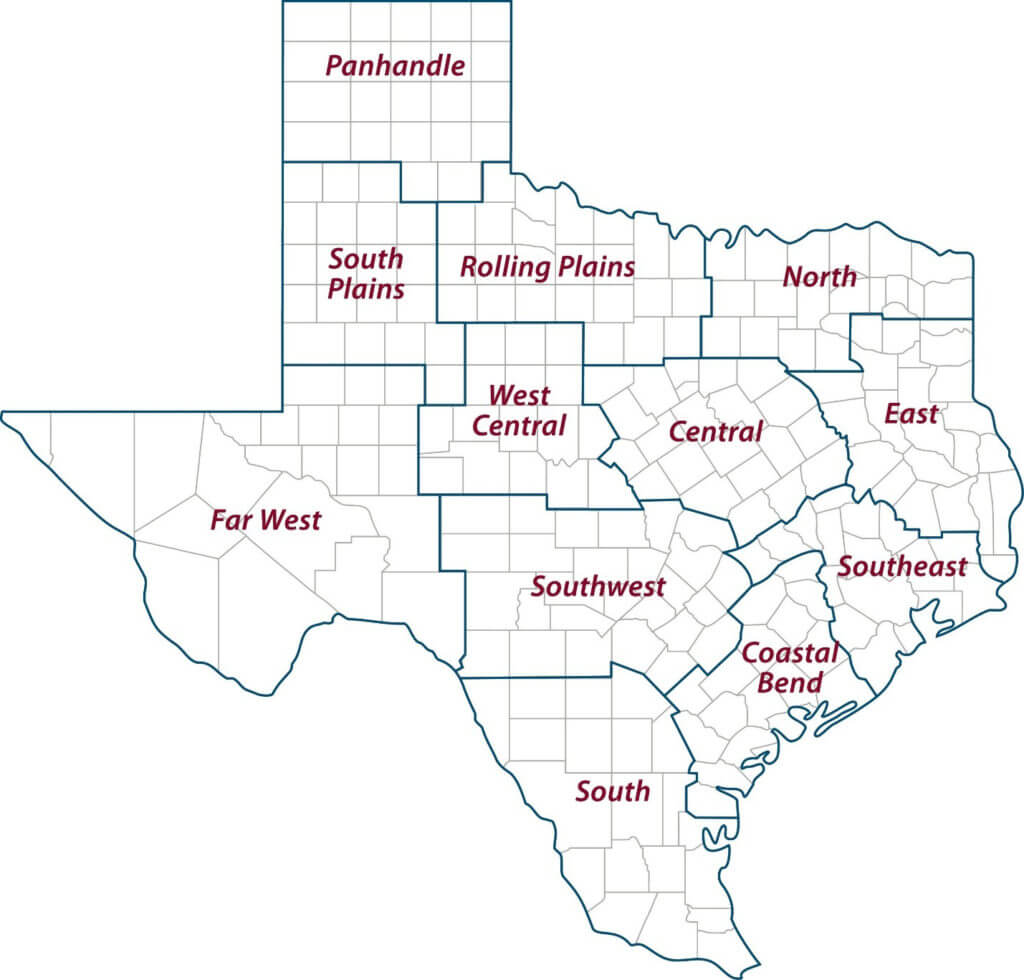
AgriLife Extension district reporters compiled the following summaries:
A map of the 12 Texas A&M AgriLife Extension Service districts.
Central
The recent weather varied across the district with intermittent rain followed by warmer temperatures and occasional severe storms, including hail. Soil moisture levels were generally good, though some areas reported drying conditions with above-normal temperatures setting daily records. Pastures and grasslands were growing well, keeping livestock in mostly good condition, though some producers continued supplemental feeding. Hay cutting began with promising results. Wheat and oat harvests got underway as fields dried, with good yields reported in some areas. Corn progressed nicely and began to tassel and benefit from the heat, while sorghum started heading. Cotton planting finished in some areas and was just beginning in others, with growth somewhat slower due to cooler temperatures and high thrips populations. Stock tanks were full in some counties but concerningly low in others. Producers were monitoring conditions closely as drought concerns persisted in certain areas.
Rolling Plains
The previous week’s rains benefited conditions across the district. Native grass pastures were in excellent shape, and livestock drinking sources remained filled. With the weather drying and warming up, farmers took advantage and prepared for upcoming hay and cotton planting. There were scattered reports of expanded wild hog activity, as well as noted increases in grasshopper and mosquito populations. Wheat harvest was expected to start soon with favorable yield projections.
Coastal Bend
The district experienced hot, dry conditions throughout the week, though overcast skies helped limit crop stress. Soil moisture conditions continued to decline with unseasonably warm temperatures and strong south winds. In some places, conditions dried faster than expected. Corn stands looked promising for a good harvest, and some late-planted sorghum was heading, but more moisture was needed. Cotton was growing and looked good but needed additional rain for good yields. Warm-season forages were starting to grow, and cool-season grasses were mostly dormant. Range and pasture conditions were good, and herbicide applications were being made in pastures as wind allowed. Haying was beginning to pick up with round bales showing up and more hay being laid down. Livestock continued to find good quality forage. Cattle body condition scores were improving.
East
Many counties continued to receive rainfall. Subsoil and topsoil conditions were adequate. While some areas were very wet, others remained dry and in need of rainfall. The weather has been unseasonably warm for late spring as well. Producers started cutting ryegrass to make way for warm-season forages. Growing conditions for most of the region were ideal. Pasture and rangeland conditions were good. Cattle markets remained strong, with some producers contemplating reducing herd size with the high market prices. Fire ant and wild pig control was underway. Gnats and flies were becoming an increasing nuisance.
Southeast
Rainfall played a crucial role in determining crop health, pasture quality and fieldwork progress. Corn in some areas appeared stunted due to early heavy rains, while other areas started drying out. Hot, dry and windy conditions stressed corn and late planted cotton. Producers saw boosted forage growth and improved pasture conditions and began or continued their first hay cuttings. Livestock conditions started to improve. Rain was needed for better forage production in some areas. Saturated conditions delayed fieldwork and rice planting in some areas while other areas remained dry. Excessive moisture prevented herbicide applications and hay harvesting and forced some producers to graze cattle on hay fields. Soil moisture levels were short to surplus. Corn progress was strong, sorghum was planted and some fields had headed out, while planted rice emerged. Winter wheat was 100% headed, and cotton and soybeans were planted and emerged.
South Plains
Soil conditions declined rapidly due to high winds and hot temperatures, making corn and cotton planting challenging. Locations with adequate moisture at the beginning of the week were dry-planted by the end of the week; the need for rain was high. Cotton, corn and sorghum were being planted, and irrigation was being turned on. Early planted corn and sorghum looked good. Wheat for grain was either being harvested or sprayed for harvest in the next month. Wheat silage was being cut. Forage fields were being cut for hay. Weeds were coming on strong in many places. Producers were using pre-emergent spraying applications to combat weeds. Potatoes had emerged and were growing.
Panhandle
The recent rains allowed growers to take advantage of improved soil moisture conditions to plant warm-season crops. Cotton planting began; sorghum planting was expected to get underway soon. Wheat and other small grain crops continued to mature and fill developing kernels. Silage harvesting continued to ramp up on the first cutting of the season for alfalfa and early planted wheat fields that reached or were nearing ideal growth stages for maximum feed value. Rangelands improved daily due to rain and temperatures. Overall, soil moisture levels were short to adequate, pasture and range conditions were fair to good and crops were fair to good.
North
Topsoil and subsoil were short to adequate. Pasture and range conditions were fair to good. Some damaging storms and scattered showers occurred, with some areas receiving up to 2 inches of rainfall. Wheat, oats, corn, sorghum and Sudan grass crops looked good; most wheat had turned color or was close to turning. Grazing pastures were transitioning from ryegrass and other cool-season forages to summer forages. Many hay pastures with cool- and warm-season grass mixes were cut, raked or baled before the rainfall. Harvest season for blackberries, squash and tomatoes began. Potato planting will start soon, and winter vegetable harvests were coming to a close. Feral hogs remained active across the district. Livestock were in excellent condition. Nuisance fly populations were high, and mosquitoes were increasing rapidly.
Far West
Extreme heat occurred with daily temperatures soaring above 95 degrees and one day exceeding 100 degrees. Temperatures were significantly higher than the seasonal average of 86 degrees. With rainfall becoming increasingly critical, widespread soaking rain was needed to improve planting conditions and to support crops and grazing lands. Persistent high winds accelerated the soil moisture loss from previous rains. Winter wheat has largely been bailed for hay or plowed under. While a few growers began planting cotton on well-irrigated fields with sufficient moisture, many were waiting for rain or relying on irrigation to prepare their fields. Dryland planting remained unlikely without substantial rainfall, and sustaining crops through the summer would require multiple heavy rains. Corn and sorghum responded well to the heat, with no reported insect pressure. Melons were beginning to vine out, though bird activity caused some damage. Pasture and grazingland conditions continued to decline, and producers continued feeding livestock.
West Central
Some areas received rain over the weekend, while most locations stayed dry. Hot and dry conditions persisted. Thunderstorms brought high winds with some hail, but the moisture helped pastures, cotton planting and grain sorghum. Warm-season forage growth slowed due to hot, dry days. Some fields were planted in sorghum and forage Sudan. Wheat harvest was expected to begin soon, although many wheat and oat fields were grazed out. Coastal Bermuda grass and hay grazer looked good, but more rain was needed as subsoil moisture levels remained low from extended drought. Weed control was ongoing. Range and pastures were in good condition where rain was received but dry in other parts. Livestock remained in good condition where the early May rains fell, and stock tanks and low spots in creeks were full. However, the rains were followed by 100-degree days and the soil moisture depleted fast. Drier pastures offered little grazing and livestock were being supplemented.
Southwest
Topsoil dried out due to the high temperatures, though subsoil moisture remained adequate from recent rainfall. Hot and dry conditions continued. High temperatures reached over 100-degrees during the week, with no precipitation. Row crops looked good but needed another rain soon. Irrigated crops looked strong, and all cotton was planted. Vegetable gardens were doing well. Livestock performance was expected to dip due to reduced grazing and animals seeking shade. Livestock markets were high to steady. Some producers began cutting perennial grass patches. If conditions remain the same, hay grazer cutting was expected to begin soon. Some producers were trying to balance available grazing and stocking rates by selling calves slightly lighter than usual. Producers were still heavily supplementing feed for both livestock and wildlife. Overall, livestock body condition scores remained marginal. Whitetail deer were beginning to drop fawns.
South
Conditions were hot, dry and humid, typical for this time of year. In some areas with lighter and rocky soils, the vegetation was already drying out and turning brown. A strong line of thunderstorms produced some much-needed rain — 2-5 inches – in some areas, but some hail and straight-line winds up to 115 mph accompanied the storm. Trees and structures were severely damaged by the wind. Approximately 2,500 acres of row crops were damaged by the wind and hail. The rainfall increased local stock tank levels. Hay harvest was underway. Strawberry production slowed, with some fruit still being harvested in low numbers. Row crops continued to progress well, benefiting from good soil moisture. Winter wheat and onions were being harvested. Cotton was in the full bloom stage. Cotton fleahoppers were above threshold levels, and farmers were advised to spray. There was high rice stink bug pressure in grain sorghum in the soft dough stage. Midge was present in flowering sorghum, and sugarcane aphids were building up. In sesame fields, there appeared to be beet armyworm pressure and some thrips. Approximately 80% of the corn was in the dent stage and is now past the critical stages for insects. Citrus orchards were being irrigated and treated for pests. Most pastures were still in fair condition but starting to stress due to the heat and high winds. Some pastures were in excellent condition; wildlife and cattle were thriving. Cattle prices remained high as supplies remained low. Livestock were in fair to good condition, but ranchers and deer breeders were still supplementing feed.
A 39-year-old Mexican national who illegally resided in McAllen has been sentenced for conspiracy to distribute cocaine and possession with intent to distribute it. Image for illustration purposes
Texas Border Business
U.S. Attorney’s Office, Southern District of Texas
McALLEN, Texas – A 39-year-old Mexican national who illegally resided in McAllen has been sentenced for conspiracy to distribute cocaine and possession with intent to distribute it.
Chief U.S. District Judge Randy Crane has now ordered Marin-Hebert to serve 36 months in federal prison. Not a U.S. citizen, Marin-Herbert is expected to face removal proceedings following his imprisonment.
On Aug. 14, 2024, law enforcement conducted surveillance on Marin-Hebert and observed him making hand-to-hand exchanges around McAllen with his children in the vehicle. They conducted a traffic stop, at which time he threw a box containing cocaine in a ditch in an attempt to avoid detection. Authorities found multiple individually-wrapped baggies of cocaine in the box.
They subsequently conducted a search of his home and also discovered additional baggies of cocaine, drug scales, drug paraphernalia, two firearms and over $12,000 in cash.
At the time of his arrest, Marin-Hebert admitted he sold cocaine for a living.
He has been and will remain in custody pending transfer to a Federal Bureau of Prisons facility to be determined in the near future.
Immigration and Customs Enforcement – Homeland Security Investigations conducted the investigation with the assistance of Hidalgo County Precinct 4 Constable’s Office. Assistant U.S. Attorney Amanda McColgan prosecuted the case.
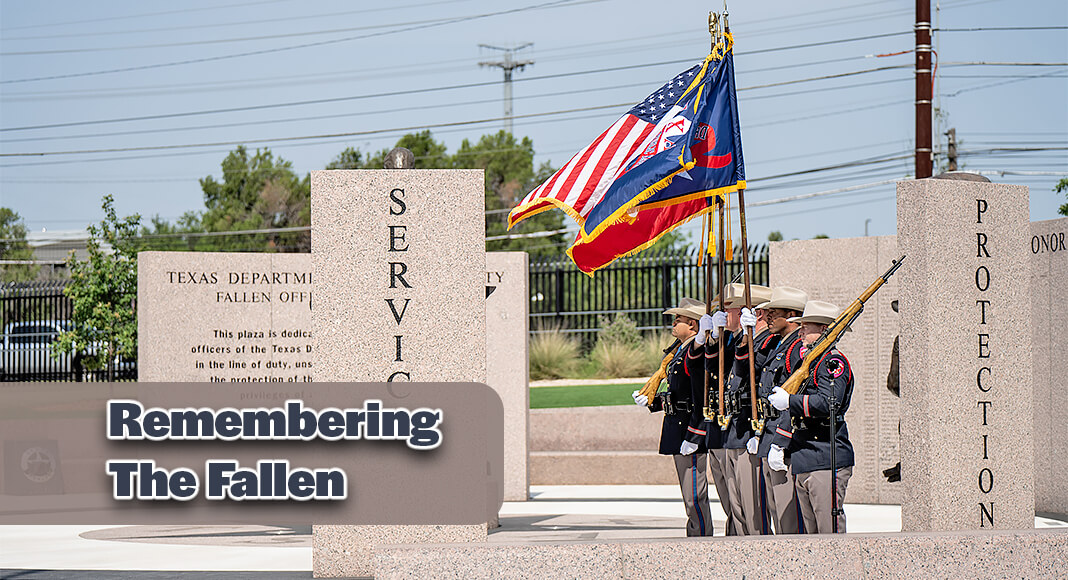
Held at the DPS Fallen Officers Memorial, the service was only the second to take place in front of the Texas pink granite and bronze monument, which was dedicated last year. Photo: Texas DPS
Texas Border Business
AUSTIN – The Texas Department of Public Safety (DPS) today honored the legacy of DPS officers and non-commissioned employees who lost their lives in the line of duty at this year’s annual Peace Officers Memorial Service in Austin. Held at the DPS Fallen Officers Memorial, the service was only the second to take place in front of the Texas pink granite and bronze monument, which was dedicated last year.
Members of the Public Safety Commission (PSC) and DPS Colonel Freeman F. Martin were joined at this year’s service by special guest speaker Texas Governor Greg Abbott, the family of fallen Trooper Kevin Ramirez Vasquez and family members of fallen officers.
“In communities across our state, DPS Troopers perform an often thankless duty,” said Governor Abbott. “They do it with a badge on their chest and a pledge in their heart to protect and serve. In Texas, we recognize the weight of that calling and the price that some are asked to pay. That is why we honor our fallen peace officers, who gave their lives so that others might live in safety and peace.”
“As Texans, we are so fortunate to know that when we walk out the door each morning, there are DPS personnel across this state working to keep us safe,” said PSC Chairman Steven P. Mach. “Whether it be a DPS Trooper out on patrol, a Texas Ranger putting on the badge or a DPS Pilot preparing for takeoff, these men and women risk their lives every day for the sake of ours. It is truly a special moment to be at this year’s Peace Officers Memorial Service as we take the time to honor those who have made the ultimate sacrifice in service to Texas.”
DPS Colonel Freeman F. Martin and Texas Governor Greg Abbott. Photo: Texas DPS
“The Peace Officers Memorial Service is a critical reminder of why we, as DPS officers, wear the badge, why we train the way we do, why we must always be at the top of our game and how tomorrow is never promised,” said Colonel Martin. “Not only do we honor the fallen at today’s service, but we thank their families for all they sacrificed along the way—and we remind them that their heroes will never be forgotten.”
Photo: Texas DPS
One of the main features of DPS’ Fallen Officers Memorial is a large panel showcasing DPS’ Wall of Honor. The panel highlights all 243 names of DPS personnel who have died while serving their fellow Texans since the early 19th Century.
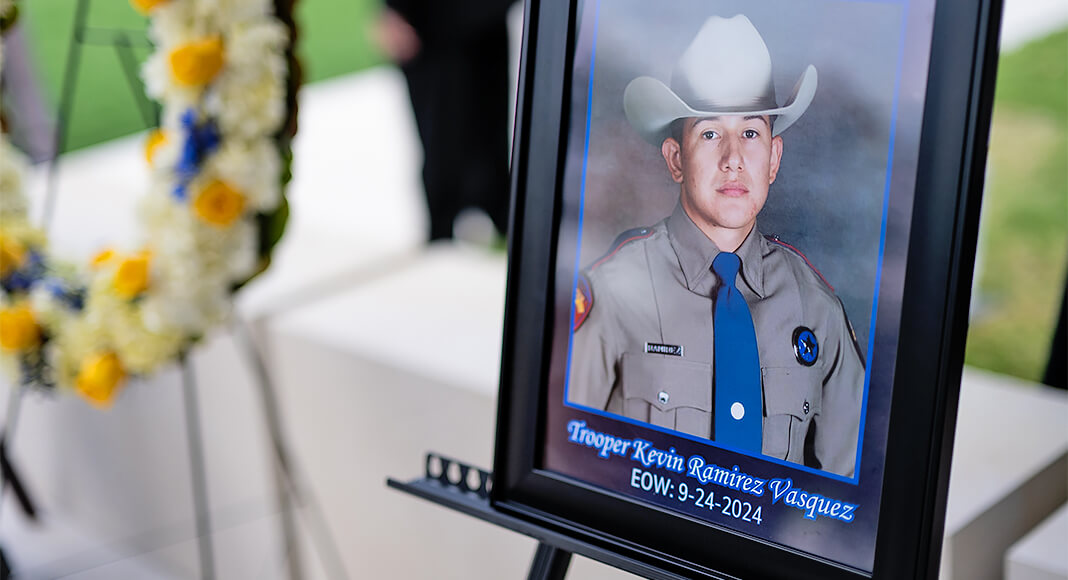
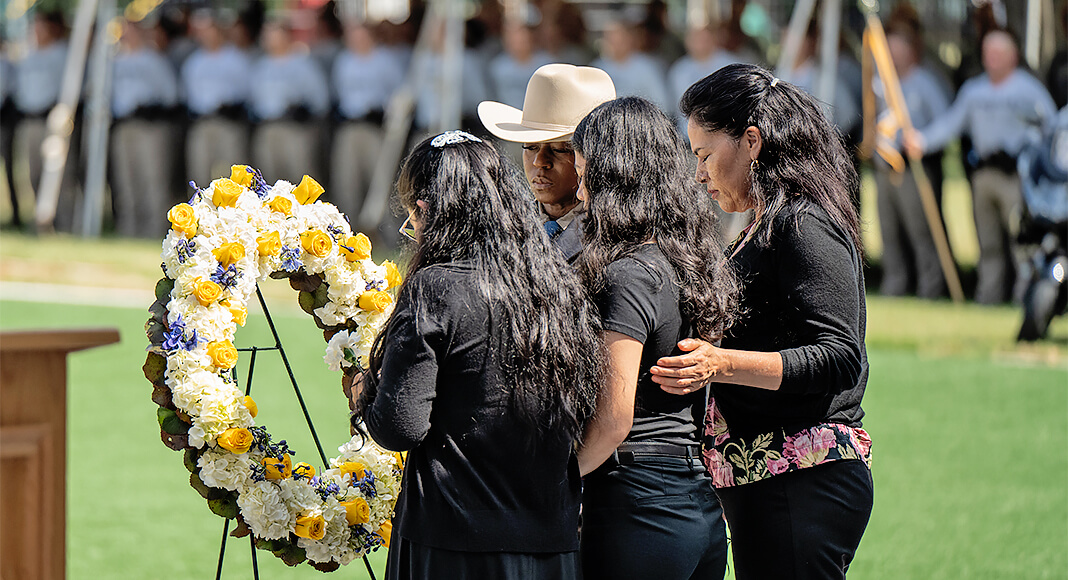
In the last year, Trooper Kevin RamirezVasquez’s name was added to the Wall of Honor. On Sept. 17, 2024, Trooper Ramirez Vasquez, 25, was struck by a vehicle while investigating a traffic crash along SH 203 in Ector County. The young Trooper succumbed to his injuries on Sept. 24, 2024. Trooper Ramirez Vasquez was the 241st DPS officer to die in the line of duty. Surviving members of Trooper Ramirez Vasquez’s family honored his life and legacy of service during a special wreath-laying ceremony today.You can find a list of fallen DPS officers since 1823, when the agency first began as the Texas Rangers, here.
Summer camps begin June 8 as campers from across the state are invited for the first week of overnight camp. Spots are still open for overnight camps. Day Camp is also open for registration. Image courtesy of IDEA Public Schools
Texas Border Business
Adventure is back and bigger than ever at Camp RIO, as the award-winning outdoor camp celebrates 10 years of unforgettable summer memories. This year’s camp activities kick off on Sunday, June 8 and will be open to children ages 5-14. To celebrate Camp RIO’s 10-year anniversary, each camp week will have a different decade theme.
Camp Rio. Image courtesy of IDEA Public Schools
Located on the historic Lula Sams property in Brownsville, Texas, Camp RIO has become a South Texas summer tradition known for immersive, nature-based programming. Activities include archery, canoeing, arts and crafts, team building, sports, and swimming.
Camp Rio. Image courtesy of IDEA Public Schools
“Camp RIO provides a safe and exciting learning environment for kids where they can grow, thrive, and discover their potential,” said Camp RIO Director Nancy Mance. “As we celebrate our 10th anniversary, we’re proud of the impact Camp RIO has made on thousands of campers and their families over the last decade.”
Camp Rio. Image courtesy of IDEA Public Schools
Summer camps begin June 8 as campers from across the state are invited for the first week of overnight camp. Spots are still open for overnight camps. Day Camp is also open for registration. Dates for day or overnight camps are June 8-28, and July 6-26 for one-week sessions. Mini Overnight camp is available to those wanting to try it out for a shorter time. The program is open to all children between the age of 5-14 years.
Camp RIO staff have a passion for the outdoors. The vision is to provide a quality camp experience for people in the Rio Grande Valley. Camp RIO offers a wide range of activities at the historic Lula Sams property in Brownsville, Texas, operating outdoor education and day camp programs since 2015. Camp RIO is proudly Accredited by the American Camp Association. Camp RIO is the only camp of this kind in South Texas.
Dr. Esmeralda Adame. Photo by Roberto Hugo González
Texas Border Business
By Roberto Hugo González
The Be the Change Leadership Conference, now in its fourth year, stands as a compelling example of one leader’s vision to transform a generation. Dr. Esmeralda Adame, founder of the Persistence in Adversity Foundation, is the driving force behind the initiative, known for her resilience, relentless spirit, and unique approach to community leadership. Recognizing a gap in leadership and life skills among young people, she established the conference to inspire positive change.
“I saw the necessity in our younger generations,” said Dr. Adame. “Too many were graduating without knowing how to lead, how to communicate, or how to empathize. I needed to be the change I wanted to see—not just in my circle, but in my community and the world.”
Since its inception, the conference’s mission has remained focused: to plant seeds of leadership that grow into impactful individuals. This year, Skill Spark sessions were introduced as workshops that teach life skills, such as CPR, writing checks, tying ties, and business basics, offering practical knowledge often missing from classrooms.
“We hope that these seeds grow into game-changers,” she explained. “We want to build professionals who turn around and plant more seeds in the generations that follow.”
Attendees, including students and community leaders, consistently report feeling more confident and motivated. “We are teaching them that the barriers they see are not walls—they’re challenges that can be broken down with the right mindset, with grit, and with community behind you,” Dr. Adame said.
As a nonprofit, funding is the greatest challenge. But the mission draws in support. “The hardest part is always the budget,” she said. “But once speakers understand our mission, they’re all in. They know they’re not just attending a conference—they’re planting seeds that may one day grow into leaders who change the world.”
This year’s theme—empowerment and resilience—was selected to reflect the strength needed in today’s youth. “We can’t just cheer them on. We need to hand them the map, show them the way, and give them the tools. Empowerment without resources is a disservice,” she said.
A conference highlight was the “Legacy of Inspiration Award,” given this year to José Francisco Ochoa, affectionately known as Don Pancho. “To me, legacy is an inheritance of wisdom,” Dr. Adame reflected. “Mr. Ochoa has been that example—always ready, always giving, and always inspiring.”
Her leadership philosophy is deeply tied to the foundation’s name: Persistence in Adversity. “I believe in planting seeds of hope, encouragement, and ganas,” she said. “Because one day, those same seeds can grow into a forest of change-makers.”
For young leaders who don’t know where to start, Dr. Adame offers this advice: “Find a mentor, observe good leadership, volunteer, and commit to being incredibly awesome. Start where you are. You don’t need to be perfect—you need ganas and a willingness to serve. If you can be the light for one person, you’ve already started changing the world.”
“To be the change means to be the example,” she added. “It means breaking the cycle of ‘that’s just how it is’ and daring to build something better. It means investing in others because someone once—or maybe never—invested in you.”
Looking ahead, Dr. Adame sees exponential growth. “In five years, I see us impacting ten times more people,” she said. “The seeds we’ve planted are already growing. Now we need to keep watering them with empathy, leadership, and love.”
The foundation’s work continues year-round. The #spreadthewarmthRGV blanket drive has collected over 8,000 blankets for families across the Rio Grande Valley. “There are no breaks when it comes to service,” Dr. Adame affirmed. “There’s too much to be done. We need more people willing to do it.”
As the foundation prepares for its sixth year, the call to action remains: join the movement, be the change, and help shape the next generation of leaders.
As Dr. Adame often reminds those around her:
“If you don’t live to serve, you don’t serve to lead.”
The Pharr City Commission, in partnership with IT Director Jose Peña, proudly recognized ten outstanding PSJA ISD students: Jesus Alejandro Serna, Gavin Trevino, Hector A. Arriaga, Miguel Mendez, Jose Cantu, Miguel A. Aviles, Diego Naranjo, Orlando Robles, Yan Lucka Barajas, and Damian Rivera, who completed the Methodist Healthcare Ministries Grant Internship Program. Image courtesy of The City of Pharr
Texas Border Business
The Pharr City Commission, in partnership with IT Director Jose Peña, proudly recognized ten outstanding PSJA ISD students: Jesus Alejandro Serna, Gavin Trevino, Hector A. Arriaga, Miguel Mendez, Jose Cantu, Miguel A. Aviles, Diego Naranjo, Orlando Robles, Yan Lucka Barajas, and Damian Rivera, who completed the Methodist Healthcare Ministries Grant Internship Program.
Funded by Methodist Healthcare Ministries of South Texas, Inc., the internship program is part of a regional effort to empower students through education and career-readiness. The grant supports paid internships, hands-on training, and certification opportunities that prepare students for high-demand fields, specifically in cybersecurity and digital technology. During the special presentation, each student was awarded a certificate of completion in honor of their hard work and commitment. “This year, we were able to expand the program. These students are paid interns and are also part of the cybersecurity certificate program at South Texas College,” said Peña. “They were trained as Digital Navigators and in digital literacy—we are incredibly proud of what they’ve accomplished,” he added. PSJA ISD’s Belinda Vargas expressed her appreciation for the collaboration with the City of Pharr. “Thank you to city leadership for partnering with us. Our students gain real-world experience, and we’re grateful for the opportunity to be part of this,” she said.
Three students received special recognition for their exceptional hours of service: Hector Arriaga – 863 hours, Miguel Mendez – 807 hours and Josue Serna – 786 hours. “This is the first program of its kind—not just in Pharr, but across the region and state,” said Assistant City Manager Cindy Garza Reyes. “Our goal is to create educational pathways for our students. This program is a model for what we can achieve when we work together to support education and workforce development.” The City of Pharr is proud to celebrate these student interns, who have not only excelled in their high school coursework, but also earned college credits, certifications, and valuable real-world experience, laying the foundation for a stronger, smarte