Federal prosecutors in the Western District of Texas filed 231 new immigration and immigration-related criminal cases from March 20 to March 26. Image for illustration purposes
Texas Border Business
U.S. Attorney’s Office, Western District of Texas
SAN ANTONIO – Federal prosecutors in the Western District of Texas filed 231 new immigration and immigration-related criminal cases from March 20 to March 26. Charges were brought against human smugglers and illegal aliens with past convictions for violent crimes, drug trafficking, numerous DWIs, and multiple prior removals.
These cases were referred or supported by federal law enforcement partners, including ICE, U.S. Border Patrol, the Drug Enforcement Administration (DEA), the FBI, the U.S. Marshals Service (USMS), and the Bureau of Alcohol, Tobacco, Firearms and Explosives (ATF), with additional assistance from state and local law enforcement partners.
The U.S. Attorney’s Office for the Western District of Texas comprises 68 counties located in the central and western areas of Texas, encompasses nearly 93,000 square miles and an estimated population of 7.6 million people. The district includes three of the five largest cities in Texas—San Antonio, Austin and El Paso—and shares 660 miles of common border with the Republic of Mexico.
These cases are part of Operation Take Back America, a nationwide initiative that marshals the full resources of the Department of Justice to repel the invasion of illegal immigration, achieve the total elimination of cartels and transnational criminal organizations (TCOs), and protect our communities from the perpetrators of violent crime.
Indictments and criminal complaints are merely allegations and all defendants are presumed innocent until proven guilty beyond a reasonable doubt in a court of law.
Joya ISD welding students recently sparked success and welded their way to the top, earning top honors on a regional stage and showcasing the district’s strength in Career and Technical Education (CTE). Image courtesy of La Joya ISD
Texas Border Business
LA JOYA, Texas – La Joya ISD welding students recently sparked success and welded their way to the top, earning top honors on a regional stage and showcasing the district’s strength in Career and Technical Education (CTE).
During the second annual Weld Wars hosted by South Texas Vocational Technical Institute (STVT), students from La Joya High School and Juarez-Lincoln High School delivered standout performances against top competitors from across the Rio Grande Valley.
Juarez-Lincoln High School earned the Overall Championship title, rising to the top through a strong cumulative performance under an updated scoring system that awarded points across multiple categories. The Huskies’ consistency and depth secured them the highest overall score of the competition. Notable achievements included:
Miguel Partida, named team MVP, earning 2nd Place Overall and a 50% scholarship
Santiago Martinez, 1st Place in GMAW
La Joya High School delivered an exceptional performance, placing first in all individual categories, highlighting the team’s technical excellence and skill across the board. The Coyotes’ top performers included:
Emmanuel Galaviz, named VIP Overall, earning 1st Place in GTAW and a full-tuition scholarship
Jose Ramos, 1st Place in SMAW
Julio Ramirez, 1st Place in Cutting Torch
Fernando Gonzalez, 2nd Place in GTAW
Beyond the competition, STVT raised the stakes this year by offering a significant incentive for top participants. Each team selected an MVP based on overall performance, skill, and precision, with those students receiving either a full-tuition or half-tuition scholarship to continue their training in STVT’s welding program – providing a direct pathway into advanced technical education and high-demand careers in the skilled trades.
Weld Wars is a high-energy, hands-on competition designed to challenge students through timed welding projects, testing their technical ability, precision, and performance under pressure. The event also connects students with industry opportunities and postsecondary pathways.
“This achievement reflects the dedication, talent, and hard work of our students and instructors,” said Pablo DeLeon, La Joya ISD CTE Director. “Our CTE programs are designed to equip students with real-world, in-demand skills, and competitions like this provide an opportunity for students to truly shine. We are incredibly proud of how our students represented La Joya ISD.”
The success at Weld Wars aligns with La Joya ISD’s strategic plan, Achieving Excellence Together: 2030, particularly Priority 2: Empowered Graduates, by providing students with meaningful, hands-on experiences that prepare them for college, career, and workforce success.
With an overall championship for Juarez-Lincoln High School and a dominant category sweep by La Joya High School, La Joya ISD continues to set the standard for excellence in CTE across the Rio Grande Valley.
La Joya ISD extends its congratulations to all participating students and wishes them continued success as they pursue their future careers.
Supervisory Special Agent Jake Archer (left), program manager of the FBI’s Art Crime Program, and Ambassador Rodolfo Coronado, permanent representative of Peru to the Organization of American States, shake hands at the Peruvian Embassy in Washington, D.C. The FBI returned 48 artifacts to Peru during a March 24, 2026, repatriation ceremony. Image courtesy of FBI
Texas Border Business
Federal Bureau of Investigation (FBI)
WASHINGTON, DC – Dozens of cultural artifacts—some centuries old—began their journey home to Peru last week.
Recovered through FBI investigations in New Mexico and Nevada, 48 items were formally returned to the South American country during a March 24, 2026, repatriation ceremony marking yet another FBI effort to combat the illicit trafficking of cultural property. The event took place at the Embassy of Peru in Washington, D.C.
The Peruvian artifacts were recovered through FBI investigations in Santa Fe, New Mexico, and Las Vegas, Nevada. Image courtesy of FBI
“The FBI is proud to work with the Peruvian minister of culture to return artifacts significant to the cultural heritage of their nation,” said Assistant Director Heith Janke of the FBI’s Criminal Division. “We are happy to see these items returned home so that they can be further appreciated and enjoyed.”
The artifacts—ranging from colonial-era paintings and textiles to ceramics and silver ornaments—span centuries of Peruvian history. Some are linked to pre-Columbian cultures, including the Chancay (later the Inca Empire), underscoring the depth of cultural heritage restored through the effort.
See the gallery below to see the artifacts—ranging from colonial-era paintings and textiles to ceramics and silver ornaments—span centuries of Peruvian history. All images courtesy of FBI
The return followed extensive investigative and legal work in Santa Fe and Las Vegas that confirmed the artifacts belong to Peru. It also reflected close coordination between the FBI’s Art Crime Program, the Embassy of Peru, and U.S. and Peruvian authorities.
The Bureau’s Art Crime Program, a part of the Criminal Division, began in 2004 to oversee a team of special agents and personnel uniquely trained in art and cultural property investigations. The agents—from field offices around the country—have recovered more than 20,000 items worth more than $1 billion.
“By coming together today, we’ve done more than return these irreplaceable objects,” said Darren Beattie, the senior bureau official of the U.S. Department of State’s Bureau of Educational and Cultural Affairs. “We have reaffirmed the commitment our countries share to combat the illicit trade of cultural property.”
That commitment is reinforced by a longstanding bilateral agreement (PDF) between the United States and Peru restricting the importation of archaeological and ethnological materials—a powerful tool implemented by the State Department in 1997 to discourage trafficking and protect cultural heritage.
As the U.S. and Peru mark 200 years of diplomatic relations, officials say efforts like this highlight the strength of their partnership. Each returned artifact, they said, represents not only the outcome of a successful investigation but the preservation of history for future generations.
“Thanks to the relentless joint efforts of U.S. and Peruvian law enforcement, these treasures will continue to inspire the world for years to come,” Beattie said.
The facility, located in the Mission Expressway Business Park, spans roughly 270,000 square feet and was developed as a manufacturing site for DEWALT tools. Images: Google Earth Screenshots.
Texas Border Business
By Roberto Hugo González / Texas Border Business
Teclo Garcia. Image: Texas Border Business
Teclo Garcia announced that Stanley Black & Decker “will soon grow operations in Mission with a greater than $4M expansion that will add nearly 100 new jobs and retain an existing 150,” highlighting new investment tied to the company’s presence in Mission.
Garcia linked the expansion to the company’s original decision to locate in the Rio Grande Valley, stating the firm “first landed in Mission in 2017,” and describing that move as a key milestone for the city’s industrial development. He added “respect and appreciation for SB&D…for choosing to stay here,” emphasizing the company’s continued commitment to the community.
The facility, located in the Mission Expressway Business Park, spans roughly 270,000 square feet and was developed as a manufacturing site for DEWALT tools. At the time of its arrival, company announcements indicated the plant would serve as a major production hub, part of a strategy to expand manufacturing capacity within the United States.
Garcia said the expansion will build on existing operations that include “assembly and plastic injection molding and various other positions,” reflecting the type of manufacturing work established when the facility opened. He also noted that job postings have ranged “from the high teens to $28 per hour,” indicating the range of wages associated with positions at the plant.
The economic impact of the operation has also been measured locally. Garcia said, “the overall annual economic impact of the project will be about $24M,” citing a study conducted by the University of Texas Rio Grande Valley. The estimate reflects the facility’s contribution to the regional economy since its establishment.
The 2017 decision by Stanley Black & Decker to locate in Mission remains central to the city’s manufacturing base. Garcia reiterated that the company’s arrival marked a long-term investment in the Rio Grande Valley, with ongoing growth tied directly to that initial expansion.
The Supreme Court of the United States is set to hear arguments on April 1, 2026, in a case that could reshape how citizenship is granted in the United States. Image for illustration purposes
Texas Border Business
Texas Border Business
The Supreme Court of the United States is set to hear arguments on April 1, 2026, in a case that could reshape how citizenship is granted in the United States. The dispute centers on a January 20, 2025 executive order issued by Donald Trump that seeks to limit automatic citizenship for certain children born on U.S. soil.
According to the Court’s public docket, the case, Trump v. Barbara, has been scheduled for oral argument after the justices agreed to review it in late 2025. The executive order at issue would deny citizenship to some children born in the United States if their parents are in the country unlawfully or on temporary status. Court filings state that the policy would apply to births occurring more than 30 days after the order’s effective date.
As of now, the policy has not taken effect. Multiple federal courts have blocked enforcement while legal challenges proceed. The Associated Press reported that the restrictions “have never taken effect,” noting that judges at different levels have ruled against the order. Legal analysis published by SCOTUS blog states that “all lower courts that have weighed in so far have ruled the order unconstitutional.”
The case focuses on the Citizenship Clause of the Fourteenth Amendment to the United States Constitution, which declares that all persons born in the United States and subject to its jurisdiction are citizens. Opponents of the executive order argue that this language has long been interpreted to guarantee citizenship to nearly all individuals born in the country, citing the precedent set in United States v. Wong Kim Ark. In that decision, the Court held that a child born in the United States to non-citizen parents was a citizen under the Constitution.
Supporters of the administration’s position argue that the phrase “subject to the jurisdiction thereof” has been interpreted too expansively and should exclude certain categories of individuals. Reporting from Reuters indicates that the administration contends the current understanding of the clause does not reflect its original meaning.
The stakes of the case are significant. Reuters reported that the outcome could affect “hundreds of thousands of U.S.-born children each year” if the policy were ultimately upheld. For now, however, birthright citizenship remains unchanged while the Supreme Court considers the arguments.
The upcoming hearing marks a pivotal moment in a long-running legal and political debate. A final decision from the Court is expected later in its term, which typically concludes in late June. Until then, the existing interpretation of the Constitution continues to govern how citizenship is granted at birth in the United States.
The non-profit Holistic Organic Practical Education for Small Farm Sustainability (H.O.P.E.) announced that it was among 49 out of 50 organizations nationwide notified this week that their federal grant has been terminated by the U.S. Department of Agriculture (USDA). H.O.P.E. was the only recipient in Texas. Image for illustration purposes
Texas Border Business
HARLINGEN, Texas – The non-profit Holistic Organic Practical Education for Small Farm Sustainability (H.O.P.E.) announced that it was among 49 out of 50 organizations nationwide notified this week that their federal grant has been terminated by the U.S. Department of Agriculture (USDA). H.O.P.E. was the only recipient in Texas.
The $7.4 million grant, awarded through the USDA’s Increasing Land, Capital, and Market Access Program —funded by the American Rescue Plan Act—was intended to address declining agricultural production and rising food costs across South Texas, Central Texas, and North Texas.
According to the USDA, the termination was based on findings that the program involved “discriminatory preferences based on Diversity, Equity, and Inclusion (DEI)” and constituted “wasteful spending that did little to further lawful agricultural land purchases.”
Local leaders and program organizers strongly dispute that characterization.
“Agricultural acreage and production in the Rio Grande Valley has significantly declined, dropping by about 20% since 2008,” said Salomon Torres, Projects and Grants Advisor for H.O.P.E. “The grant was designed to help reverse that trend by reclaiming and preserving agricultural land across Texas, with a focus on revitalizing production and supporting local farmers.”
H.O.P.E.’s program was designed as a collaborative effort between the federal government and small farmers, providing training, resources, and access to markets to strengthen the regional food system.
“This decision is both wrong and misguided,” said Diana Padilla, Executive Director of H.O.P.E. “We are building a new generation of farmers who are committed to sustaining our communities long-term. It is difficult to believe this administration supports farmers at every level when political priorities are placed above real solutions.”
H.O.P.E. has confirmed it will appeal the USDA’s decision and is inviting local officials, community leaders, and the media to visit their farm and meet with participants in the program to garner public support at a press conference on Wednesday, April 1st, at 10 AM at 19833 Morris Rd, Harlingen, TX.
For more information on H.O.P.E. or to learn more about their mission to serve both the Rio Grande Valley and Texas as a whole, please visit: Hopeforsfs.org
Information source: Holistic Organic Practical Education for Small Farm Sustainability (H.O.P.E.)
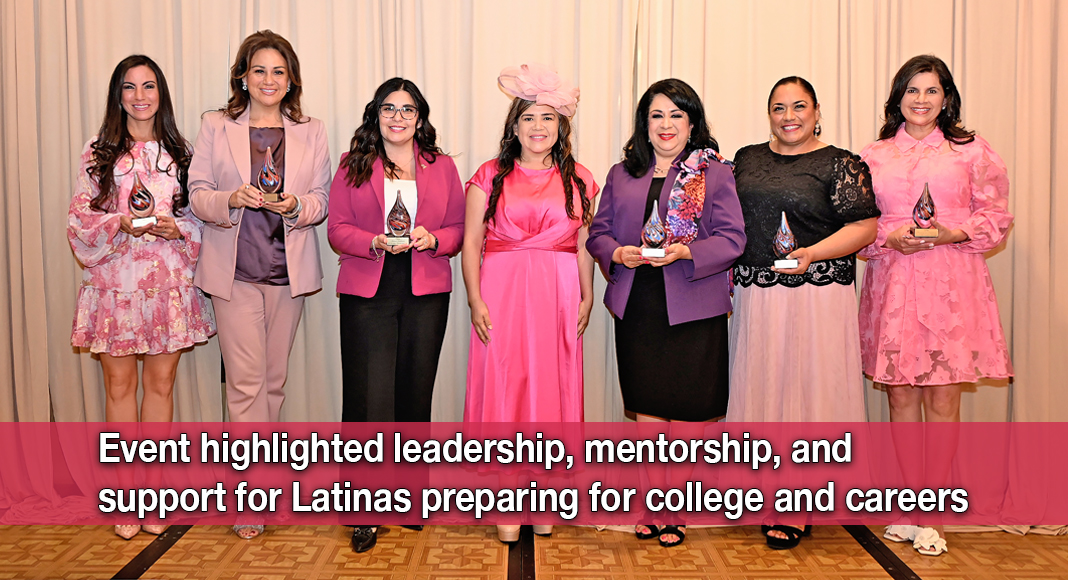
From left to right: Lizzy de la Garza Putegnat, representing Dr. Linda Treviño Burke; Dr. Bonnie De La Rosa Villarreal; Norma Sepulveda; Dr. Esmeralda Adame; Marie Salazar Garcia; Dr. Jennifer Mendoza Culbertson; and Therese Anne Capistran, recognized during the Hispanic Women’s Network of Texas Rio Grande Valley event honoring women leaders and supporting scholarships for future generations. Image Texas Border Business
Texas Border Business
By Roberto Hugo González / Texas Border Business
Six professional women from the Rio Grande Valley were recognized at a Hispanic Women’s Network of Texas Rio Grande Valley chapter event that also raised support for student scholarships and leadership development. Speakers said the organization’s mission is to advance women in “public, corporate and civic life through education, personal and professional development.”
Dr. Esmeralda Adame, Chair, said HWNT is a statewide organization and that “every single dollar goes into scholarships, goes back into the community.” Assistant treasurer Miriam Frias said the group’s Latinas in Progress program served “80 students this year,” offering college readiness support, mentorship, and scholarship opportunities. Frias said, “We are investing in the next generation of women who will one day hopefully be exactly where you are today.” Speakers also promoted the Lady in Red Scholarship Gala and Madrina sponsorships, which Frias said provide $1,000 toward scholarships.
Sussie Neaville, who introduced the honorees, said event proceeds support students in a Saturday leadership program that includes etiquette, financial literacy, self-defense, and college preparation. She then presented the six women recognized for professional and community leadership.
Dr. Bonnie De La Rosa Villarreal, owner of Rio Vista Dentistry in Harlingen, said she leads “a dental practice in Harlingen” and employs “20 females” in an all-female practice with three other doctors. She said ownership required extra effort as a woman and added, “That extra hard work and grit matter.”
Therese Anne Capistran, superintendent of Point Isabel ISD, said she has worked in education for 37 years and is a first-generation high school and college graduate. She said education was “the only way to break the cycle of poverty” for her family. Capistran also noted that while “about 75% of Texas teachers are females,” only “between 28 29% of superintendents in Texas are females.”
Dr. Linda Treviño Burke, pediatric dentist and owner of Burke Children’s Dentistry in Harlingen, was recognized in absentia. According to her introduction, she has held leadership roles with the Harlingen Economic Development Corporation, the Harlingen Area Chamber of Commerce, Valley Baptist Hospital, and the Texas State Board of Dental Examiners. In remarks read by Lizzy de la Garza Putegnat, Burke said, “your voice matters, your dreams matter, and you’re capable of more than you know.”
Dr. Jennifer Mendoza Culbertson, chief administrator for internal affairs at Hidalgo County Precinct 4, said the recognition reflected collective effort. “None of us makes history alone,” she said. Culbertson said making history means “opening doors so others can walk through them.”
Harlingen Mayor Norma Sepulveda, introduced as the city’s first female mayor, said, “I had no intention of getting into politics. I had no roadmap.” She said women often think they must be “overly qualified” before stepping forward and added that Harlingen now has “more women directors than we do men.”
Marie Salazar Garcia, executive director of the Heart, Mind, and Money Foundation and founder of Latina Empire RGV, said the honor marked “a full circle moment” after years of service with HWNT. She said her work is guided by a “100-year plan” focused on whether today’s efforts will “open doors for women” and “inspire the next generation of young leaders.”
Throughout the event, speakers tied the recognition of established leaders to a practical goal: funding scholarships and creating opportunities for younger women.
TSC President Dr. Jesus Roberto Rodriguez, TSC Board of Trustees Chairwoman Adela Garza and TSC Board of Trustees Secretary Dr. Norma Lopez-Harris pose for a picture with the top three male finishers of the TSC Historic 5K Run. Thirteen-year-old Pavel Cruz took first place with a time of 19:56. Image courtesy of TSC
Texas Border Business
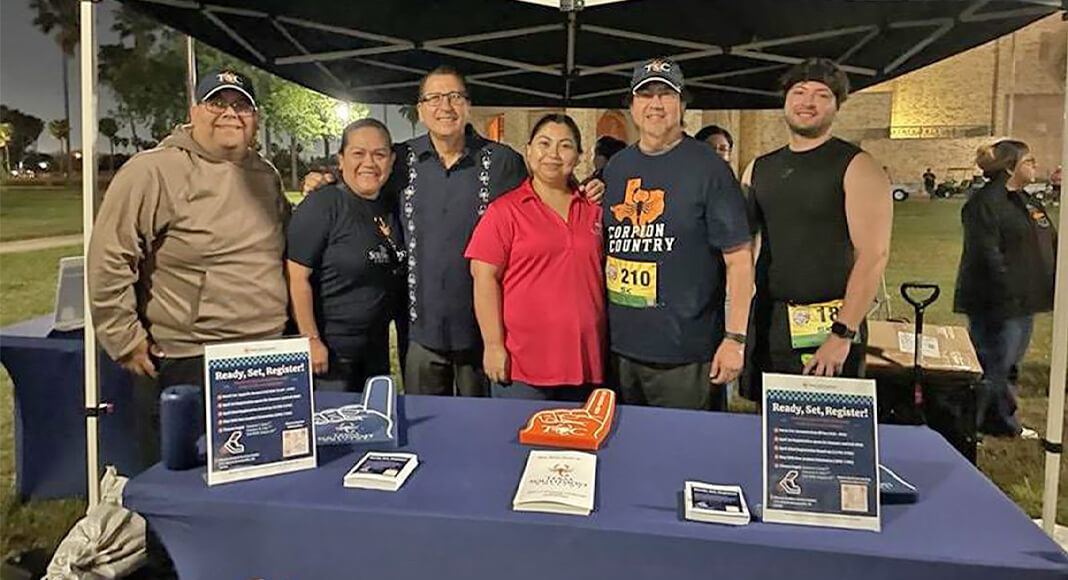
Runners of all ages and skills levels made their way to Texas Southmost College (TSC) to take part in the school’s Historic Runand Half Marathon. The event gave participants an opportunity to run through TSC’s scenic and historic Fort Brown campus.
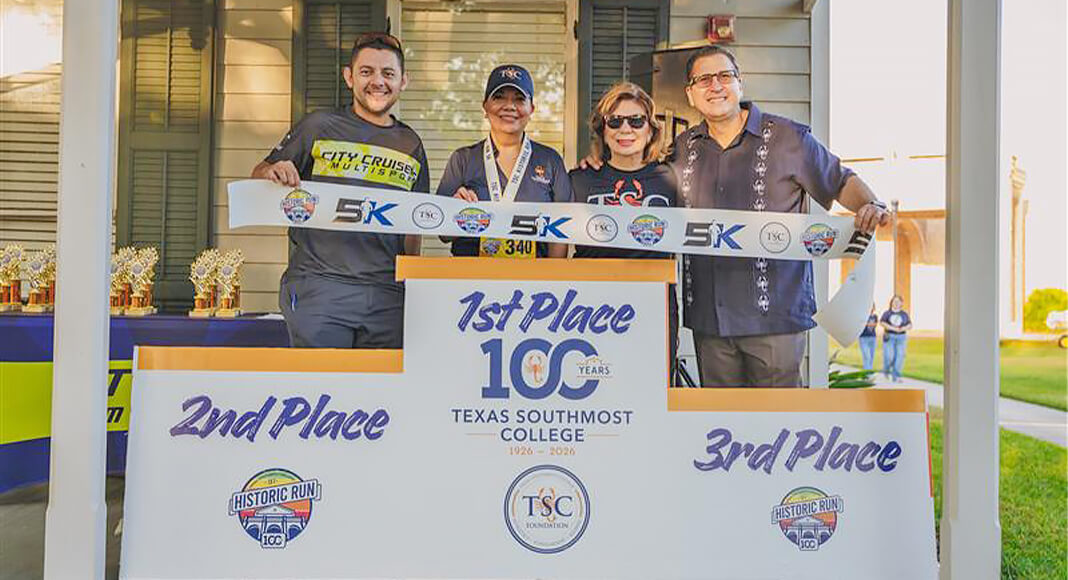
Ben Del Angel of City Cruisers, which helped organize the TSC Historic Run and Half Marathon, joins (from left to right) TSC Board of Trustees Secretary Dr. Norma Lopez-Harris, TSC Board of Trustees ChairwomanAdela Garza and TSC President Dr. Jesus Roberto Rodriguez for a picture at the podium. Image courtesy of TSC
“It’s amazing to see the community come together,” said TSC Board of Trustees Chairwoman Adela Garza.
Garza presented medals and trophies to the top runners, alongside President Dr. Jesus Roberto Rodriguez and Board of Trustees Secretary Dr. Norma Lopez-Harris.
TSC President Dr. Jesus Roberto Rodriguez joined at the podium by the top three teams who ran the TSCHalf Marathon. Brian Aranda and Luis Aranda won took first place. Image courtesy of TSC
“When we decided to celebrate the 100th anniversary, we were going to do something for every part of the community,” Garza added.
TSC’s Historic Run and Half Marathon is one of the many events the school is hosting this year to celebrate its 100th anniversary.
TSC President Dr. Jesus Roberto Rodriguez joins the top three male finishers of the TSC Half Marathon. IanAndreas (in black shirt) won with a time of 1:30.51. Image courtesy of TSC
In addition to being a presenter on the podium, Dr. Lopez-Harris ran the 5K race. She took sixth place in her age group.
Trustees Eward C. Camarillo, M.P.P.M., and Edgar E. Garcia, MPAS, PA-C, also attended the Historic Run.
“It’s the first time we have done this race here at the college,” said Dr. Lopez-Harris. “I think it’s awesome for health and the community to promote all this. I think from now on every year we’re thinking of possibly doing it. It’s just going to motivate others to do it and become healthier and active.”
TSC President Dr. Jesus Roberto Rodriguez joins the top three female finishers of the TSC Half Marathon.Denise Nuñez (wearing visor) won with a time of 1:57.28. Image courtesy of TSC
Thirteen-year-old Pavel Cruz was the first person to cross the finish line in the 5K race.
Cruz was cheered on by family members and spectators as he claimed first place with a time of 19:56. He finished 40 secondsahead of second place runner Ivan Martinez. Luis Espinoza rounded out the podium with a time of 22:15.
Cynthia Espinoza took first place in the women’s 5K race in 23:47.
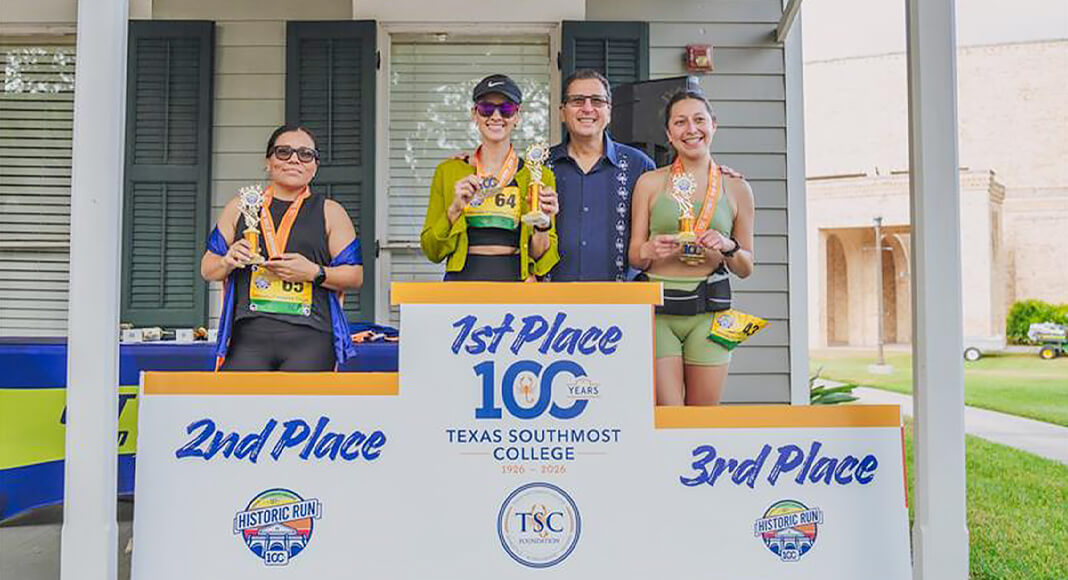
TSC President Dr. Jesus Roberto Rodriguez (right), TSC Board of Trustees Chairwoman Adela Garza (center),and TSC Board of Trustees Secretary Dr. Norma Lopez-Harris (left) pose for a picture with Cynthia Espinoza (wearing visor) who took first place in the women’s division of the TSC Historic 5K Run and AngelicaGutierrez who finished third. Image courtesy of TSC
The race was an emotional one for Espinoza, who ran in honor of her daughter, Rosa Isela Espinosa, who died in February.
“I wanted to be [the first] overall female for a while and I finally got there,” said Espinoza, who ran the race with a shirtfeaturing an image of her daughter. “I know I wouldn’t have been able to cross that line if it wasn’t for her motivating me to get up and do something when I feel like not doing anything.”
Monica Robles Moreno took second place with a time of 27:04. Angelica Gutierrez finished third in 27:10.
Ian Andreas took first place in the half marathon in 1:30.51.
TSC Board Trustee Edward Camarillo and TSC President Dr. Jesus Roberto Rodriguez pose for a picture with spectators and participants at the TSC Historic Run and Half Marathon. Image courtesy of TSC
Denise Nuñez was the first woman to finish the half marathon with a time of 1:57.28.
“I love the course,” Nuñez said. “I love the history. I love the views. It was a very nice course.” Luis Aranda and Brian Aranda won the half marathon relay in 1:54.30.
TSC’s next centennial celebration event will be the Play Day at the Zoo held at Gladys Porter Zoo on Sunday, April 19.
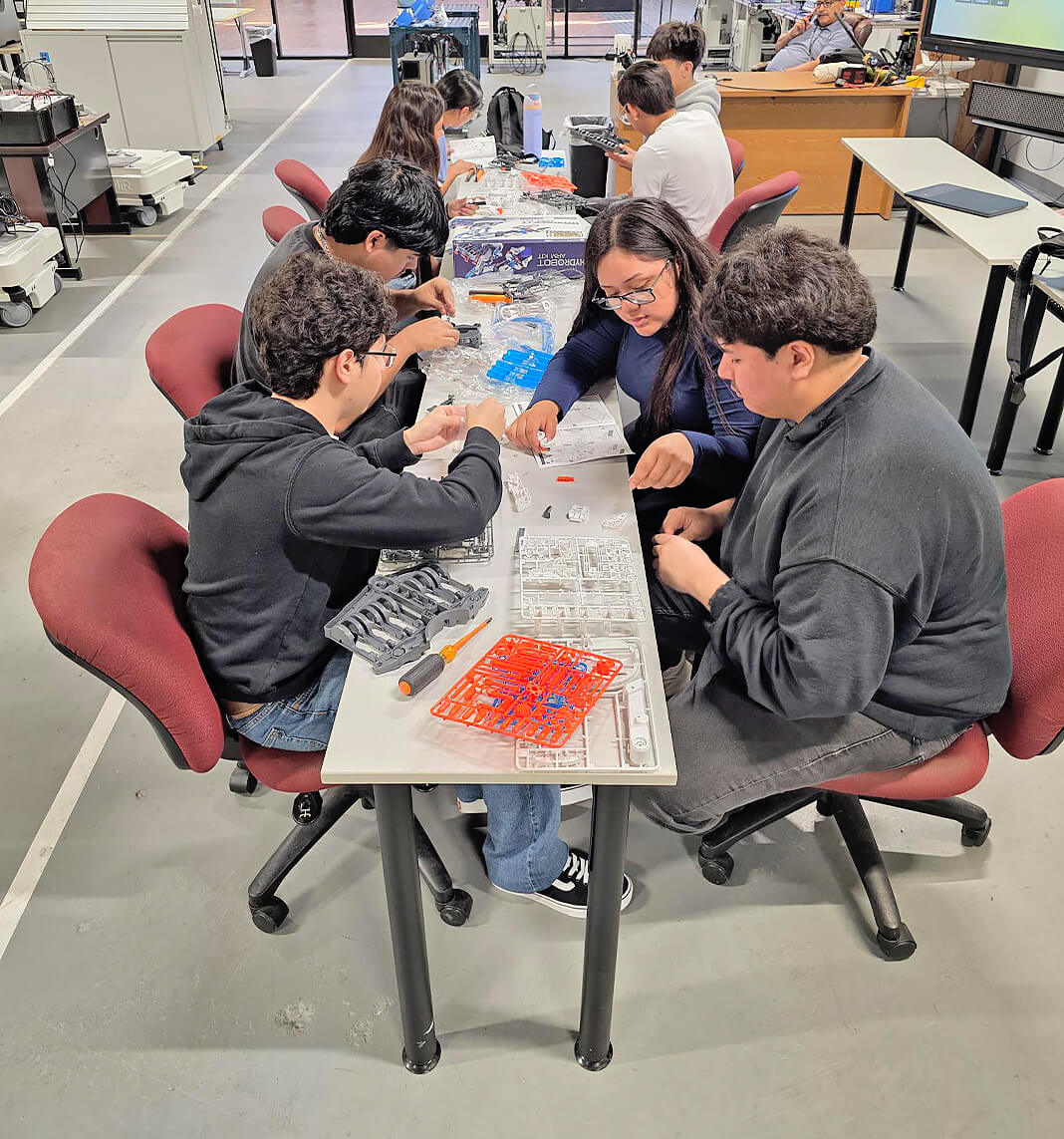
Texas Southmost College’s Industrial Maintenance and Robotics Lab will welcome local high school students this spring for an immersive, hands-on learning experience aimed at building advanced technical skills and industry-recognized credentials. Image courtesy of TSC
Texas Border Business
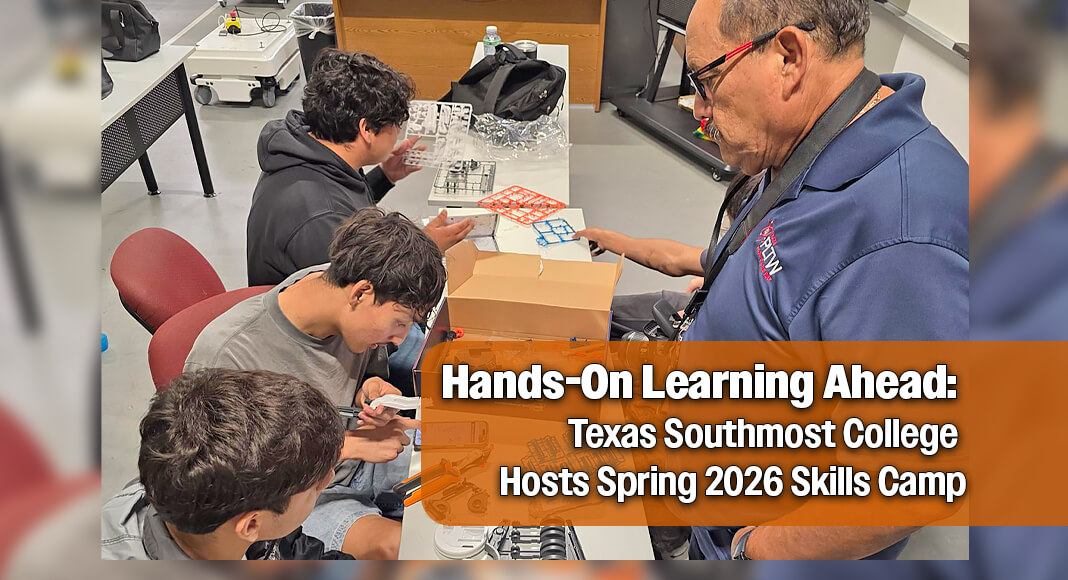
BROWNSVILLE, Texas — Texas Southmost College’s Industrial Maintenance and Robotics Lab will welcome local high school students this spring for an immersive, hands-on learning experience aimed at building advanced technical skills and industry-recognized credentials.
The Spring 2026 Skills Camp with Porter High School will bring students into TSC’s Advanced Manufacturing and Robotics Automation (AMRA) Lab, where they will engage in practical activities and work toward earning the Smart Automation Certification Alliance (SACA) Gold Certification in Pneumatics.
In addition to student engagement, SACA also supports educators through professional development. Teachers can participate in specialized training programs lasting three to five days, enabling them to proctor certification exams and deliver preparation courses aligned with Industry 4.0 standards. Image courtesy of TSC
Juan Rivera, TSC’s Industrial Mechanics and Maintenance Technology (IMMT) Program Coordinator, said the event is designed to bridge classroom learning with real-world applications.
“During the camp, students will participate in hands-on skill activities in the AMRA Lab, and we’ll be challenging our Dual Practicum class to earn the SACA Gold Certification in Pneumatics,” Rivera said.
The certification process is rigorous and requires students to demonstrate both theoretical knowledge and technical proficiency. Participants must complete three individual exams at their workstations, where they identify pneumatic symbols and correctly assemble systems based on detailed diagrams.
“The objective is for students to obtain the SACA Gold Level Certification in Pneumatics,” Rivera explained. “These exams require students to apply what they’ve learned by identifying symbols and connecting diagrams according to given specifications.”
Before attempting the gold-level credential, students must first pass the silver-level certification, a foundational requirement that ensures they understand core pneumatic concepts.
Rivera, who is certified to administer the credential, earned his qualification last December through training at a SACA-authorized center. He emphasized the value of these industry certifications for students entering technical careers.
“SACA certifications validate both knowledge and hands-on skills. When students successfully complete the written exam and performance assessments, they demonstrate they are workforce-ready,” Rivera said.
In addition to student engagement, SACA also supports educators through professional development. Teachers can participate in specialized training programs lasting three to five days, enabling them to proctor certification exams and deliver preparation courses aligned with Industry 4.0 standards.
The upcoming Skills Camp reflects TSC’s continued commitment to workforce development and partnerships with local schools, providing students early exposure to high-demand technical fields such as industrial maintenance, automation, and robotics.The event is expected to give participating students a competitive edge as they pursue careers in advanced manufacturing and related industries
A ceremony will be held to celebrate a major milestone in regional flood protection. The Hidalgo County Urban County Program (UCP), Precinct 1, and Drainage District No. 1 will host a ribbon cutting for the Main Floodwater Channel Expansion Project. Image for illustration purposes
Texas Border Business
EDCOUCH – A ceremony will be held to celebrate a major milestone in regional flood protection. The Hidalgo County Urban County Program (UCP), Precinct 1, and Drainage District No. 1 will host a ribbon cutting for the Main Floodwater Channel Expansion Project. This long-anticipated investment represents one of the most significant upgrades to the County’s flood control system in decades, delivering increased storm-water capacity and stronger protection for hundreds of thousands of residents across the region.
To celebrate the completion of this monumental project, UCP and its partners will host a ribbon cutting ceremony on Thursday, April 2, 2026, at 10 a.m., at 5818 Brandy St, Monte Alto, TX 78538.
“This project represents years of planning, coordination, and responsible investment in our region’s future,” said Dr. Joel Rivera, Hidalgo County Urban County Program Director. “Expanding this channel strengthens the backbone of our regional system and gives nearly 400,000 residents greater peace of mind during heavy rain events. It is a smart, strategic investment that will serve Hidalgo County for generations.”
Representatives from the Office of U.S. Congressman Vicente Gonzalez (Dist. 34) and the Texas General Land Office (GLO), who were instrumental in securing funding for this project, are expected to attend the ribbon cutting ceremony.
“Every recovery dollar we invest in drainage improvements is a step toward a brighter, stronger future for Hidalgo County families,” said Texas Land Commissioner Dawn Buckingham. “By delivering these funds directly into Rio Grande Valley communities that face repetitive flooding, we are protecting more than roads and homes—we’re restoring confidence, hope, and resilience.”
The Main Floodwater Channel Expansion Project will have a tremendous mitigation impact in Hidalgo County and across the State of Texas. Flooding in Hidalgo County has long been tied to the saturation of the Main Floodwater Channel. When the channel reaches capacity, hundreds of regional drainage systems across Hidalgo and Willacy Counties are unable to discharge into it, causing water to back up into neighborhoods and roadways.
After extensive engineering analysis, Hidalgo County and the Drainage District determined that expanding approximately 20 miles of the channel from its average width of 150 feet to roughly 350 to 400 feet would deliver the most immediate and cost-effective regional benefit by more than doubling its capacity and adding millions of cubic yards of storm-water storage.
With construction costs at approximately $3 million per mile, this nearly $20 million investment allowed for the expansion of more than three miles of channel and added roughly 2 million cubic yards of additional capacity.
The project was completed in two phases with funding provided by the GLO. For Phase I, awarded in 2015, the GLO provided $9,858,499.20 in funding. Phase II, awarded in 2016, totaled $9,962,444.40. Construction on both phases began on November 30, 2021, and has now been completed.
In 2018, Hidalgo County voters approved a $190 million Drainage District Bond to fund dozens of flood control projects countywide. The Main Floodwater Channel Expansion Project complements that bond program, as many of those projects ultimately discharge into the Main Floodwater Channel. Increasing its capacity ensures that the broader system functions as designed and delivers long-term protection for residents.
The project is expected to benefit an estimated 397,800 residents, including 212,783 low-to-moderate income residents. By increasing the channel’s capacity, the project strengthens flood protection for communities throughout the region, with a significant impact on neighborhoods most vulnerable to severe weather events.
All media and the public are invited to attend.
DETAILS
WHO: Hidalgo County Urban County Program, Hidalgo County Precinct 1, Hidalgo County Drainage District No. 1, Office of Congressman Vicente Gonzalez Dist. 34, and the Texas General Land Office
WHAT: Ribbon Cutting for Floodwater Channel Expansion Project