
















Texas Border Business



By Roberto Hugo González / Texas Border Business
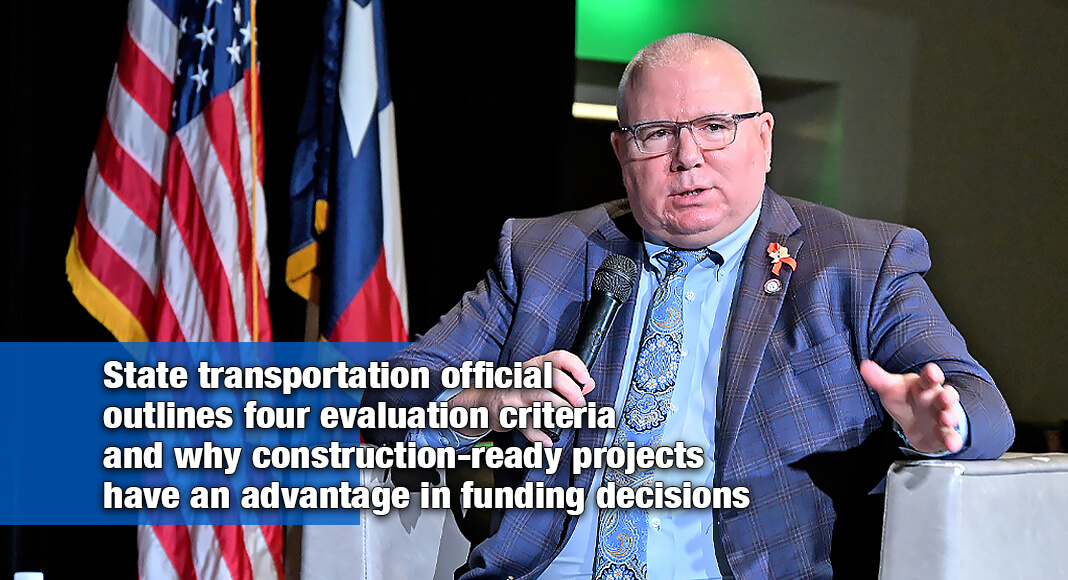
MISSION, Texas — Brian R. Barth, deputy executive director for program delivery at the Texas Department of Transportation, said regional cooperation and construction-ready projects are essential for securing transportation investments in the Rio Grande Valley.
Barth participated in an infrastructure summit organized by the Rio Grande Valley Partnership on October 20, 2026, at the Mission Event Center.




The discussion included Texas Transportation Commissioner Alex Meade and Pedro “Pete” Alvarez, TxDOT’s Pharr District engineer. Paco Sanchez, president and CEO of the Rio Grande Valley Partnership, moderated the panel.
Barth credited the consolidation of the Valley’s three metropolitan planning organizations into one regional organization with strengthening its ability to compete for state transportation funding.
“The first step that this region took was really the merging of the three MPOs into one bigger MPO and a bigger voice,” Barth said.
He explained that the region’s transportation funding continued increasing even after statewide funding reached its peak around 2023.
Barth attributed that progress partly to the region’s unified approach to identifying transportation priorities.
“The MPOs set the priorities for this region, and that plays a big part in what gets funded in the Unified Transportation Program,” he said.
Sanchez emphasized that transportation planning must reflect the Valley’s interconnected economy.
“Our roads, our power lines, our broadband utilities don’t stop at a city or a county line,” Sanchez said.
He noted that workers, freight, visitors and businesses regularly travel throughout Cameron, Hidalgo, Starr and Willacy counties.
Barth agreed that transportation projects should be evaluated as parts of a regional system rather than isolated improvements.
“Congestion doesn’t stop at a county line. Connectivity doesn’t stop at a county line,” he said.
He explained that connecting highways, international bridges, ports and commercial destinations helps demonstrate the economic benefits of transportation investments.
Asked how TxDOT evaluates projects competing for funding, Barth identified four principal criteria.
“Every project that’s submitted to the UTP is scored in four different areas: safety, connectivity, congestion relief and economic development,” he said.
Barth said freight movement, passenger travel and opportunities for economic development help determine a project’s potential benefits.
He acknowledged that measuring economic returns remains challenging and said TxDOT continues working to improve its evaluation methods.
Construction readiness was another major consideration.
Barth explained that transportation funding opportunities can emerge when other projects experience delays, construction bids come in below estimates, or federal grants become available.
However, communities must have projects sufficiently developed to take advantage of those opportunities.
“The only way you can accelerate projects is if you have it ready,” Barth said.
He encouraged local governments to participate in engineering, right-of-way acquisition and utility relocation when possible.
According to Barth, those contributions can help projects advance toward construction.
Sanchez said the Partnership’s objective is to encourage regional collaboration and strengthen the economic case for transportation investment.
Barth concluded that continued coordination among local governments, regional planning organizations, and TxDOT would help the Valley compete for future transportation funding.