
















Texas Border Business




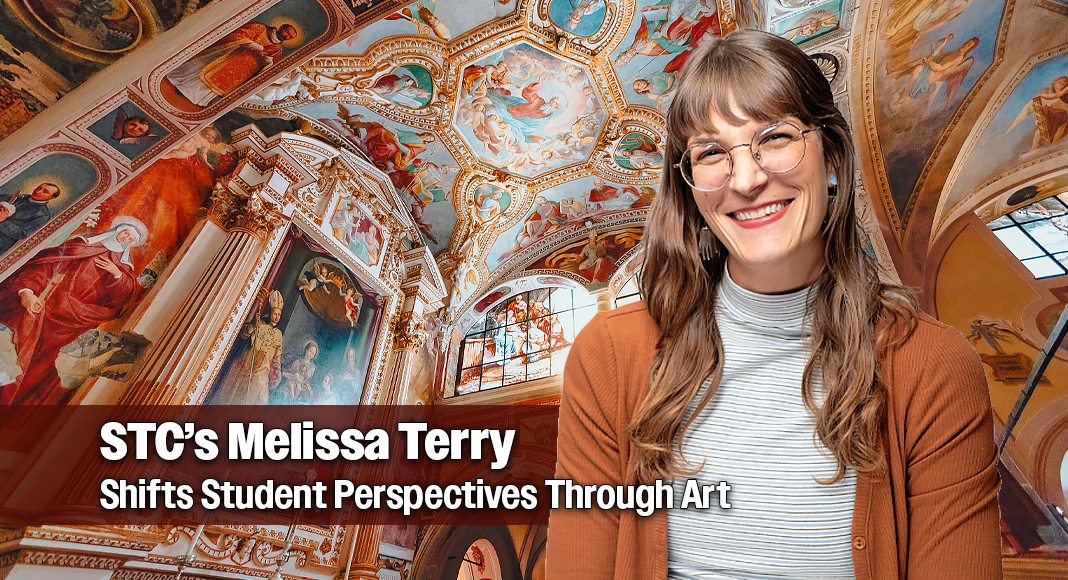
McALLEN, Texas – For South Texas College faculty member Melissa Terry, being an Art History teacher is about more than sharing knowledge about paintings and artifacts. It is about helping students build empathy, explore new perspectives and better understand different cultures, beliefs and the experiences of others.
Recently recognized with the National Institute for Staff and Organizational Development (NISOD) Excellence Award and earning the title of assistant professor last year, Terry, 39, takes pride in her role at STC, helping students strengthen critical thinking skills and gain new perspectives through art history.
“I hope students leave my classes understanding that if everyone were more empathetic, the world would be so much better,” Terry said. “Even though it’s an art history class, it’s about learning how people who are different from you understand the world and seeing value in those perspectives. Through art history, we learn about different cultures, beliefs and ways of understanding the world.”



Originally from Minnesota, Terry’s path to art history began with a passion for art.
Initially pursuing studio art with plans to become a high school Art teacher, Terry said her perspective shifted during college after taking Art History courses.
“I just fell in love with art history,” Terry said. “I was fascinated with the social, political, and cultural context and dramatic storytelling that surrounded art. The fact that these objects remain relevant and even powerful felt important to me. I realized teaching young people about history was something meaningful that could help people better understand humanity and how we all engage in the world.”
Terry also participated in a study abroad program in Florence, Italy, an experience she said further solidified her passion for art history and desire to become a professor.
After earning a double bachelor’s degree in Studio Art and Art History from Minnesota State University, Mankato, Terry continued her studies at the University of Wisconsin–Milwaukee, where she earned a master’s degree in Art History.
She later enrolled in a doctoral program in Art History at the University of Illinois Urbana-Champaign, but life led her in a new direction.
After her husband and fellow historian, John Terry, accepted a teaching position at STC in 2015, Terry relocated to the Rio Grande Valley the following year while eight months pregnant with their first daughter, stepping away from her doctoral program.
“I really wanted to finish,” Terry said. “Leaving my program, my friends and everything behind was hard, but it also brought me to a place and community I care deeply about.”
A few months after her first daughter was born in 2016, Terry began teaching part-time at STC as an adjunct faculty member while navigating new motherhood.
Though she also taught for a time at The University of Texas Rio Grande Valley (UTRGV), Terry continued building her future at STC, where what began as a part-time role eventually turned into nearly a decade of teaching.
“I’ve always wanted to teach at a community college,” Terry said. “I realized the part of higher education I cared about most was teaching, building connections with students and helping young people grow. At STC, I get to do that every day.”
Terry found purpose in helping students build confidence and understand perspectives beyond their own. That student-centered approach extends into her classroom, where art history is taught through conversation, critical thinking and connection.
Rather than relying solely on lectures, Terry incorporates small group discussions, hands-on materials and modern cultural references to help students better understand historical concepts and their relevance today.
“We don’t have to see things a certain way,” Terry said. “We can decide how we see things. That’s one of the tools I hope students pick up in my class.”
Now a mother of two, Terry said some of her proudest accomplishments have centered on creating meaningful experiences for her students.
Among them is the “She Roars” Women’s History Month series, a collaborative initiative launched in 2023 that welcomed a founding member of the internationally recognized feminist art collective Guerrilla Girls to STC while featuring artist talks, film screenings, lectures and exhibitions focused on women’s voices in Art and History.
More recently, Terry helped organize an educational trip to the Museum of Fine Arts in Houston, supported by the STC Foundation, giving Art History students the opportunity to experience world-renowned art collections in person, many for the first time.
“A lot of these students had never even left the Valley,” Terry said. “They had only seen these works in pictures, and suddenly they were standing in front of them. Watching that excitement and seeing them experience something so new was incredibly moving.”
This past November, students also visited the Menil Collection and the Rothko Chapel in Houston before transforming their experiences into fused glass artwork through a partnership with McAllen Stained Glass.
“One of our students even got a part-time job through this experience,” Terry said. “Moments like that make me feel like I can truly make a difference in students’ lives.”
Looking ahead, Terry said she hopes to continue growing both personally and professionally while remaining committed to the work she values most: Teaching and supporting students at STC.
“Helping them feel a sense of agency and excitement for their own ideas and their ability to affect the world is so exciting to me,” she said. “I feel lucky to be at STC and doing work that really matters to me. I hope I get to keep doing it for a long time.”