
















Texas Border Business





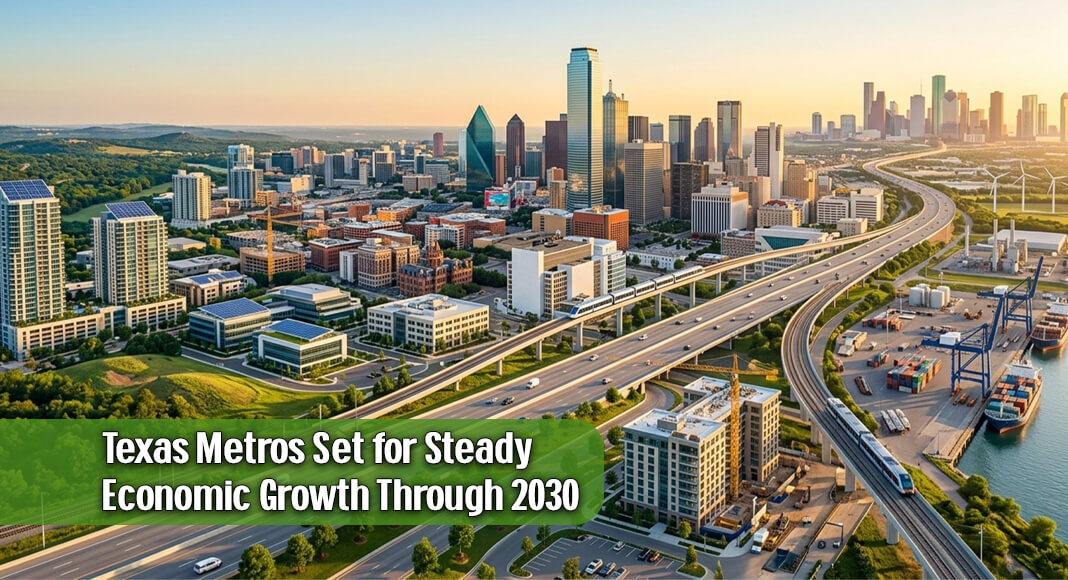
Texas and its metropolitan statistical areas (MSAs) and metropolitan divisions (MDs) are projected to see notable economic expansion from 2025 to 2030 despite national and global uncertainties and significant headwinds. The pace will be uneven and likely backloaded to the later segments of the projection period, but gains are expected over the five-year horizon. Let’s review some highlights from our most recent forecasts.
The largest metros continue to drive activity, and most are expected to expand at a faster annual pace than that of the US and Texas. The seven most populated urban centers should see an increase of about 1.08 million over the five-year period (a slight decrease from last year’s forecasted increase due largely to intervening policy actions) representing about 78% of the state’s overall employment gain.
The Austin-Round Rock-Georgetown MSA is expected to continue to be a growth leader over the next five years, with a compound annual growth rate in wage and salary employment of 1.95%, which is well above the statewide rate of 1.78%. (Compound annual growth rates, CAGRs, reflect changes in the base from which growth is calculated and are the measure we typically use.) Impressive growth is projected for the Dallas-Plano-Irving economy, with employment expanding at a healthy 1.85% per annum. The Fort Worth-Arlington-Grapevine MD is also well positioned to outpace the state, with yearly job gains averaging 1.80% over the next five years.




The El Paso MSA is projected to add jobs at a notable pace of 1.61% per year over the period. The Houston-The Woodlands-Sugar Land MSA is a major economic engine for the state and is expected to add more net new jobs than any other MSA (about 337,500), for a 1.83% pace. McAllen-Edinburg-Mission is expected to see an annual growth rate of 1.76%. Employment in the San Antonio-New Braunfels MSA is projected to grow at a 1.80% per year pace.
Population and economic growth in Texas are concentrated in larger MSAs, but the smaller metropolitan areas are also forecast to provide a significant portion (14.3%) of Texas’ overall employment gain through 2030. The smaller population centers are projected to add net new jobs by at least 1.34% per annum over the five-year period, though rates vary significantly, and several are forecast to add wage and salary employment at a faster pace than the state as a whole, including Midland (1.85%), Tyler (1.85%), Brownsville-Harlingen (1.84%), and Sherman-Denison (1.79%).
Global, national, and state conditions will affect the pace and the downside risks are notable at present, but over the five-year forecast horizon the trend is likely to be positive given underlying industrial patterns. Fluctuations will no doubt occur, but Texas metropolitan areas are well positioned to sustain future growth. Stay safe!
_________
Dr. M. Ray Perryman is President and Chief Executive Officer of The Perryman Group (www.perrymangroup.com), which has served the needs of more than 3,000 clients over the past four decades.