

















Texas Border Business



By Selene Rodriguez
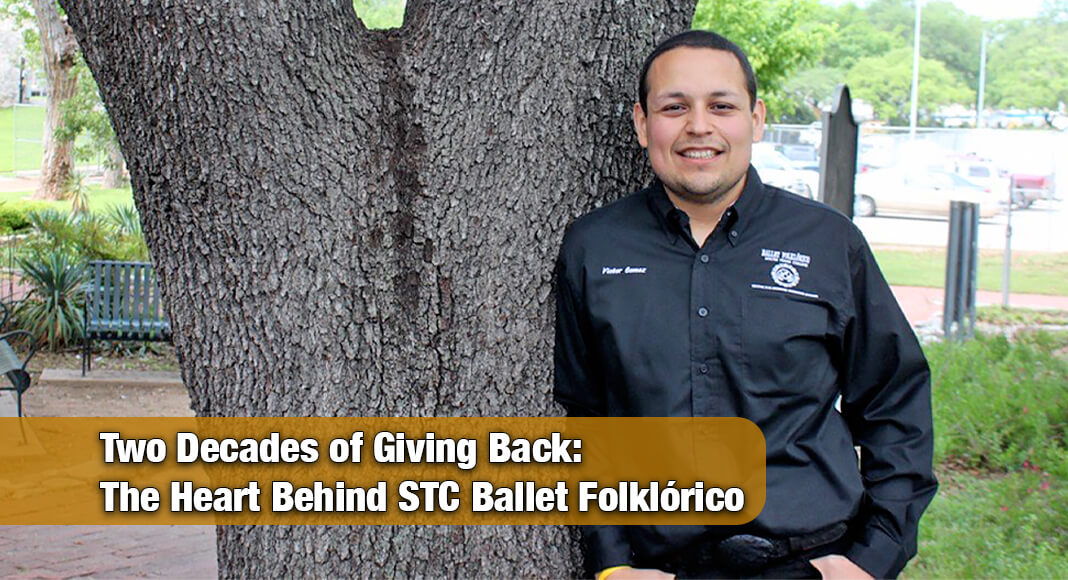
McALLEN, Texas – Across two decades at South Texas College, Assistant Professor of History Victor Gomez has dedicated his career to inspiring students to become leaders, both in the classroom and on the dance floor.
A proud STC alumnus, Gomez has given back to the institution that shaped his future by founding Ballet Folklórico South Texas College, growing it into one of the region’s most recognized collegiate cultural programs while mentoring generations of students through history, culture and leadership.





“One thing I never take for granted is that I was once an STC student myself,” he said. “I like being assigned to the classrooms where I once sat as a student because it reminds me where I started. I tell my students, ‘If I did it, so can you.’ I want them to understand that we’ve all faced doubts and insecurities. I want them to see someone who came from the same place they did and realize they can accomplish anything.”
Like many of the students he now teaches, Gomez didn’t have his future figured out when he arrived at STC. He began as a Nursing major before switching to Education, earning an associate degree in 2002.
After transferring to the former University of Texas-Pan American (UTPA), now University of Texas Rio Grande Valley (UTRGV), one Texas history course inspired Gomez to pursue a bachelor’s degree in history, followed by a master’s degree in history with a minor in anthropology.
Although he spent one semester pursuing a doctorate at the University of Houston, a visit to his former professors at STC unexpectedly turned into a teaching opportunity in 2006, beginning a career that has now spanned two decades.
“I was only 25 years old, and looking back now, I realize how fortunate I was,” he said. “I simply came back to visit my former professors, and that visit completely changed the direction of my life. Twenty years later, I’m still here and I haven’t looked back.”
Committed to expanding learning beyond the classroom, Gomez soon began creating new opportunities for students to connect with history and culture.
In 2008, he organized a regional conference at STC for the National Association for Chicana and Chicano Studies, an event that attracted scholars and attendees from across the country. Its success led Gomez to become coordinator of the college’s Center for Mexican American Studies in 2009, where he expanded cultural programming through lectures, book talks, conferences and community events.
As those efforts gained momentum, college leadership challenged him to think even bigger, leading to the establishment of Ballet Folklórico South Texas College.
“Every semester, I saw students wearing jackets and T-shirts from their high school folklórico programs,” Gomez said. “I’d ask them if they were still dancing, and almost every time they’d tell me they weren’t because there wasn’t anywhere nearby to continue after high school. Many didn’t have the time or opportunity to join a university program. I thought STC could fill that gap.”
Believing the program could serve both students and the community, Gomez partnered with STC Continuing Education and invited anyone interested to attend an informational meeting in December 2011. The response exceeded all expectations.
“Honestly, I expected maybe 10 or 15 people,” Gomez said. “Instead, about 70 or 75 people showed up. From the very beginning, I wanted the community to be involved. Working with continuing education made that possible because the program wasn’t only serving students, it was serving the entire community.”
Nearly 15 years later, the program has grown into one of the college’s, and the region’s, signature cultural organizations, representing STC across Texas, throughout the United States and internationally in Mexico and Peru.
“We end up performing in places we never imagined we’d visit, meeting people we never thought we’d meet and representing our community wherever we go,” Gomez said. “Many of our dancers tell me they would never have had the chance to travel outside the Rio Grande Valley if it weren’t for folklórico.”
For Gomez, directing the program has never been about recognition or compensation. He volunteers his time because he believes in its impact on students.
“Seeing the joy on the dancers’ faces makes everything worth it,” Gomez said. “Watching them earn these opportunities and proudly representing STC and the Rio Grande Valley is incredibly fulfilling. These opportunities change their lives.”
Throughout his career, Gomez has received some of STC’s highest honors, including the 2011 Faculty of the Year Award, the National Institute for Staff and Organizational Development Excellence Award and the League of Excellence Award.
Despite being offered opportunities outside the RGV, including a full scholarship to pursue a doctorate at the University of Texas at Austin, Gomez remains committed to STC, believing he can make the greatest impact at the place where it all began.
“I’ve always wanted to be part of something big here, at home, and that’s what we’re doing,” Gomez said. “What I really want is to continue developing leaders. When younger students see former members become teachers, nurses, engineers and other professionals, they realize they can accomplish those same goals.”
Although he’ll become eligible for retirement in the coming years, Gomez said he isn’t ready to step away from the classroom.
“At some point, I think I’ll be ready to step back from the administrative side and return to doing what I love most, which is standing in front of the classroom,” he said. “Maybe it’ll be time for someone else to bring new energy and new ideas to folklórico. For me, the classroom is where I’ll always belong.”
Information source: STC