














Texas Border Business




By Roberto Hugo González / Texas Border Business
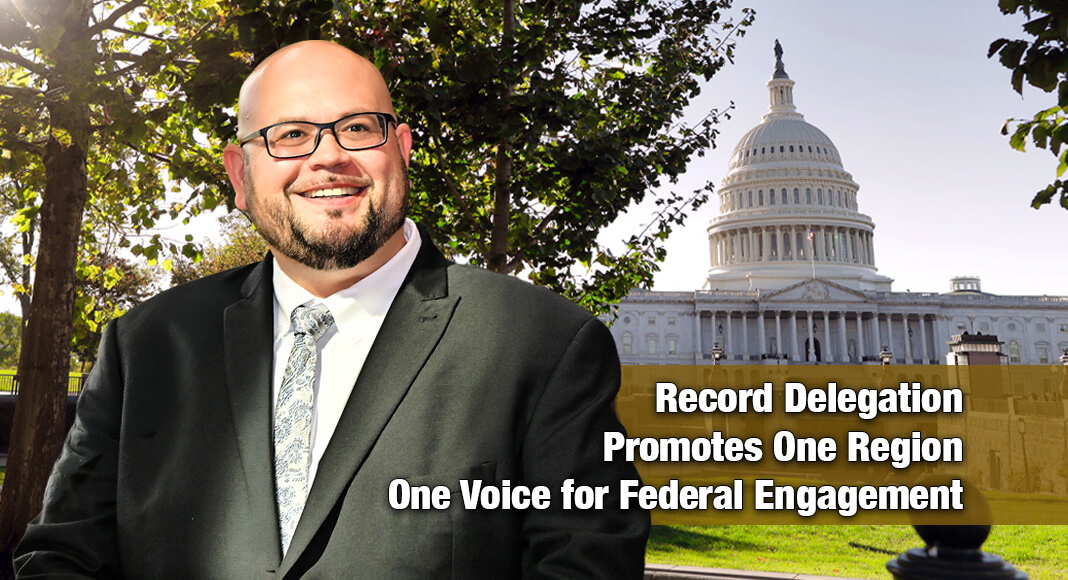
The Rio Grande Valley Partnership is leading one of the largest RGV-to-DC delegations in the initiative’s history, bringing approximately 70 leaders from government, business, education, healthcare, and economic development to Washington, D.C., from June 10 to June 12. According to RGV Partnership President and CEO Paco Sanchez, the trip is designed to ensure the Rio Grande Valley maintains a strong voice in federal discussions and remains competitive for resources and investment.
“This year’s trip marks a renewed commitment to ensuring the Rio Grande Valley has a strong voice in Washington and is positioned to compete for federal resources and investment,” Sanchez told Texas Border Business. He said the delegation provides communities, chambers of commerce, economic development organizations, and RGV Partnership members an opportunity to present their concerns directly to federal decision-makers.



Sanchez said the delegation represents communities across the four-county region, including the cities of Brownsville, Harlingen, Weslaco, Edinburg, and Mission, as well as their chambers and economic development corporations. Participants also include representatives from Texas National Bank, Texas Regional Bank, UT-RGV, South Texas College, RGV LEAD, South Texas Health System, Doctors Hospital at Renaissance, Atlas, and Hall & Rodriguez.
According to Sanchez, the RGV Partnership developed its priorities through input from participating cities and industries, as well as discussions held during RGV Connect sessions. He said hospitals and other sectors also coordinated internally to identify common priorities. The key regional issues being presented in Washington include economic development, healthcare, education and workforce development, transportation and infrastructure, and energy, water, and natural resources.
“Our main message is the same that we’ve covered during our RGV Connect sessions: the Rio Grande Valley is united as a region to address water, infrastructure, and economic development,” Sanchez said.
He noted that major projects, including Rio Grande LNG, Valeo, America First Refining, and other developments, represent billions of dollars in investment and thousands of current and future jobs. Sanchez said the region’s focus is on ensuring adequate water supplies, transportation infrastructure, energy capacity, and workforce development to support continued growth.
The delegation is scheduled to meet with representatives from several federal agencies and organizations, including the Economic Development Administration, the Small Business Administration, the Department of Labor, the Department of Commerce, the Federal Aviation Administration, the Smithsonian Institution, the I-69 Alliance, and the U.S. Chamber of Commerce. Senior staff from congressional committees are also expected to participate.
Sanchez said the delegation anticipates visits, schedule permitting, from Senator John Cornyn, Senator Ted Cruz, Congressman Henry Cuellar, Congressman Vicente Gonzalez, and Congresswoman Monica De La Cruz. He also highlighted a scheduled appearance by the Small Business Administration’s Deputy Director, William “Bill” Briggs.
Trade and economic development are expected to receive significant attention during the trip. Sanchez pointed to the upcoming review of the United States-Mexico-Canada Agreement and ongoing discussions surrounding the BUILD America 250 transportation bill as issues with major implications for the Rio Grande Valley and North American commerce.
“The July USMCA joint-review deadline happens a few weeks after our visit, and the BUILD America 250 transportation bill is under review as well,” Sanchez said. “These two pieces of legislation will shape the future of North American trade, which is especially important for a border region like ours.”
Sanchez emphasized the importance of presenting a unified regional agenda in Washington. “The RGV is not the RGV without Willacy, Starr, Cameron, or Hidalgo,” he said. “What impacts one county impacts the entire region.”
He added that regional collaboration has already produced significant results through initiatives such as the merger of metropolitan planning organizations, the creation of UT-RGV, and the development of the South Texas Alliance of Cities. “More people listen to us when we speak as ‘One Region, One Voice,’” Sanchez said.
The delegation’s primary meeting day is scheduled for June 11 at the historic Members’ Room in the Library of Congress. Planned discussions include healthcare, economic development, higher education, workforce development, and regional growth strategies. A debriefing session on June 12 will focus on next steps and continued collaboration after the group returns to South Texas.
Sanchez said the effort will continue beyond the Washington visit through RGV Connect, RGV Days in Austin, the RGV Legislative Tour, and the creation of a new Legislative Committee to formalize regional priorities and advocacy efforts.
“There’s a combination of factors that make this trip critical for 2026,” Sanchez said. “Global trade patterns, supply-chain shifts, and the upcoming USMCA review are creating both opportunities and challenges for border communities.”
See related story: