












Texas Border Business




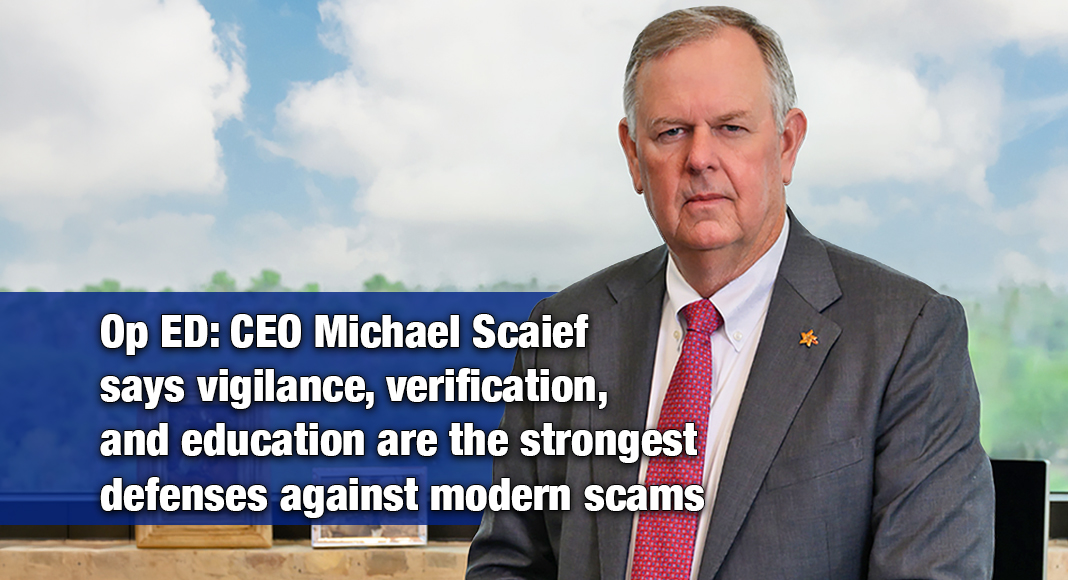
By Michael Scaief / Chairman & CEO Texas Regional Bank
As fraud continues to affect financial institutions and consumers nationwide, Texas Regional Bank Chairman and CEO Michael Scaief shares practical guidance for households and businesses.
To Our Fellow Texans,



Over the past several months, I’ve reminded Texas Regional Bank (TRB) customers never to share online banking
credentials, passwords, or one-time passcodes. Today’s message broadens that conversation to include fraud awareness and prevention as part of every household’s and every business’s culture. These are practices every Texan should understand and adopt.
To help you get started quickly and keep you ahead of current threats, here are two resources our team developed:
- Fraud Protection Pledges for businesses and households. Review these with family members or employees who may be at risk and have them acknowledge their understanding.
- TRB Fraud Resource Page. Essential resources and reading for folks with access to your accounts or finances. Additionally, thereare several things you, your household, and your business should be talking about right now:
Fraudsters research individuals and businesses they intend to target. Public records, business websites, networking sites, social media, and information exposed through data breaches allow criminals to build detailed profiles before contacting their targets. Assume fraudsters know enough about you and your business to coax you or your team into lettingyour guard down.
Fraud prevention is no longer just a banking responsibility. It has become a household responsibility and a business responsibility.
The common error in nearly every fraud case is granting access, which criminals gain by (1) building trust through research, (2) creating urgency that leads to stress and mistakes, and (3) causing fear. While criminals may know more about you than you realize, they still need you to give them access to commit the crime—whether through your online banking password, a one-time passcode, a security token code, your debit card information, or your authorization to movemoney. Personal information alone is no longer a reliable way to verify identity and mitigate fraud; in the wrong hands, itcan create a false sense of security.
It needs to be standard practice for you, your family, and your business: if anyone claiming to represent your bank calls, emails, or texts you and asks for credentials or to approve account access, stop and call a trusted phone number you know belongs to the bank to verify before acting.
Criminals identify people within an organization or household with access to accounts, purchasing, or payments. A convincing phone call or email directed to the right person can be financially catastrophic.
Fraud will continue to evolve, and criminals will adapt. Fraud tactics today may change tomorrow. A regular training cadence and staying informed about current fraud trends remain best practices. Financial institutions continue to invest in technology, monitoring, personnel, and processes to prevent and identify fraud. Even so, customer diligence remains one of our strongest defenses.
As a reminder:
- Never provide your online banking password, one-time passcode, security token code, or debit card number by phone, text message,or email.
- If someone claiming to represent your bank asks you to disclose this information or approve account access—even if they know personal details about you—end the conversation and contact your financial institution directly using a trusted phone number, such as the number on the back of your debit card or on its official website.
- If you own a business, establish clear verification procedures for payment requests and account changes, and make fraud awareness part of ongoing employee training.
In closing, I am one of the most frequently impersonated employees at TRB in phishing emails and text messages.
Fraudsters routinely impersonate bank executives because they know authority and urgency can influence decisions.
Slow down, verify with a trusted person, make a call, and only accept confirmation from The People You absolutely Know. Sincerely,
Michael Scaief
Chairman & CEO Texas Regional Bank
About Texas Regional Bank
Founded in 2010 and rooted in local purpose, Texas Regional Bank (TRB) is a privately owned financial institution bringing full-service,relationship-driven banking back to the communities it serves. With more than 38 locations across the Rio
Grande Valley, Texas Hill Country, Houston, and the Dallas–Fort Worth Metroplex, TRB delivers a full suite of financial solutions for individuals, families, and businesses through locally-led teams supported by the scale and capabilities of a diversified financial services platform. Together with its subsidiaries, TRB offers domestic and international banking, trust and wealth management, insurance, mortgage, capital markets, economic development, and foreign exchange services.
For more information about Texas Regional Bank, visit www.trb.bank.