
















Texas Border Business




By Roberto Hugo González / Texas Border Business
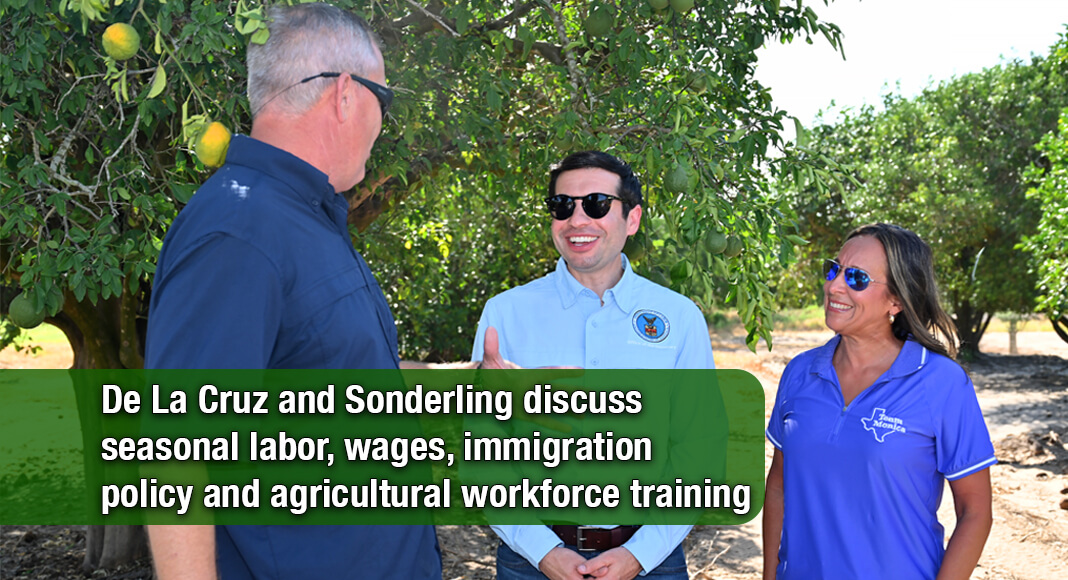
MONTE ALTO, Texas — U.S. Rep. Monica De La Cruz and Acting U.S. Secretary of Labor Keith Sonderling visited Rio Farm Inc. in Monte Alto on Wednesday, Aug. 12, to tour the farm and discuss labor needs, agricultural workforce development and immigration policy affecting South Texas growers.
De La Cruz, who represents Texas’ 15th Congressional District, said agriculture and workforce issues remain central concerns for the region and that Sonderling’s visit provided South Texas agricultural stakeholders an opportunity to communicate directly with the federal administration.



“This community depends on labor and workforce,” De La Cruz said. “Labor issues are at the forefront of conversations right here in South Texas.”
De La Cruz said the roundtable discussion at Rio Farm included legislative proposals she has supported, including what she described as the Bracero 2.0 program and legislation addressing farmworker wages.
“These are important issues for our farmers and our farm workers, and we want to make sure that we keep the communication between our stakeholders and the administration,” De La Cruz said.
Sonderling said South Texas agriculture faces an immediate need for workers while also requiring a longer-term effort to attract local students and workers to the industry.
“The worst thing that we can have is these generational Texas farms, like we’re here now, not be able to pick crops because they don’t have workers,” Sonderling said.
He said the federal H-2A program provides a lawful way for agricultural employers to bring seasonal foreign workers into the United States when needed. Sonderling said maintaining domestic agricultural production is important because the administration considers food security a national security issue.
“We need our products coming from Texas,” Sonderling said.
At the same time, Sonderling said schools, community colleges and workforce organizations should encourage local residents to consider agricultural careers. He said technological changes in agriculture are creating a need for workers capable of operating increasingly sophisticated equipment.
“Modern-day equipment is like operating the space shuttle,” Sonderling said. “We’re getting growers here in South Texas the workers they need right away. And number two, we’re encouraging the local communities to start teaching agriculture to get people inspired to feed America.”
Asked about young people entering agriculture, De La Cruz said schools should provide greater exposure to skilled trades and agricultural education.
“What I’m hearing is that we need to bring some of these skilled labor jobs, such as electricians and plumbers,” De La Cruz said. She also called for renewed support for FFA and other programs that can introduce students to different career paths.
Sonderling also addressed the cost of using the H-2A program. He said regulations adopted during the Biden administration increased agricultural labor costs by 40% to 50%. He said the Trump administration has worked with the U.S. Department of Agriculture to base wages more closely on local labor markets using Bureau of Labor Statistics data.
“We’re using Bureau of Labor Statistics now, their wage rates, to see what the wage rates are locally and make sure that the growers here are paying those rates, not paying just one state wage, which may work in Dallas, but is not going to work here,” Sonderling said.
Sonderling said some processing fees have also been waived. He said the changes are expected to save growers about $2.5 billion and provide an additional 119,000 certified workers.
“That’s going to help with the immediate need for farm labor in this area,” Sonderling said.
De La Cruz also addressed concerns about federal immigration policy and its effect on South Texas industries. She said she supports legal immigration pathways that allow workers to enter the United States for employment.
“When it comes to immigration, we believe that there is a path for legal immigration into our country, and we welcome that,” De La Cruz said.
She said she has supported the Bracero 2.0 proposal as a way to bring workers legally into the United States for industries including agriculture and construction. De La Cruz also cited her support for the Dignity Act, which she described as a bipartisan effort to address immigration reform.
“It is a bipartisan piece of legislation, and what I think it does is it begins the conversation of changes that need to be made to our immigration policy,” De La Cruz said. “Those conversations are ongoing.”
The visit took place at Rio Farm Inc., located at 25601 North FM 88 in Monte Alto.