














Texas Border Business




By Roberto Hugo González | Texas Border Business
McALLEN, Texas — Economic development leaders from across Rio South Texas told business representatives from the San Luis Potosí Automotive Cluster that regional collaboration, transportation infrastructure and workforce development position South Texas as a strategic partner for Mexico’s expanding automotive industry.
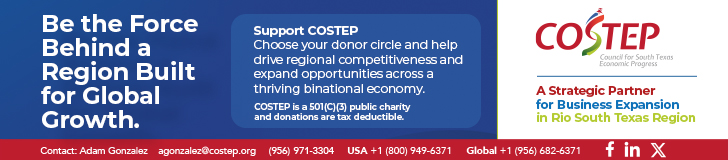
The discussion took place during a June 11 business forum hosted by the Council for South Texas Economic Progress (COSTEP) at the Cambria Hotel in McAllen. The panel featured Teclo García of Mission Economic Development Corporation, Jaime Ortiz of the City of Laredo, Daniel Garza of Edinburg Economic Development Corporation and Daniel Rivera of Elsa Economic Development Corporation, who outlined how their communities support manufacturers and suppliers expanding into the United States.



Teclo García, chief executive officer of Mission Economic Development Corporation, described San Luis Potosí as one of Mexico’s fastest-growing manufacturing centers and said Mission has built a strong relationship with the automotive cluster through previous trade missions. He pointed to the Anzalduas International Bridge, where commercial cargo operations are expected to begin in 2026, as a key logistics asset for companies serving both countries.
“Our strategic location and our land availability around the Anzalduas Bridge are our two strongest points,” García said, adding that companies should view Rio South Texas as an integrated regional network rather than individual cities competing for investment.
Jaime Ortiz, manager of the Economic Development Department for the City of Laredo, said the Port of Laredo remains the principal land gateway for trade between Mexico and the United States, with automotive parts representing its highest-value commodity. He said Interstate 35 provides direct access to U.S. markets and noted that additional bridge projects will further strengthen the city’s logistics capacity.
Ortiz also described Laredo’s recently redesigned “one-stop shop” permitting system, which brings city departments together early in the development process to help companies avoid delays before construction begins.
Daniel Garza, business development manager for Edinburg Economic Development Corporation, said the region’s workforce is one of its greatest competitive advantages. He cited the University of Texas Rio Grande Valley, South Texas College, Texas State Technical College and the Texas Manufacturing Assistance Center as partners preparing workers for advanced manufacturing.
“Our workforce capacities are over 400,000, and the majority is bilingual,” Garza said. “We understand that’s extremely important to auto manufacturing clusters from Mexico.”
Garza said Edinburg also coordinates permitting, utilities and municipal services through a single point of contact, allowing companies to move projects forward more efficiently.
Daniel Rivera, executive director of Elsa Economic Development Corporation, said that Rio South Texas communities increasingly function as a single interconnected economy. He noted that existing commuting patterns across Hidalgo and Cameron counties provide employers with access to a broad labor pool, while educational institutions collaborate to meet workforce needs.
“Our region has never worked more closely together,” Rivera said. He added that Elsa emphasizes rapid response and direct communication with prospective investors, using technology to deliver information and coordinate development quickly.
Throughout the discussion, the panelists emphasized that Rio South Texas offers manufacturers an integrated network of industrial sites, international bridges, workforce resources, educational institutions and economic development organizations working together to support investment and strengthen supply chains with central Mexico.
The forum concluded with the signing of a memorandum of understanding between COSTEP and the San Luis Potosí Automotive Cluster, reaffirming their commitment to expanding business relationships and fostering cross-border economic cooperation.
See related stories: