













Texas Border Business




By Valentina Guerra-Gonzalez
A teenage kid wakes up and steps out of his bedroom. His dad tells him he’s home from work on an “extended leave.” But the kid knows there’s more to it. He tells his parents his stomach hurts, but both say going to the doctor is too risky. So he goes to the door and into his family’s car, whose AC has been broken for the past few months. The 100-degree sun passes through the windows, and he prays another part won’t break down. His family can’t afford another loss. Since the 2026 USMCA renewal negotiations stalled, families living along the U.S.-Mexico border have felt such rampant consequences.
The renewal negotiations began in July 2026, prompting the U.S. to decline to extend the deal. The United States and Mexico face questions about market access, tariffs, and immigration; the negotiations’ greater impact is on border communities. As the stalemate continues, the U.S. and Mexico should recognize the effects of this ongoing economic and political uncertainty on an area defined by both cultures and sustained by bilateral trade and tourism.


A major tension surrounding the current renewal is the U.S. Section 232 national security tariff. In March 2025, the Trump administration imposed a 25% tariff, and by June 2025, the steel and aluminum tariff had risen to 50%. From Mexico’s perspective, this is seen as a threat to free trade with its largest market, the United States. On the other hand, the U.S. views this as a way to promote national security and protect domestic producers and manufacturers. While both countries aim to address their economic priorities, they are ignoring the interconnected trade that supports border communities. This places financial burdens on consumers, especially those who already struggle to afford daily necessities and may now be unable to afford rising auto repair prices.
In this stalemate, the U.S. also needs to recognize the dependence U.S. consumers have on Mexico’s market. Because of Mexico’s ideal climate for produce, most U.S. grocery stores carry brands like “Avocados from Mexico” and “Driscoll” strawberries. These brands, along with other natural produce, are grown or manufactured in Mexico, making them highly dependent on stable U.S.-Mexico trade and underscoring the countries’ interconnected dynamic. With the stalemate and continuing tensions, the possibility of tariff increases places another financial burden on consumers. If an agreement fails to preserve tariff-free agricultural trade, grocery prices would rise even higher, and some may no longer be able to afford this produce.
Border cities also serve as manufacturing hubs for U.S.-Mexico trade, with maquiladoras, or factories, located in northern Mexico and employing both U.S. and Mexican workers. Their low-cost labor and proximity to the U.S. and Mexico allow the United States to manufacture its products in these places and export them across the border, both domestically and internationally. Maquiladoras employ thousands of Mexican and U.S. workers, who cross the border every day to work as managers, specialists, or engineers. The stalemate, however, threatens the jobs of these workers. Amid current trade instability, foreign businesses avoid investing in these maquiladoras because the future market remains uncertain. Without foreign business investments, maquiladoras could face shutdowns, and workers from both sides of the border could lose their jobs.
The Trump administration’s immigration policies have also complicated the treaty’s socio-political negotiations. Many people immigrate to the U.S. hoping to start anew and find jobs in transportation, agriculture, and maintenance, which support American facilities that produce goods for trade. However, since Trump’s first presidential campaign in 2015, he has advocated stricter policies toward immigrants, including the construction of a border wall, and has expanded the authority of government agencies, such as the Immigration and Customs Enforcement (ICE).
Stricter border security enforcement has also led to longer inspections of trade, causing delays and additional costs for businesses. Furthermore, it has led to an increasing number of immigrant detentions. Immigrant workers’ jobs are a pillar of the U.S. economy and contribute to the supply chain that the U.S. economy runs on. Without them, manufacturing and production industries face the risk of losing workers, which would disrupt the production of goods and hinder a smooth U.S.-Mexico trade relationship.
Trump’s administration’s security measures at the border have already strained U.S.-Mexico relations. In January 2025, he declared a national emergency on the southern border, allowing the deployment of military personnel to the border. In February 2025, he issued Executive Order 14194 titled “Imposing Duties To Address the Situation at Our Southern Border.” While some goods were negotiated to receive protections under the USMCA, imported goods from Mexico received an additional 25% tariff. Mexico’s president, Claudia Sheinbaum, has pushed for cooperation by providing humanitarian aid to those turned away at the border or sent back to Mexico. Still, the Trump administration persists in asserting that Mexico’s government is weakly handling illegal immigration, thereby increasing drug trafficking. These events have heightened tensions ahead of USMCA renegotiations and are factors in the continuing stalemate. As this review remains unresolved, free trade becomes more uncertain, and the border economy faces greater threats.
It is essential for both countries to understand the interconnected lives of those at the border, whose stability now rests in the hands of negotiators in Washington and Mexico City. As the review continues, Mexico must reduce its dependence on the U.S. market while continuing to advocate for free trade across North America. Similarly, the United States must recognize its dependence on Mexico for many goods. Ultimately, given both countries’ geographic proximity and integrated communities, the border economy and dynamics should be the top priority. If both administrations recognize their mutual reliance and see that the stalemate is destabilizing trade and affecting the daily lives of their citizens, an agreement that prioritizes people and protects national sovereignty is possible.
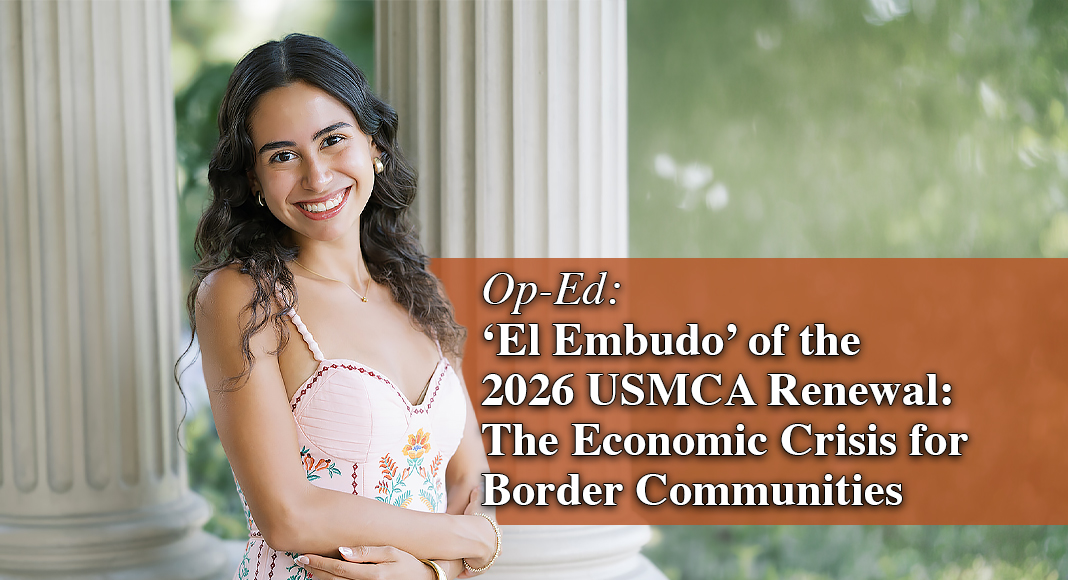
Written by Valentina Guerra-Gonzalez, a 17-year-old senior at St. Andrew’s Episcopal School in Austin, Texas, and a former Rio Grande Valley resident whose interest in U.S.–Mexico relations inspired her research on the economic challenges facing border communities.