
















Texas Border Business




Federal Bureau of Investigation (FBI)
For more than 91 years, the FBI National Academy (NA) program has welcomed law enforcement officers from state, local, county, Tribal, federal, military, and international agencies. Graduates leave the program as world-class leaders with access to a global alumni network to tap into for support.
And now, for the first time since its founding, FBI special agents have been invited to take part in this one-of-a-kind personal- and professional-development experience.



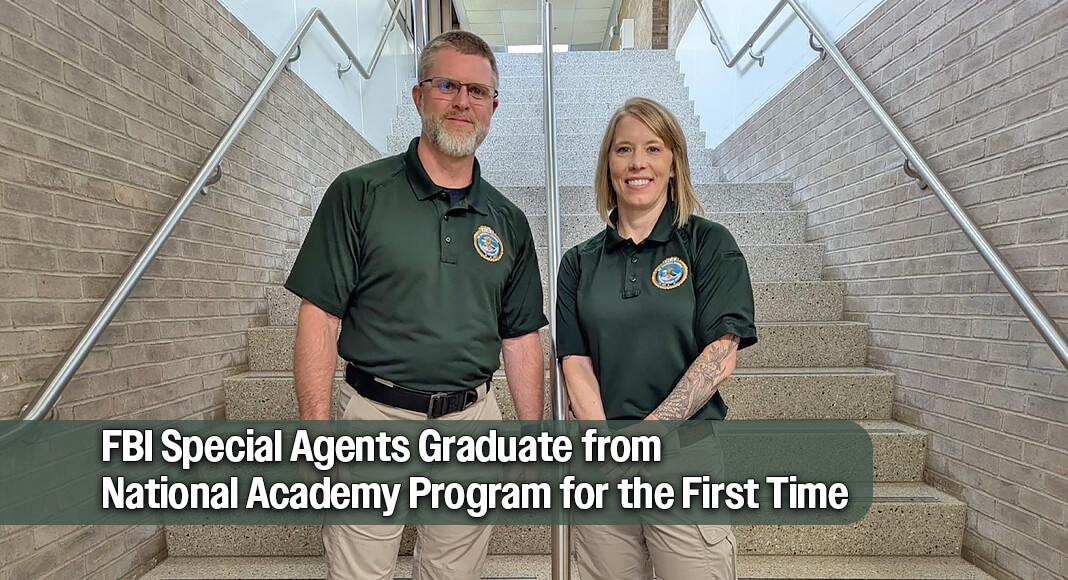
In September 2026, Tim Swanson, an assistant special agent in charge at FBI Pittsburgh, and Bianca Pearson, a supervisory senior resident agent who oversees FBI Charlotte’s satellite offices in Asheville and Hickory, North Carolina, became the program’s first-ever special-agent graduates, departing Quantico as alumni of National Academy Session 299.
The duo earned this distinction by gaining an internal selection board’s approval, making it through the program’s competitive application process, and then spending 10 weeks at the FBI Training Academy campus. There, they immersed themselves in leadership training; graduate-level academics accredited by the University of Virginia; and fitness, wellness, and resilience activities; all while learning from the diverse experiences and expertise of the hundreds of law enforcement professionals training alongside them.
Now, the FBI Training Division hopes that their experience will inspire more field-level leaders to apply for future National Academy sessions.
Pearson said that agents should use the program as an opportunity to invest in themselves. “Ten weeks is really a small amount of time in your 20-year career,” she said. “And the benefits that you will get after that are far more than the 10 weeks that it takes to go through this.”
From tactics to leadership
The FBI National Academy Program was initially founded in 1935 as the FBI Police Training School. The innovative model allowed state and local police officers to acquire the kind of specialized tactical knowledge that’d previously only been accessible to students in the FBI Training Academy at Quantico.
But in the mid-60s, the program’s focus began to shift away from pure tactics and toward leadership development. Today, the program’s mission is to provide senior law enforcement leaders with transformative developmental opportunities that build partnerships and promote excellence in policing worldwide.
Until this year, FBI police officers were the only Bureau personnel permitted to study at the National Academy. But the program’s gradual realignment towards leadership led the Training Division to recognize the benefits of allowing FBI special agents to attend. It opened opportunities for FBI field-level leaders to build partnerships with their law enforcement counterparts from other agencies.
Likewise, it gave agents the chance to develop their leadership skillset—especially since the program builds on, but doesn’t replicate, New Agent Training.
“To address the gap, we opened the National Academy doors to select FBI special agent senior leaders in July 2026,” said FBI National Academy Unit Chief Rebecca Vassilakos. “Specifically, FBI field office assistant special agents in charge and supervisory senior resident agents are invited to apply to the program due to their robust engagement with partner law enforcement agencies.”
For more than 91 years, the FBI National Academy (NA) program has welcomed law enforcement officers from state, local, county, Tribal, federal, military, and international agencies. Graduates leave the program as world-class leaders with access to a global alumni network to tap into for support.
And now, for the first time since its founding, FBI special agents have been invited to take part in this one-of-a-kind personal- and professional-development experience.
In September 2026, Tim Swanson, an assistant special agent in charge at FBI Pittsburgh, and Bianca Pearson, a supervisory senior resident agent who oversees FBI Charlotte’s satellite offices in Asheville and Hickory, North Carolina, became the program’s first-ever special-agent graduates, departing Quantico as alumni of National Academy Session 299.
The duo earned this distinction by gaining an internal selection board’s approval, making it through the program’s competitive application process, and then spending 10 weeks at the FBI Training Academy campus. There, they immersed themselves in leadership training; graduate-level academics accredited by the University of Virginia; and fitness, wellness, and resilience activities; all while learning from the diverse experiences and expertise of the hundreds of law enforcement professionals training alongside them.
Now, the FBI Training Division hopes that their experience will inspire more field-level leaders to apply for future National Academy sessions.
Pearson said that agents should use the program as an opportunity to invest in themselves. “Ten weeks is really a small amount of time in your 20-year career,” she said. “And the benefits that you will get after that are far more than the 10 weeks that it takes to go through this.”
From tactics to leadership
The FBI National Academy Program was initially founded in 1935 as the FBI Police Training School. The innovative model allowed state and local police officers to acquire the kind of specialized tactical knowledge that’d previously only been accessible to students in the FBI Training Academy at Quantico.
But in the mid-60s, the program’s focus began to shift away from pure tactics and toward leadership development. Today, the program’s mission is to provide senior law enforcement leaders with transformative developmental opportunities that build partnerships and promote excellence in policing worldwide.
Until this year, FBI police officers were the only Bureau personnel permitted to study at the National Academy. But the program’s gradual realignment towards leadership led the Training Division to recognize the benefits of allowing FBI special agents to attend. It opened opportunities for FBI field-level leaders to build partnerships with their law enforcement counterparts from other agencies.
Likewise, it gave agents the chance to develop their leadership skillset—especially since the program builds on, but doesn’t replicate, New Agent Training.
“To address the gap, we opened the National Academy doors to select FBI special agent senior leaders in July 2026,” said FBI National Academy Unit Chief Rebecca Vassilakos. “Specifically, FBI field office assistant special agents in charge and supervisory senior resident agents are invited to apply to the program due to their robust engagement with partner law enforcement agencies.”
Building more resilient leaders
Wellness is also a pillar of the modern National Academy curriculum.
All NA students must take a Wellness and Fitness in Law Enforcement course and engage in weekly fitness challenges.
These challenges culminate in the Yellow Brick Road, the National Academy’s signature 6.1 mile-long endurance challenge that students in each NA class must pre-qualify to compete in. Pearson and Swanson both made it through this crucible to earn a separate, unique honor—a yellow-painted brick—in honor of the achievement.
Both agents agreed that the NA afforded them a rare and precious opportunity to focus on their own wellness and resilience. “You know, by taking care of ourselves, we can take care of those we lead better,” Swanson said. He added that his NA experience showed him that wellness can look different for leaders and employees and illuminated the critical role that community plays in the pursuit of well-being.
For Pearson, it meant getting to look inward instead of just looking out for the welfare of her teams and learning how to have more grace for herself as a leader.
“I think one of the biggest things that I noticed was about week three, that the weight that we feel as leaders in the FBI—the kind of heaviness of our shoulders and … your parasympathetic [nervous] system is kind of on fight-or-flight all the time—that dissipated, and I finally felt calm and at ease for the first time in a really long time,” Pearson recalled. “That was something that I was hoping was going to happen, but I didn’t know how it would be possible.”
An intentional dynamic
National Academy students spend nearly every waking moment in community and participate in enrichment activities around the National Capital Region and beyond—including a visit to New York City—for both personal and professional enrichment.
As for the day-to-day, having a roommate, wearing mandatory uniforms, eating in a shared cafeteria, taking part in group fitness activities, and studying together for 10 weeks makes rapport inevitable.
“I think the relationships are built quickly at the NA because it’s a residential program, and you’re interacting with our colleagues, our classmates daily, in all facets of life,” Swanson said. “We have some of the same struggles, some of the same joys, excitements, you know, same difficulties, and that creates bonds that just, you can’t really recreate without this type of a setting.”
Those relationships are the foundation of the alumni network that participants can tap into for the rest of their professional lives. The September graduation brought the all-time total number of National Academy graduates to 57,461, with 4,469 of those coming from international partner agencies.
Should crisis strike, Pearson said she felt confident she could call any of her classmates from National Academy Session 299 at any hour of the day or night—and that they’d drop everything to respond.
“I don’t think you can put a value on the ability to be able to have a contact when you desperately need one or just being able to ask someone who may have more experience, ‘How did you do this, and how can you guide me?’” Pearson said. “The amount that you will take away from just that connectedness with everybody else, it’ll grow your investigative knowledge and your leadership knowledge tenfold because now, you have all these other people and touchpoints to draw from.”
Likewise, the National Academy fosters an environment in which students can openly share their views and experiences.
For example, Pearson said, a class that examined suicide rates among law enforcement officers who previously served in the military let students have candid conversation while feeling supported.
“People got to discuss and be vulnerable in a way that we, generally, are never vulnerable unless you’re with your significant other,” said Pearson, a U.S. Navy veteran. “So, I think it was really therapeutic for a lot of us to be able to talk about different things that we’ve experienced or seen in a space that was safe for all of us.”
Fostering international partnerships
The National Academy Program also boasts an International Partnership Program (IPP), which lets students opt to be paired with a student from an international law enforcement agency for the extent of the session.
In addition to being roommates for the 10 weeks of the program, program participants are invited to take part in IPP-only extracurricular events, including educational offsites and an international night. In this way, IPP participants serve as ambassadors of not only their home law enforcement agencies but also of their national cultures.
Looking ahead
Swanson remembers being “pretty excited” upon learning that the National Academy was opening its classes to agents. One of his uncles graduated from Session 198, and Swanson’s partner during his time at the Ankeny, Iowa, Police Department graduated from Session 267.
The program’s biggest lure—and now success—for him, though, was the relationships participants forged at the program.
“The networking aspect of the National Academy is a huge benefit,” Swanson said. “Knowing people all across the country and other field offices and now expanding that network … is incredibly valuable.”
Reflecting on her experience, Pearson said she was excited to return to North Carolina reinvigorated and ready to put her lessons learned into action in both her personal and professional lives.
“I saw it as an opportunity to get some leadership experience, to meet people from all over the world, and to try to expand my knowledge about law enforcement and leadership, in general,” she said.
Swanson echoed her gratitude.
“It’s absolutely an honor to be among the first two FBI agents to graduate from the National Academy,” he said. “It just shows the FBI’s commitment to continually pursuing excellence and realizing that there’s value for their own employees to go through this training alongside our partners.”
Information source: Federal Bureau of Investigation (FBI)