














Texas Border Business



By Amanda Sotelo
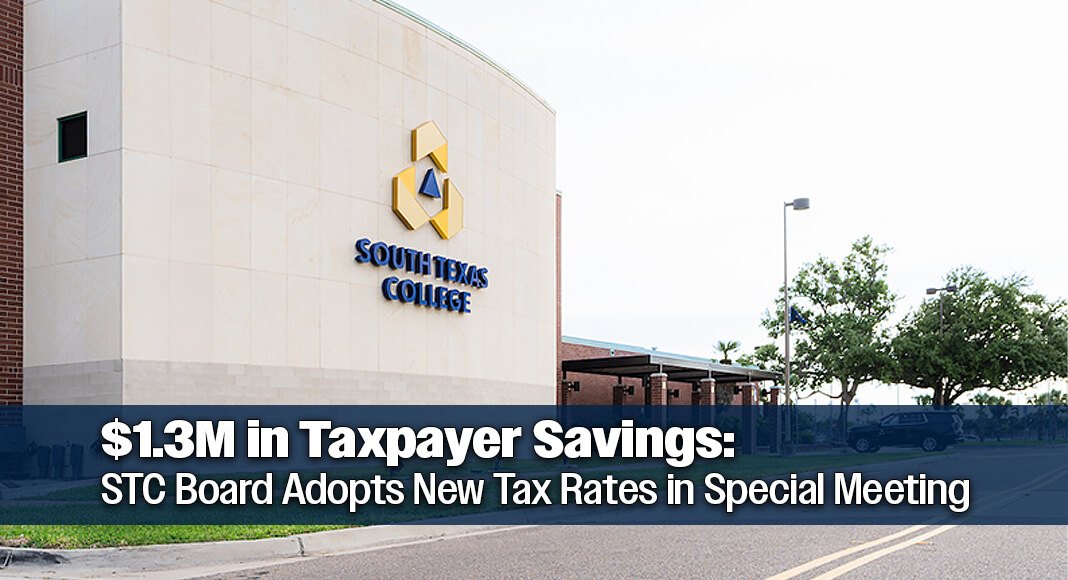
In a special meeting called by the South Texas College Board of Trustees, board members voted to adopt tax rates that will, over the years, save taxpayers approximately $1.3 million.

“I’m very proud of the action the board took today in adopting and maintaining tax rates that will be of great benefit to our students, administration and taxpayers,” said STC Board President Paul R. Rodriguez. “We owe our constituency transparency – this vote is going to allow us to continue our aggressive program in reducing our bond debt.”


The board adopted a property tax rate renewal of $.1620 per $100 taxable value, remaining the same as the previous year.
The maintenance and operations rate remains at $.14 per $100 taxable value, which is the maximum voter-approved tax rate, although the voter-approval tax rate sits at $.1513.
The interest and sinking tax rate also remains at $.0220 per $100 taxable value. This is the rate needed to fund this fiscal year’s debt service and future year debt retirement.
To give some perspective and understanding, the Hidalgo County and Starr County average homestead taxable value of $205,461 will be assessed an additional $3.30 of annual property taxes.
STC Vice President of Finance and Administrative Services Maria Del Paz said the excess revenue collected from the proposed rates will be used to reduce the college’s future debt.
“This move is going to save taxpayers approximately $1.3 million,” she said. “Prudent financial responsibility requires the college to analyze the overall interest and sinking tax liability that will positively affect our taxpayers in short and long-term.”
In a recent economic impact study on STC, for every $1 a student invests in the college, the student gains $8.70 in lifetime earnings and taxpayers gain $1.10 in added tax revenue and public sector savings.
Ultimately, STC’s total annual impact equals $693.5 million in added income to the region.
Rodriguez said STC is expecting an underpayment from the state for completion performance measures as part of changes in funding models and state fund allocations.
“Unfortunately, we’re in a situation where despite our success in filling the mandates set forth by the state in producing more dual credit hours, more workforce training, increasing certificate, associate degree and bachelor’s degree completion, etc., we will still be short $6.5 million,” he said. “We’re not sure what to expect in the future. Overall, this vote, is a win-win situation for the college and our taxpayers.”
These new tax rates go into effect for fiscal year 2027.