
















Texas Border Business




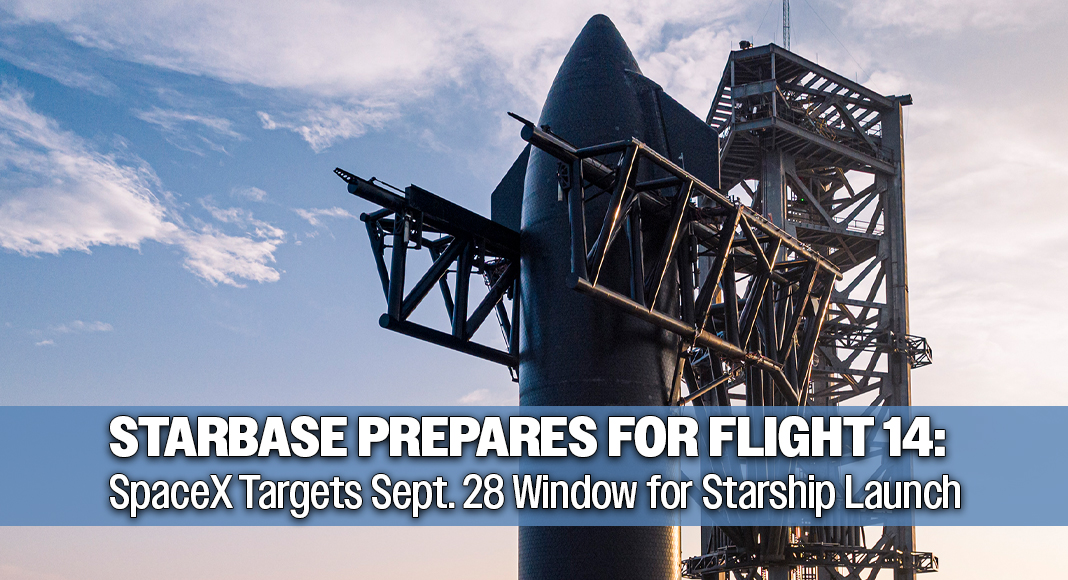
STARBASE, Texas – The 14th flight of Starship is preparing to launch as soon as Monday, September 28, pending regulatory approval. The 75-minute launch window will open at 7:15 a.m. CT.
The upcoming flight is planned to be the first to send Starship into orbit around Earth. Flight tests until this point have intentionally flown passively safe suborbital trajectories to maximize public safety while allowing for maximum learning. By going to orbit, the next phase of developing Starship to be fully and rapidly reusable can begin.
This will also mark the first time we plan to deploy Starlink V3 satellites into the constellation, delivering a payload that will dramatically expand connectivity speeds and reliability around the world.




Starship’s initial orbital mission is expected to fly at an altitude approximately 275 km above Earth and complete approximately six orbits around the planet over the course of a nearly 10-hour flight, with splashdown targeted in the Pacific Ocean to the west of Chile. Read moreabout what going to orbit means, along with the mission design and safety measures for this major milestone.
A live webcast of the flight will begin about 30 minutes before liftoff, which you can watch here and on X @SpaceX. Coverage is planned to continue through splashdown, with the potential for hours of live views from Starship as it orbits Earth. As is the case with all developmental testing, the schedule is dynamic and likely to change, so be sure to check in here and stay tuned to our X account for updates.
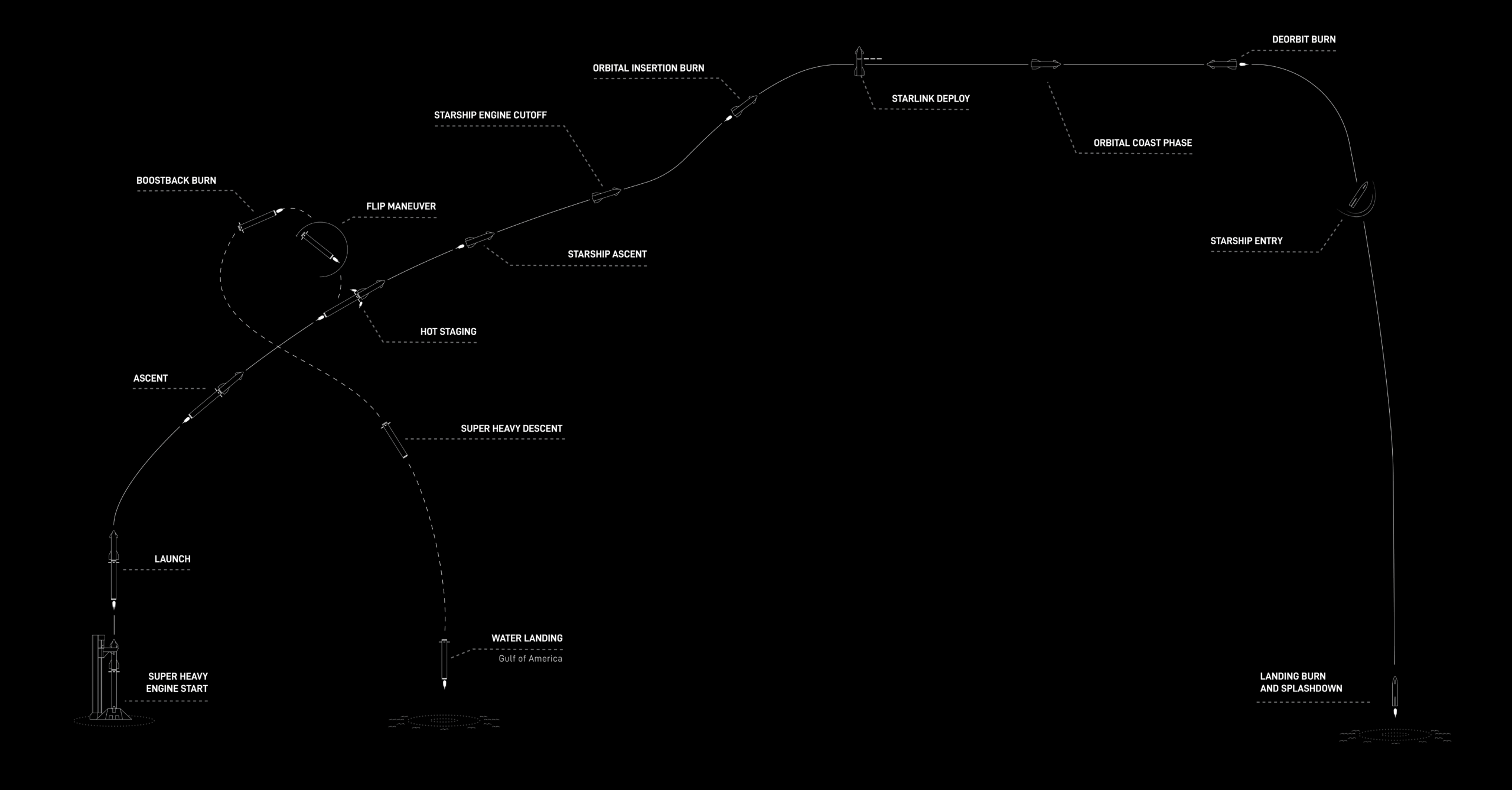
The booster’s primary test objective on Flight 14 will be executing a successful launch, ascent, stage separation, boostback burn, and landing burn at an offshore landing point in the Gulf of America. There have been several modifications to hardware and software to address issues seen on the previous flight.
After stage separation and flip on Flight 13, the Super Heavy booster was able to use all 33 engines on its boostback burn for the first time. In the terminal phase of the burn, the three center engines showed signs of ice clogging which triggered an early end to the maneuver. The booster went on to attempt a landing burn, with 8 of the 13 planned engines reigniting before the booster made a hard splashdown in the Gulf. The Super Heavy on this upcoming flight has hardware modifications to improve filtering to the engines and software changes to enhance relight reliability.
The Starship upper stage’s primary objectives include the first orbital insertion maneuver, the deployment of 26 Starlink V3 satellites, a deorbit burn using a single Raptor engine while in space, and a controlled reentry, descent, and splashdown in the Pacific Ocean. Starship will only execute a burn to enter orbit after the flight control team has ensured there is sufficient redundancy on hardware critical to doing the subsequent deorbit burn at the end of the mission.
Starship will deliver 26 Starlink V3 satellites to orbit for the first time, which aim to greatly expand the network’s capacity and user speeds. Each Starlink V3 satellite will add 1 Tbps of capacity to the constellation, for a total of 26 Tbps of capacity added on this mission alone. That’s ~10x the capacity compared to a single launch of V2 mini Starlink satellites on Falcon 9.
After deploying from Starship, the Starlink V3 satellites will unfold their antennas and deploy their solar arrays and make initial contact with the ground and the rest of the Starlink constellation via radio frequency and laser links. The satellites will then begin raising their orbits with their onboard thrusters. Following their on-orbit checkouts, the satellites should begin serving customers as soon as a few weeks after launch.
Three of the satellites have been modified with a suite of cameras to scan Starship’s heatshield and transmit imagery down to operators to continue testing methods of analyzing Starship’s heatshield readiness for return to launch site on future missions.
Several upgrades and experiments related to Starship’s heatshield will also be tested, with some improvements derived directly from data gathered from the Flight 13 Starship as it floated in the Indian Ocean. They include additional retention mechanisms added to tiles in areas deemed to be at highest risk of falling off during ascent, addressing recently discovered areas that offer flow paths behind tiles for plasma, and flying multiple areas with a curved tile design that has shown the ability to reduce heating in the gaps between tiles. And finally, two tiles recovered from Ship 40 are planned to be reflown on Ship 41, marking the first tile reuse for Starship.
COUNTDOWN
All Times Approximate
| HR/MIN/SEC | EVENT |
| 00:50:00 | SPACEX FLIGHT DIRECTOR CONDUCTS POLL AND VERIFIES GO FOR PROPELLANT LOAD |
| 00:36:33 | BOOSTER LOX (LIQUID OXYGEN) LOAD UNDERWAY |
| 00:35:00 | BOOSTER FUEL (LIQUID METHANE) LOAD UNDERWAY |
| 00:34:13 | SHIP LOX LOAD UNDERWAY |
| 00:34:11 | SHIP FUEL LOAD UNDERWAY |
| 00:21:40 | RAPTOR BEGINS ENGINE CHILL ON BOOSTER AND SHIP |
| 00:02:50 | BOOSTER PROPELLANT LOAD COMPLETE |
| 00:02:10 | SHIP PROPELLANT LOAD COMPLETE |
| 00:00:30 | SPACEX FLIGHT DIRECTOR VERIFIES GO FOR LAUNCH |
| 00:00:17 | FLAME DIVERTER ACTIVATION |
| 00:00:03 | BOOSTER ENGINE STARTUP COMMAND |
| 00:00:00 | EXCITEMENT GUARANTEED |
FLIGHT TIMELINE
All Times Approximate
| HR/MIN/SEC | EVENT |
| 00:00:00 | LIFTOFF |
| 00:00:58 | MAX Q (MOMENT OF PEAK AERODYNAMIC STRESS ON THE ROCKET) |
| 00:02:20 | SUPER HEAVY MECO (MOST ENGINES CUT OFF) |
| 00:02:22 | HOT-STAGING (STARSHIP RAPTOR IGNITION AND STAGE SEPARATION) |
| 00:02:27 | SUPER HEAVY BOOSTBACK BURN START |
| 00:03:07 | SUPER HEAVY BOOSTBACK BURN SHUTDOWN |
| 00:06:35 | SUPER HEAVY LANDING BURN START |
| 00:07:01 | SUPER HEAVY LANDING BURN SHUTDOWN |
| 00:08:11 | STARSHIP ENGINE CUTOFF |
| 00:25:28 | STARSHIP ORBITAL INSERTION BURN START |
| 00:25:47 | STARSHIP ORBITAL INSERTION BURN SHUTDOWN |
| 00:34:18 | PAYLOAD DEPLOY START |
| 01:04:50 | PAYLOAD DEPLOY COMPLETE |
| 08:52:18 | DEORBIT BURN START |
| 08:52:29 | DEORBIT BURN SHUTDOWN |
| 09:28:52 | STARSHIP ENTRY |
| 09:47:30 | STARSHIP IS TRANSONIC |
| 09:48:07 | STARSHIP IS SUBSONIC |
| 09:50:11 | LANDING BURN START |
| 09:50:13 | LANDING FLIP |
| 09:50:21 | LANDING BURN 3 TO 2 ENGINES |
| 09:50:22 | LANDING BURN 2 TO 1 ENGINE |
| 09:50:30 | AN EXCITING LANDING! |
Information source: SpaceX