















Texas Border Business




By Roberto Hugo González / Texas Border Business
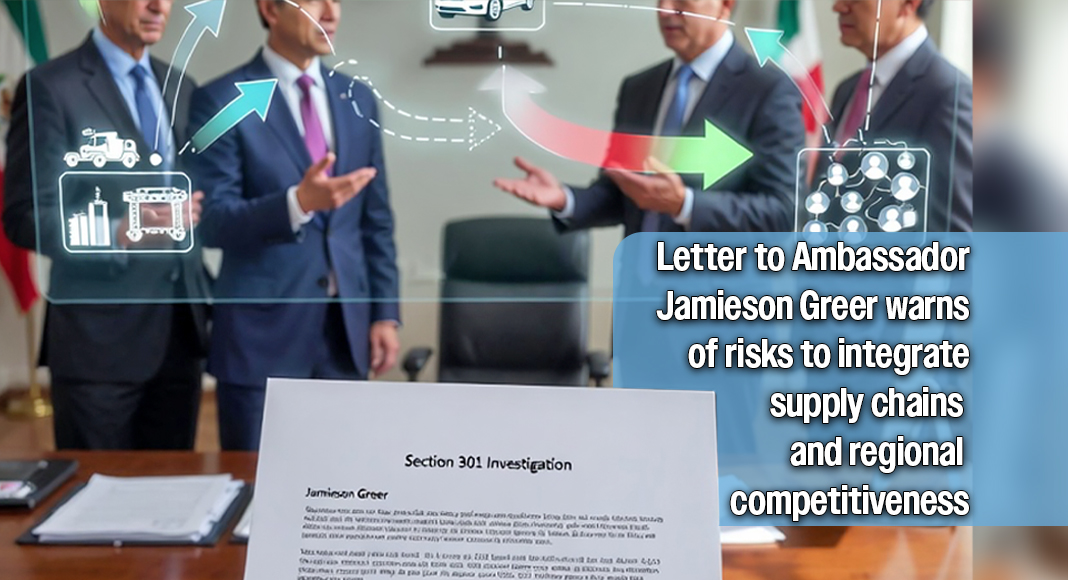
Mexican business organizations have formally appealed to Jamieson Greer to exclude Mexico from potential tariffs linked to a Section 301 investigation into global manufacturing overcapacity. In a letter dated April 14, 2026, the Consejo Coordinador Empresarial (CCE), the Confederación de Cámaras Industriales (CONCAMIN), and the Consejo Nacional de la Industria Maquiladora y Manufacturera de Exportación (INDEX) outlined their concerns about the investigation and its potential impact on the U.S.-Mexico economic relationship.
The organizations argue that Mexico should not be subject to tariffs because it does not engage in the types of government interventions identified in the investigation as causes of structural excess capacity. The letter states that “Mexico should be exempted from any tariffs” and describes the country as a “market-based open economy” where production decisions are driven by market forces rather than state policies. According to the document, Mexico does not promote exports through subsidies, suppress wages, or rely on state-owned enterprises to distort competition, practices cited in the investigation as problematic.



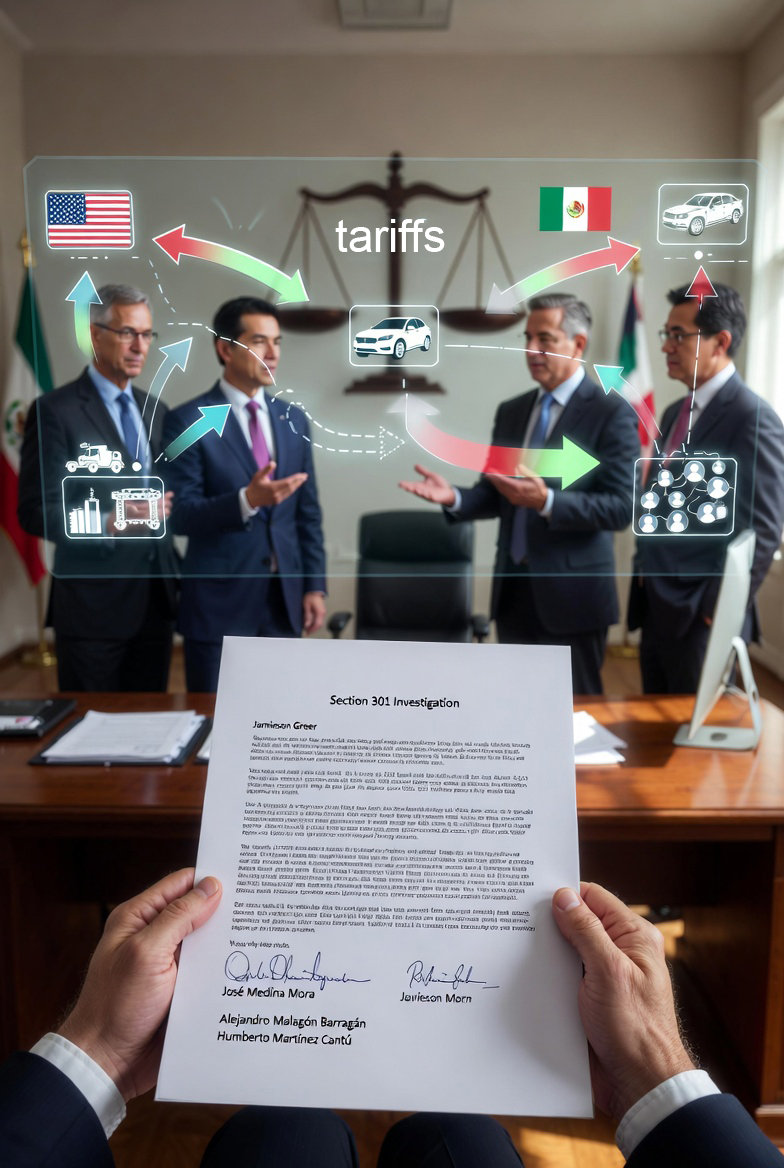
The letter emphasizes the depth of economic integration between the United States and Mexico, highlighting a production model in which goods and components cross the border multiple times before reaching final consumers. It notes that 62% of Mexican imports from the United States and 59% of U.S. imports from Mexico consist of industrial inputs used in manufacturing processes. This “regional coproduction model,” the groups argue, has strengthened North American competitiveness and created a highly interdependent industrial base.

Jorge Torres, President of Interlink Trade Services, reinforced that position by urging policymakers to view the issue through the larger framework of North American integration and the upcoming review of the United States-Mexico-Canada Agreement. “In the spirit of the USMCA revision, these types of actions by the U.S. government should not be contemplated. It is the consensus of both the public and private sectors that the USMCA should continue, preferably as a tri-lateral agreement. Yes, it is important to implement certain measures and safeguards to minimize the risk of the trans-shipment of goods to take advantage of the preferential treatment that the USMCA provides, such as foreign (Chinese) goods imported to Mexico for re-export to the U.S., applying USMCA preferential treatment, but this should be explicit in the agreement itself. If North America wants to succeed as a powerful economic region, the U.S. should grant certain concessions to Mexico and Canada, such as removing Section 232 and Section 301 tariffs. Mexico and Canada should reciprocate by allowing greater direct investment with fiscal and legal certainty,” said Torres.
Mexico’s role as a key export market for the United States is another central point in the letter. The organizations state that Mexico “has emerged as the most important market for the United States,” surpassing the combined exports to several major Asian and European economies. They add that Mexico is a leading market for 24 U.S. industries and serves as a top destination for exports from 26 U.S. states, underscoring the breadth of the bilateral trade relationship.
The groups warn that new tariffs or trade restrictions resulting from the investigation would have significant negative consequences for both countries. The letter states that such measures would “hinder trade” and “disrupt consolidated supply chains,” increasing costs and slowing production across North America. They argue that these disruptions would weaken the region’s ability to compete globally, particularly against third-country manufacturers.
Torres’ remarks echoed that concern, while also pointing to the need for more clearly defined rules within the USMCA to address trans-shipment risks without undermining regional cooperation. His comments suggest that business leaders on both sides of the border see stronger enforcement and deeper integration not as opposing goals, but as complementary steps needed to preserve North America’s competitiveness.
In addition to trade impacts, the organizations highlight the uncertainty created by the ongoing investigation. They state that the process is affecting exporters, investors, and logistics providers in both Mexico and the United States, complicating long-term planning and discouraging new investment. “The Investigation introduces another layer of uncertainty, hindering long-term planning and deterring new investment in the region,” the letter notes.
The document also addresses broader trade dynamics, noting that Mexico maintains a relatively balanced trade position and that surpluses and deficits vary by industry according to comparative advantage. This, the organizations argue, reflects normal behavior in an open economy rather than evidence of structural imbalance or unfair practices.
The letter is signed by José Medina Mora, Alejandro Malagón Barragán, and Humberto Martínez Cantú, representing major sectors of Mexico’s private industry. In their conclusion, the signatories express support for a “strong, mutually beneficial trade relationship” while acknowledging the importance of protecting U.S. industries. They call for a balanced approach that preserves the economic integration achieved under the United States-Mexico-Canada Agreement and invite continued dialogue to resolve the issue.
Read the full letter below: