
















Texas Border Business





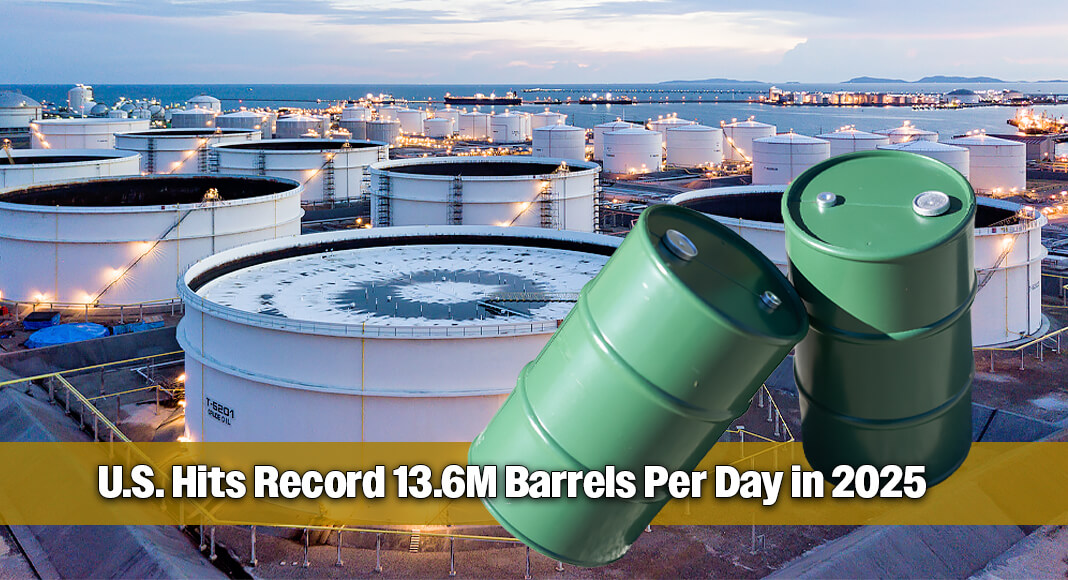
The United States remained the world’s largest crude oil producer in 2025, continuing a trend that began in 2018 and reflects a remarkable turnaround from past decades. With a record high 13.6 million barrels per day (bpd), the US led Russia (9.9 million bpd), Saudi Arabia (9.6 million bpd), and Canada (5.0 million bpd) by a wide margin.
The ongoing upward trend in production persisted despite lower prices. West Texas Intermediate (WTI) dropped from an average of $77 per barrel in 2024 to $65 in 2025 due primarily to global supplies outstripping demand. One reason for the increase is higher drilling productivity and operational efficiency, which allows operators to extract more oil per well. Production growth was particularly strong in the Permian Basin of Texas and New Mexico, which accounted for about 48% of total domestic production in 2025.
Global patterns changed dramatically around 2008, when a decades-long decline in US production reversed as fracking and other advances greatly enhanced the potential for shale oil and gas development. The shift has been highly beneficial, both in terms of economic performance and geopolitical strength.



US petroleum exports reached another record in May as disruptions in the Middle East and flows through the Strait of Hormuz increased global demand for US exports, rising sharply to 419.7 million barrels from 408.3 million barrels in April. By enhancing the overall supply of oil, the US industry has helped to dampen the effects of market disruptions. In addition, the country is far less susceptible to shortages now, importing far less than in the past.
Because oil is largely priced in a global market, however, US consumers and industries are feeling the effects of the current Middle Eastern conflict. High oil prices are not only affecting household and business budgets, but are also working their way through the entire economy. With upward pressure on prices of goods which use fuels for inputs (which is virtually everything in one way or another), inflation is the inevitable result.
Clearly, US oil production is a primary reason that oil prices have been lower and less volatile than they otherwise would have been during recent tensions. It is a significant stabilizing force, though not one that can completely insulate either the US or other regions from major supply shocks.
The US Energy Information Administration is projecting that US crude production will average near 13.7 million bpd in 2026, rising to 14.2 million bpd in 2027. With well over 40% of national production, Texas is a major player in meeting global demand. At the same time, the energy industry is seeing increased profits in the current higher price environment, enhancing the potential for additional drilling activity and long-term investment. Stay safe!
________________
Dr. M. Ray Perryman is President and Chief Executive Officer of The Perryman Group (www.perrymangroup.com), which has served the needs of more than 3,000 clients over the past four decades.