














Texas Border Business




By Texas Border Business
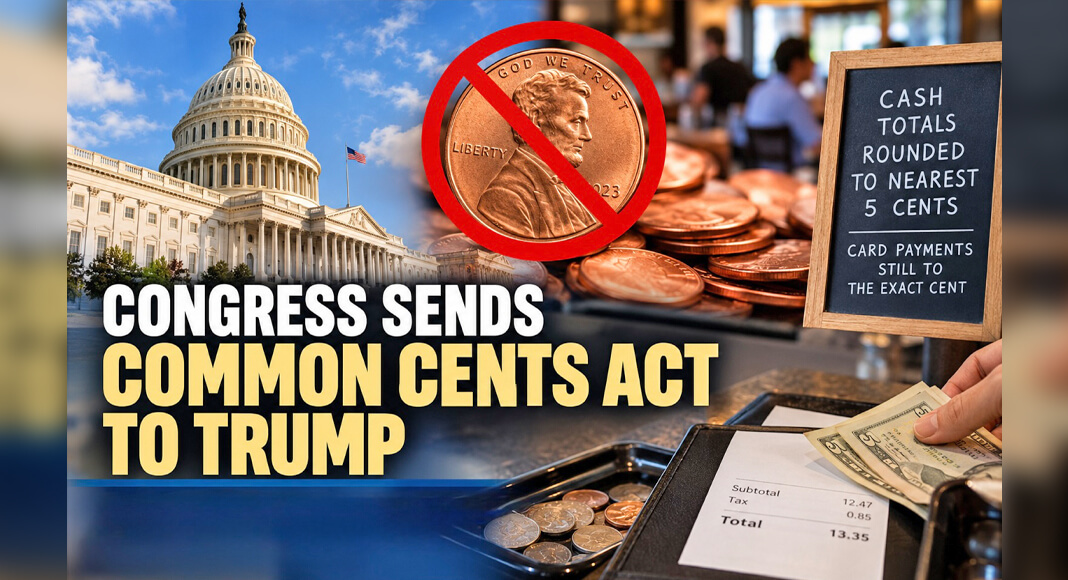
WASHINGTON, D.C. — The U.S. Senate passed the Common Cents Act on Sept. 28, sending legislation that establishes national cash-rounding rules to President Donald Trump after the phaseout of penny production.
The Senate approved H.R. 10167 after the House passed the measure earlier in September. The legislation establishes procedures for businesses that cannot provide exact change because pennies are unavailable.




Under the measure, businesses may round cash transaction totals to the nearest five cents when necessary. Electronic and other non-cash payments continue to be calculated to the exact cent, while pennies already in circulation remain legal tender.
The legislation also provides a safe harbor from liability for businesses that follow its rounding requirements.
The National Restaurant Association advocated for the legislation, saying penny shortages had created operational and legal uncertainty for restaurants. More than one in four restaurant purchases are paid in cash, the association says.

“We appreciate Congress passing the Common Cents Act to address the issues restaurant operators have been working through since the penny shortage started,” Michelle Korsmo, president and CEO of the National Restaurant Association, said in a statement.
Korsmo said operators needed clear guidance as the country moved away from penny production.
“The Common Cents Act provides clear principles and certainty, helping keep transactions simple and straightforward while allowing restaurants to focus on serving guests,” she said.
Before congressional action, many restaurant operators were rounding transaction totals down when they lacked pennies because they feared potential legal challenges, according to the association. In December 2025, the organization estimated that continued downward rounding could cost restaurant operators $13 million to $14 million each month.
The issue comes as restaurants continue to operate under narrow profit margins. The National Restaurant Association has reported that industry profit margins generally remain around 3%, while food and labor costs have risen substantially since 2020.
The Common Cents Act received bipartisan support. Rep. Lisa McClain, R-Mich., and Rep. Robert Garcia, D-Calif., led the House effort, while Sens. Cynthia Lummis, R-Wyo., and Kirsten Gillibrand, D-N.Y., sponsored related legislation in the Senate.

Sean Kennedy, chief advocacy officer for the National Restaurant Association, credited the lawmakers for advancing the measure.
“Their bipartisan collaboration underscores their support of the restaurant and small business owners on Main Street that serve as cornerstones of their local economies,” Kennedy said.
The legislation now goes to Trump for consideration. If signed, it would give businesses a federal framework for handling cash transactions when pennies are unavailable, while allowing existing pennies to remain in circulation.
Learn more about the economic contributions of the restaurant and foodservice industry here.