












Texas Border Business




U.S Department of Justice
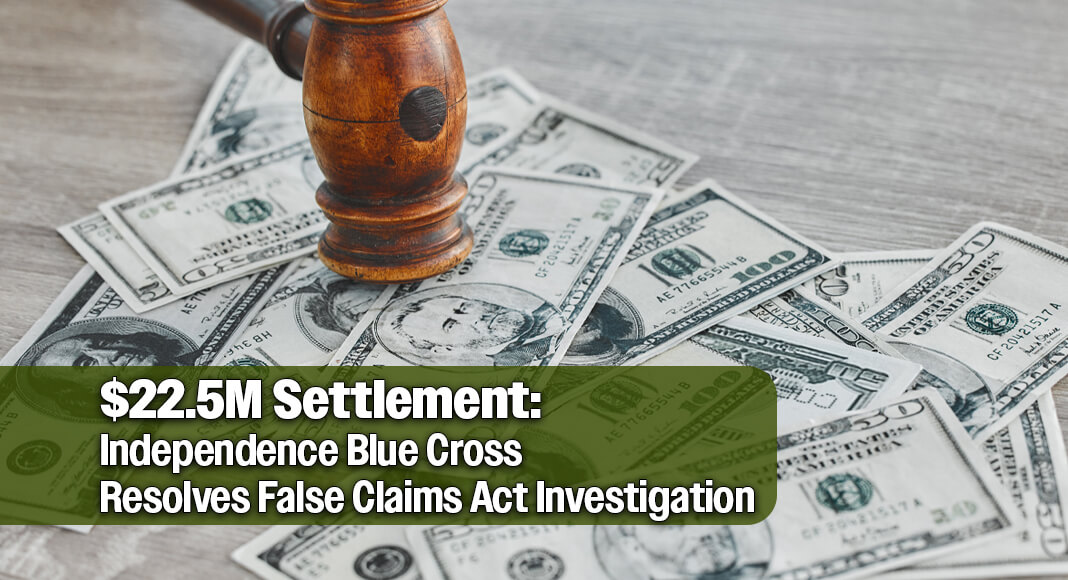
Independence Blue Cross (IBX), an insurance company incorporated under the laws of Pennsylvania, has agreed to pay $22.5 million to resolve allegations that it violated the False Claims Act by failing to withdraw inaccurate and untruthful diagnosis codes for its Medicare Advantage Plan enrollees in order to improperly retain overpayments from Medicare.
Under the Medicare Advantage (MA) Program, also known as Medicare Part C, Medicare beneficiaries may opt out of traditional Medicare and enroll in private health plans offered by insurance companies known as Medicare Advantage Organizations, or MAOs. The Centers for Medicare & Medicaid Services (CMS) pays MAOs a fixed monthly amount adjusted for various risk factors that affect expected health expenditures for the beneficiary. In general, CMS pays MAOs more for sicker beneficiaries expected to incur higher healthcare costs. To make these “risk adjustments,” CMS collects medical diagnosis codes from the MAOs.



The United States alleges that IBX submitted inaccurate and untruthful patient diagnosis data to CMS that inflated the risk adjustment payments it received from CMS, knowingly failed to withdraw the inaccurate and untruthful diagnosis data and repay CMS, and falsely certified in writing to CMS that the data was accurate and truthful. The settlement announced today resolves these allegations.
“The government pays private insurers over $530 billion each year to care for Americans enrolled in Medicare Advantage,” said Assistant Attorney General Brett A. Shumate of the Justice Department’s Civil Division. “When insurers knowingly and improperly retain inflated payments based on inaccurate and untruthful diagnoses, we will hold them accountable whether they are a small regional plan or a large nationwide organization.”
“The Medicare Advantage program depends on accurate data about patient health,” said U.S. Attorney David Metcalf for the Eastern District of Pennsylvania. “When insurers inflate their profits and the government’s costs by submitting or failing to correct unsupported diagnoses, my office will continue to hold them accountable.”
“Providing medical services to Americans is a privilege that requires strict adherence to the rules and accountability when they are not followed,” said Acting Deputy Inspector General for Investigations Miranda L. Bennett of the U.S. Department of Health and Human Services, Office of the Inspector General (HHS-OIG). “Private insurers enrolled in the Part C program purposely inflating diagnoses for financial gain is unacceptable. Today’s settlement demonstrates our commitment to ensuring the integrity of the Medicare program and to partnering with the Department of Justice to pursue allegations of risk adjustment fraud.”
The United States contends that, for payment years 2017-2021, IBX operated a “chart review” program in which its nurse reviewers reviewed medical records (also known as “charts”) and identified all medical conditions that the charts supported. IBX relied on the results of those chart reviews to submit additional diagnosis codes to CMS to obtain additional payments. However, IBX’s chart reviews did not substantiate some diagnosis codes previously reported by IBX to CMS. IBX did not delete or withdraw those diagnosis codes, which would have required IBX to reimburse CMS. The United States alleges that IBX used the results of its chart reviews to identify instances where IBX could seek additional payments from CMS while ignoring those same results when they indicated IBX was overpaid.
The civil settlement resolves a lawsuit filed under the whistleblower provisions of the False Claims Act, which permit private parties to sue on behalf of the government when they believe that a defendant has submitted false claims for government funds and receive a share of any recovery. The qui tam case is captioned United States ex rel. Crawford v. Independence Blue Cross, No. 20-cv-5818, in U.S. District Court for the Eastern District of Pennsylvania. The settlement in this case provides for the whistleblower, a former IBX employee, to receive a $3,825,000 share of the settlement amount.
This year the Administration launched the Task Force to Eliminate Fraud and the National Fraud Enforcement Division to enhance the administration’s war on fraud, waste, and abuse in federal programs. When unscrupulous actors exploit these programs for their own financial gain, they defraud the government, harm the people these programs are designed to aid and protect, and undermine American businesses that play by the rules. The Civil Division’s FCA enforcement plays a critical role in combatting such fraudulent schemes, recovering billions of dollars for the American taxpayers, and holding wrongdoers accountable. FCA matters will continue to be on the forefront of the battle against fraud, and the Civil Division’s FCA work will support and advance the mission of the Task Force to Eliminate Fraud and the National Fraud Enforcement Division.
The resolution obtained in this matter was the result of a coordinated effort between the Justice Department’s Civil Division, Commercial Litigation Branch, Fraud Section, and the U.S. Attorney’s Office for the Eastern District of Pennsylvania, in conjunction with HHS-OIG.
The investigation and resolution of this matter illustrate the government’s emphasis on combating healthcare fraud. One of the most powerful tools in this effort is the False Claims Act. Tips and complaints from all sources about potential fraud, waste, abuse and mismanagement, can be reported to the Department of Health and Human Services at www.oig.hhs.gov/fraud/report-fraud or 800-HHS-TIPS (800-447-8477).
The matter was handled by Fraud Section Attorney Wendy Zupac and Assistant U.S. Attorney Peter Carr for the Eastern District of Pennsylvania.
The claims resolved by the settlement are allegations only and there has been no determination of liability.
Updated September 30, 2026