







Texas Border Business

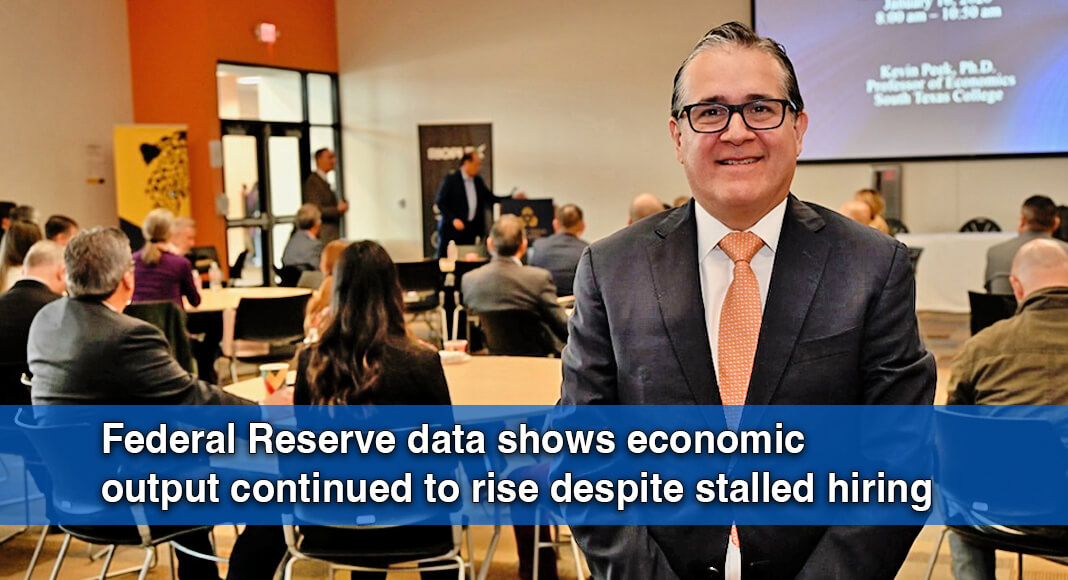
Texas Border Business presents a four-part series featuring economic briefings from Luis Torres of the Federal Reserve Bank of Dallas, offering business and community leaders a data-driven view of the forces shaping Texas and the Rio Grande Valley. The presentations, shared during the RioPlex Leadership event organized by RioPlex and executed by its Executive Director, Mario Reyna, explore key trends including stalled job growth, rising artificial intelligence investment, the strength of trade with Mexico, and the outlook for 2026, helping regional stakeholders better understand the economic conditions influencing workforce demand, investment, and long-term competitiveness across South Texas.
By Roberto Hugo González / Texas Border Business

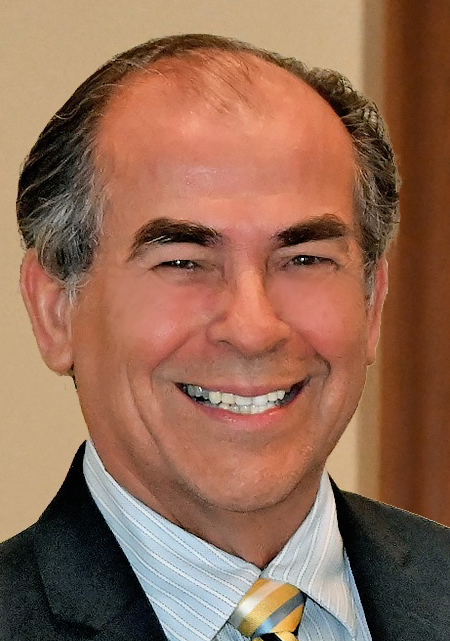
When regional leaders gathered for the RioPlex Leadership event, organized by RioPlex and executed by Mario Reyna, Executive Director and Board Secretary of RioPlex, the focus was on understanding the forces shaping the future of the Rio Grande Valley and South Texas. One message stood out clearly during the discussion: Texas experienced a year unlike any in recent history.
Economist Luis Torres of the Federal Reserve Bank of Dallas reported that “there was zero employment growth in the state of Texas in 2025. Zero.” He emphasized that the number was accurate and represented a sharp break from the state’s long-standing trend of steady job creation.
“For a state that historically grows employment at about two percent annually, this is significant,” Torres said. He noted that even during past economic slowdowns, Texas had typically continued adding jobs.
Despite flat employment, Torres said the state economy did not contract. “GDP is still growing,” he explained, adding that output was below average but remained positive, estimated at roughly 1.8 to 2 percent growth based on available data through midyear. The gap between output growth and job growth points to changes in how economic expansion is occurring.
Torres attributed the hiring slowdown to a combination of factors. He cited policy uncertainty related to tariffs, changes affecting immigration and labor supply, federal government cutbacks, and uncertainty that made firms more cautious about adding workers. “Those were the costs,” he said, referring to the factors weighing on employment growth.
At the same time, investment continued in certain areas of the economy. Torres pointed to construction activity tied to infrastructure and technology, noting that non-building construction helped support output even as residential construction weakened.
The labor market, however, has remained stable. Torres described the current conditions as “a low-hiring, low-firing economy.” He said unemployment claims have not increased, and the unemployment rate has remained relatively steady. “Companies are not hiring, but they’re also not firing,” he said.
Survey data collected by the Federal Reserve Bank of Dallas support that view. Torres reported that when Texas firms were asked about their top concerns, slowing demand ranked first, followed by inflation and domestic policy uncertainty. Even so, many businesses reported improved expectations for future activity and capital spending.
Trade continues to play a key role in supporting the Texas economy. Torres reminded the audience that Texas remains the nation’s top export state and said trade with Mexico remains a positive factor, particularly as the mix of goods traded evolves.
Looking ahead, Torres said employment growth is expected to return in 2026, though likely at a slower pace than the state’s historical average. “It’ll pick up from that zero growth in 2025,” he said, “but probably will not get to that two percent trend.”
He added that productivity gains and innovation are enabling firms to grow without adding many workers, while labor supply constraints continue to limit hiring.
Summarizing the year, Torres said, “Texas in 2025 grew without adding any jobs.” For South Texas leaders, the message was clear: economic growth is continuing, but the relationship between growth and employment is changing, requiring closer attention to productivity, workforce preparation, and long-term planning.
See related Stories: