
















Texas Border Business




Texas Border Business
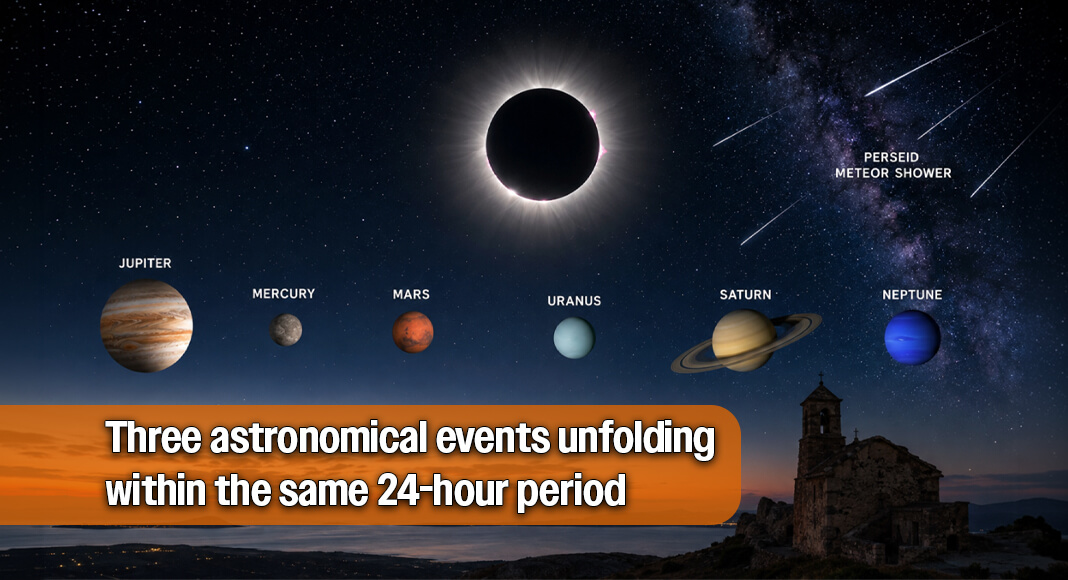
Skywatchers have several reasons to look up on Aug. 12, 2026, as a total solar eclipse, a six-planet gathering and the Perseid meteor shower occur within the same 24-hour period.
Before sunrise, six planets — Jupiter, Mercury, Mars, Uranus, Saturn and Neptune — appear across the morning sky in what is commonly called a planetary parade. Jupiter, Mercury, Mars and Saturn can be visible without optical equipment under favorable conditions, while Uranus and Neptune generally require binoculars or a telescope.



The planets are not physically lined up next to one another in space. The apparent grouping occurs because the planets orbit the Sun in roughly the same plane and therefore appear along a similar path across Earth’s sky.
Later Wednesday, the Moon will pass between Earth and the Sun, producing a total solar eclipse. NASA says the path of totality will cross Greenland, Iceland, northern Russia, the Atlantic Ocean, Spain, and a small portion of Portugal.
Most locations along the path will experience less than two minutes of totality, according to NASA. Areas near the center of the eclipse path in Greenland, Russia, and the North Atlantic can experience totality for slightly longer, but still less than two and a half minutes.
Large portions of the Northern Hemisphere will see only a partial eclipse. NASA says that includes most of Canada, much of Europe, northwestern Africa, and portions of the northern United States. The path of totality does not cross Texas.
The eclipse will occur late in the day in parts of Europe. NASA lists totality in León, Spain, from about 8:28 p.m. to 8:30 p.m. local time and in Reykjavík, Iceland, from about 5:48 p.m. to 5:49 p.m. local time. In several European locations, the Sun will set while still partially eclipsed.
NASA warns that viewers must use safe solar-viewing glasses or a proper handheld solar viewer when looking directly at the Sun during the partial phases. Eclipse glasses are different from ordinary sunglasses. Only during totality, when the Moon completely blocks the Sun’s bright face, is it safe to look directly at the eclipse without specialized eye protection.
The astronomical activity continues after sunset with the Perseid meteor shower, which reaches its annual peak around Aug. 12 and 13. The Perseids occur when Earth travels through debris associated with Comet 109P/Swift-Tuttle. Small particles enter Earth’s atmosphere at high speeds and produce streaks of light across the sky.
NASA describes the Perseids as one of the most popular meteor showers of the year. The meteors are known for being swift and bright and can leave visible trails of light as they cross the atmosphere. They appear to originate from the direction of the constellation Perseus.
The timing of the eclipse also means the Moon is at or near its new-moon phase, providing dark nighttime conditions for observing the Perseids after the eclipse.
Although the eclipse, planetary gathering, and meteor shower occur within the same period, they are separate astronomical events produced by different orbital circumstances. The total eclipse results from the alignment of the Sun, Moon, and Earth, while the Perseids are produced as Earth passes through comet debris. The planetary parade describes the appearance of multiple planets across the morning sky rather than a perfect physical alignment of the planets in space.
Together, the events make Aug. 12, 2026, an unusual day for skywatching, beginning with multiple planets before sunrise, followed by a total solar eclipse visible along a narrow path across the Northern Hemisphere and the Perseid meteor shower after nightfall.