







By Roberto Hugo González | Texas Border Business

You’re reading one of 12 exclusive stories from the McAllen City Manager’s Update—brought to you by Texas Border Business. Discover the projects, people, and progress shaping McAllen’s future. Subscribe for FREE today and enjoy the complete series!
The upcoming expansion of the Anzalduas International Bridge to accommodate full commercial cargo operations will redefine trade and transportation across the Rio Grande Valley. The project, which has been years in the making, is expected to significantly reduce crossing times, improve logistics efficiency, and enhance McAllen’s position as a significant hub for binational commerce.

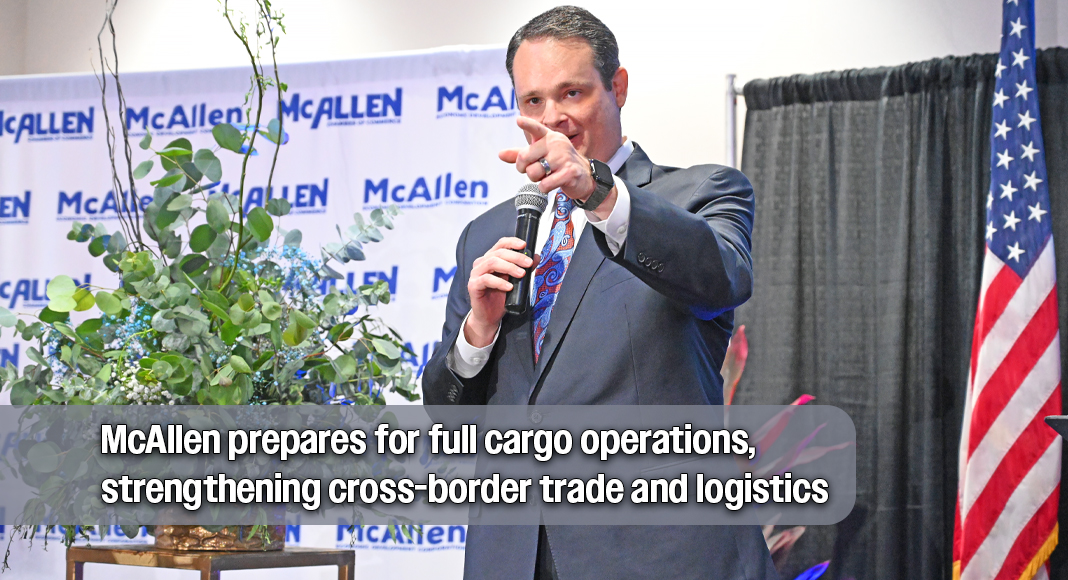
City Manager Isaac J. “Ike” Tawil highlighted the importance of the project during his remarks at the McAllen Chamber of Commerce’s Government Affairs Series, calling it “another tremendous opportunity” for the city and the entire region. “Anzalduas’ full cargo is ready to come online,” Tawil said. “It is going to be CTPAT and FAST certified, and it’s going to be exclusive in those categories.”
The CTPAT (Customs Trade Partnership Against Terrorism) and FAST (Free and Secure Trade) certifications are designed to expedite border crossings for pre-screened, low-risk cargo shipments, ensuring that trade flows efficiently and securely. Tawil explained that these certifications will make McAllen’s bridge one of the most efficient ports of entry in South Texas. “What that means is that the cargo coming across that bridge has already been predetermined, for the most part, to be safe,” he said. “It will be subject to minimal inspections and flow freely.”
According to Tawil, the time savings for carriers could be dramatic. “We’ve met with logistics clusters and trucking companies in Mexico, and depending on where they’re coming from, the difference in distance might be only about 40 kilometers compared to Laredo,” he said. “But what really matters is time—on average, they will save six to seven hours per truck crossing the bridge.”
The efficiency gains are expected to provide a major boost to the region’s freight, warehousing, and industrial sectors. “The impact this will have on our economy and on opportunities for industrial development is off the charts,” Tawil said. “Cargo that crosses our bridges typically reaches coast to coast across the United States within seven days.”

McAllen has also been coordinating closely with both U.S. and Mexican officials to ensure that the infrastructure on both sides of the border is ready for full operations. “Through our diplomatic communications in Mexico, we were able to resolve the challenges that had delayed construction on their side of the project,” Tawil said. “We’re now looking forward to finalizing the last stages and beginning operations once all inspection equipment is installed.”
The project has required extensive collaboration between local governments and federal agencies in both countries.
Tawil also serves on the Texas Freight Advisory Committee, a subcommittee of the Texas Department of Transportation (TxDOT), where he advocates for continued infrastructure improvements to support trade growth. “When I explained that Anzalduas Highway currently dead ends into the expressway at a stop sign, everyone in the room took notice,” he said. “We’re now working with TxDOT to make sure our highway infrastructure matches the growth we’re expecting from this project.”
Once operational, the Anzalduas International Bridge will join the Pharr-Reynosa International Bridge and Los Indios Bridge as a key commercial artery between Texas and northern Mexico. For Tawil, the project represents more than just an infrastructure upgrade—it is a step toward regional competitiveness and economic integration. “This bridge is going to change the way freight moves through South Texas,” he said. “It’s about efficiency, partnership, and building the next generation of trade.”
See related stories: