







- Texas Records Zero Job Growth in 2025
- AI Investment Drives Texas Economy as Hiring Growth Remains Limited
- Trade With Mexico Remains a Key Driver of Texas Economic Strength
- Mild Growth Expected for Texas Economy in 2026
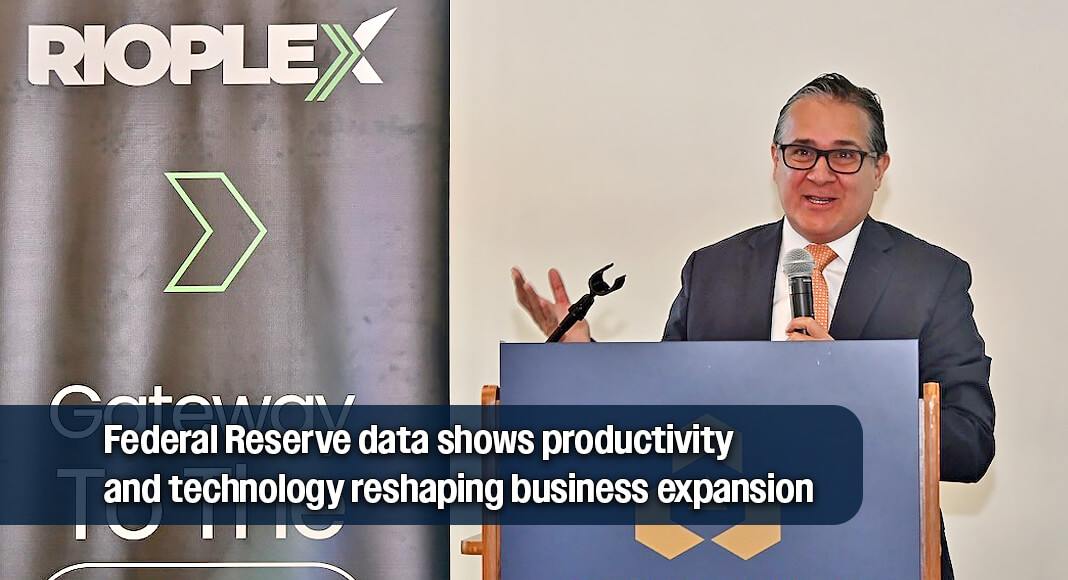
Economist Luis Torres of the Federal Reserve Bank of Dallas. Photo by By Roberto Hugo González / Texas Border Business
Texas Border Business

Texas Border Business presents a four-part series featuring economic briefings from Luis Torres of the Federal Reserve Bank of Dallas, offering business and community leaders a data-driven view of the forces shaping Texas and the Rio Grande Valley. The presentations, shared during the RioPlex Leadership event organized by RioPlex and executed by its Executive Director, Mario Reyna, explore key trends including stalled job growth, rising artificial intelligence investment, the strength of trade with Mexico, and the outlook for 2026, helping regional stakeholders better understand the economic conditions influencing workforce demand, investment, and long-term competitiveness across South Texas.
By Roberto Hugo González / Texas Border Business

Artificial intelligence and advanced technology are becoming central to how the Texas economy expands, allowing companies to increase output while relying less on traditional workforce growth. That was a key message delivered by economist Luis Torres of the Federal Reserve Bank of Dallas during a recent regional economic briefing.
Torres described AI as “one of the upticks in the economy that we’ve seen in Texas, in the U.S., internationally,” pointing to rising investment and infrastructure tied to digital computing.

The remarks were presented during the RioPlex Leadership event, organized by RioPlex and executed by its Executive Director and Board Secretary, Mario Reyna, where business and community leaders gathered to review economic indicators affecting the Rio Grande Valley and South Texas.
A visible sign of this technological shift is the rapid expansion of data centers. Torres said the recent increase in construction value across Texas is largely coming from non-building projects and added, “It is from data centers.” The state currently ranks third nationally in the value of these facilities under construction, trailing only Virginia and Louisiana.
These projects support economic activity but typically require specialized workers rather than large employee bases. The pattern reflects a move toward productivity-driven growth, in which companies invest more in technology to operate efficiently.
Federal Reserve Bank of Dallas surveys show that adoption is already widespread. Torres reported that two-thirds of Texas firms said they are currently using AI, a notable increase from earlier surveys conducted by the bank.
Despite ongoing discussions about automation, most businesses indicated that AI has not yet reduced their staffing needs. Among firms using the technology, 76 percent reported it “has not impacted their need for workers.”
Expectations for the next several years remain measured. Torres said only about a quarter of those firms anticipate decreasing their need for employees, suggesting that many organizations currently view AI as a tool that supports workers rather than replaces them.
Investment tied to AI is also influencing manufacturing and supply chains. Torres pointed to growth in computer and electronic products, particularly servers that support large-scale computing. He noted that areas along the border are well-positioned to benefit from these developments, given their existing supplier networks and energy resources.
While technology is driving expansion, businesses continue to monitor economic conditions closely. Torres said companies identified slowing demand as their primary concern, followed by inflation and domestic policy uncertainty.
Price pressures, however, appear to be moderating. Firms reported smaller-than-expected increases in wages, input costs, and selling prices over the past year, and many expect that trend to continue over the next 12 months.
Torres also noted that migration patterns are affecting labor availability. Slower domestic and international migration into Texas has reduced labor supply growth, contributing to a more constrained hiring environment.
The increasing role of AI signals a structural transition for the state economy. Facilities such as data centers generate significant investment and support long-term development, but they do not produce job growth at the same scale as traditional industries.
For regional leaders, the data underscores the importance of preparing workers for a more technology-focused economy. As companies expand their digital capabilities, workforce readiness, technical skills, and infrastructure will play an increasingly important role in sustaining economic momentum across Texas and the border region.