This trend toward urbanization will continue. Over the period through 2050, we project that urban counties will increase by 52.74% in total employment and 43.55% in population. Image for illustration purposes
Texas Border Business
Dr. M. Ray Perryman President and Chief Executive Officer of The Perryman Group
Texas is a state known for wide open spaces, and we certainly have plenty of them. Nonetheless, people and jobs are increasingly concentrated in metropolitan areas. Let’s look at some long-term trends and their implications.
Urban areas continue to see much higher levels of population and employment growth than rural areas. Patterns in jobs and business activity determine the boundaries, which are reexamined every decade.
In 2001, the Texas population was just over 21.3 million with 18.4 million (86.48%) in urban areas and about 2.9 million (13.52%) in rural areas. By 2021, the population in Texas topped 29.7 million, with the urban population increasing by 44.08% over the period to comprise 89.35% of the total. The rural population increased by only 9.82% from 2001 to 2021, totaling almost 3.2 million (10.65% of the total).
Employment similarly reveals an ongoing shift. Total employment (including employees and proprietors) was 12.3 million for Texas in 2001 with 88.71% being urban and 11.29% rural. By 2021, the urban total employment had grown by 47.08% to exceed 16.0 million which represented 91.02% of the aggregate for the state. Jobs in rural areas grew by 14.07% from 2001 to 2021 to reach 1.6 million (8.98% of the Texas total).
This trend toward urbanization will continue. Over the period through 2050, we project that urban counties will increase by 52.74% in total employment and 43.55% in population. For rural areas, those long-term growth rates are forecast to be 44.25% and 24.27%, respectively. Amazing new technologies will dramatically change the transportation and communications processes, thus likely distributing activity more broadly within urban centers. Clearly, the primary reason for the increasingly urban nature of Texas, as with other parts of the nation, is underlying shifts in the economy. Where job opportunities are, people will tend to reside. Without the ability for remote and hybrid work, the transition away from rural areas would be occurring even faster. The pace of this shift is, in fact, moderating somewhat, as broadband and other technologies stitch the state more closely together. However, deployment of the most advanced new systems will require population density to be economically viable.
Agriculture, oil and gas, and other industries centered in rural areas will remain a vital aspect of business activity in the state, not to mention the crucial role of Texas in providing food, clothing, and energy to the world. Viability of these crucial segments of the state (of which I am a product) will be challenging (as always), but they will endure and even prosper due to their essentiality. In fact, technology will open many new avenues for rural Texas, but will not reverse the patterns of population dynamics which have persisted for decades. Stay safe!
Dr. M. Ray Perryman is President and Chief Executive Officer of The Perryman Group (www.perrymangroup.com), which has served the needs of over 2,500 clients over the past four decades.
The U.S. Food and Drug Administration issued a final rule to improve access to hearing aids which may in turn lower costs for millions of Americans. Image for illustration purposes
Texas Border Business
The U.S. Food and Drug Administration issued a final rule to improve access to hearing aids which may in turn lower costs for millions of Americans. This action establishes a new category of over-the-counter (OTC) hearing aids, enabling consumers with perceived mild to moderate hearing impairment to purchase hearing aids directly from stores or online retailers without the need for a medical exam, prescription or a fitting adjustment by an audiologist.
Follow the link below for the most current information:
The rule is expected to lower the cost of hearings aids, furthering the Biden-Harris Administration’s goal of expanding access to high-quality health care and lowering health care costs for the American public. It is designed to assure the safety and effectiveness of OTC hearing aids, while fostering innovation and competition in the hearing aid technology marketplace.
Today’s action follows President Biden’s Executive Order on Promoting Competition in the American Economy, which called for the FDA to take steps to allow hearing aids to be sold over the counter and set a swift 120-day deadline for action, which the FDA met. In 2017, Congress passed bipartisan legislation requiring the FDA to create a category of OTC hearing aids, but it was not fully implemented until now. Consumers could see OTC hearing aids available in traditional retail and drug stores as soon as mid-October when the rule takes effect.
“Reducing health care costs in America has been a priority of mine since Day One and this rule is expected to help us achieve quality, affordable health care access for millions of Americans in need,” said Health and Human Services Secretary Xavier Becerra. “Today’s action by the FDA represents a significant milestone in making hearing aids more cost-effective and accessible.”
Close to 30 million Adults in the U.S. could benefit from hearing aid use. Individuals with permanent hearing impairment can use hearing aids to help make speech and sounds louder, improving the ability to communicate effectively with others. Many hearing aids can be expensive. The final rule aims to stimulate competition and facilitate the sale of safe and effective OTC hearing aids in traditional retail stores or online nationwide, providing consumers with perceived mild to moderate hearing loss with improved access to devices that meet their needs and are less expensive than current options.
“Hearing loss is a critical public health issue that affects the ability of millions of Americans to effectively communicate in their daily social interactions,” said FDA Commissioner Robert M. Califf, M.D. “Establishing this new regulatory category will allow people with perceived mild to moderate hearing loss to have convenient access to an array of safe, effective and affordable hearing aids from their neighborhood store or online.”
The OTC category established in this final rule applies to certain air-conduction hearing aids intended for people 18 years of age and older who have perceived mild to moderate hearing impairment. Hearing aids that do not meet the requirements for the OTC category (for example, because they are intended for severe hearing impairment or users younger than age 18) are prescription devices.
The FDA finalized the rule after receiving and reviewing more than 1,000 public comments on the proposed rule issued on Oct. 20, 2021. Comments submitted by consumers, professional associations, hearing aid manufacturers, public health organizations and advocacy groups, members of Congress, state agencies, and other stakeholders are summarized in the final rule, along with the FDA’s respective responses. In response to public comments and to assure the safety and effectiveness of OTC hearing aids, the final rule incorporates several changes from the proposed rule, including lowering the maximum sound output to reduce the risk to hearing from over-amplification of sound, revising the insertion depth limit in the ear canal, requiring that all OTC hearing aids have a user-adjustable volume control, and simplifying the phrasing throughout the required device labeling to ensure it is easily understood. The final rule also includes performance specifications and device design requirements specific to OTC hearing aids.
Furthermore, the action correspondingly amends existing rules that apply to prescription hearing aids for consistency with the new OTC category, it repeals the conditions for sale for hearing aids, and it includes provisions that address some of the effects of the FDA OTC hearing aid regulations on state regulation of hearing aids.
Concurrently with issuing the final rule, the FDA also issued the final guidance, Regulatory Requirements for Hearing Aid Devices and Personal Sound Amplification Products (PSAPs), to clarify the differences between hearing aids, which are medical devices, and PSAPs, consumer products that help people with normal hearing amplify sounds.
The effective date for the final rule is 60 days following publication in the Federal Register. Manufacturers of hearing aids sold prior to the effective date of the final rule will have 240 days after its publication to comply with the new or revised requirements. For hearing aids that have not been offered for sale prior to the effective date, compliance with the new or revised requirements must be achieved before marketing the device, including obtaining 510(k) clearance if applicable.
Follow the link below for the most current information:
TSTC alumnus Joseph Rizo, an information technology support specialist for Horizon Montessori III in Harlingen, ensures the school’s internet is operating at full capacity for the first day of school. (Photo courtesy of TSTC.)
Texas Border Business
HARLINGEN, Texas – Having the expertise to maintain a computer network system is a major responsibility.
For Texas State Technical College alumnus Joseph Rizo, he piqued an interest in computer networking during his early teenage years.
“I have been building and breaking down computers since I was in middle school,” Rizo said. “The electronic aspect of alternating and direct current, and seeing the issue resolved is rewarding to me.”
The Harlingen resident earned an Associate of Applied Science degree in Computer Maintenance Technology (now Computer Networking and Systems Administration) from TSTC in 2018.
The next chapter of his life would transition him to Horizon Montessori Public Schools in Harlingen. He accepted a job as an information technology support specialist. A position he has held for four years.
“Much of what I learned at TSTC carried over into my job,” Rizo said. “My duties are to support the staff with technology such as laptops, desktops, printers and the organization’s webpage. I also assist with email distribution and development. That consists of setting up an email for a new hire or an individual who is departing.”
Rizo said his experience with Horizon Montessori Public Schools has been gratifying.
“When new teachers come on-board, I introduce myself and inform them about which technology-based items are needed,” he said. “I also contribute by directing them to the payroll department. It provides them with a peace of mind.”
Rizo added the work culture at his place of employment has been splendid.
“The spectrum of my duties is always different,” he said. “Every day is never the same.”
Ana Smith, principal for Horizon Montessori III in Harlingen, said Rizo is an excellent asset to the school for any technological issue’s teachers may have.
“Joseph’s ability to manage webpages and create an entire website has contributed greatly to the communication we have with the public schools’ stakeholders,” Smith said. “During the pandemic, he was also well prepared to handle the transition to online learning. He immediately created a network of electronic devices for nearly 400 students.”
Rizo credits his career success to the education he learned at TSTC.
“The instructors made it inclusive, interesting and career relatable,” he said. “Each course pertained to a real-world experience. They are teaching based on their industry experiences. They opened my perception to the various career options available such as education, broadcast television and the banking industry.”
TSTC offers completely online training for its Computer Networking and Systems Administration program. Students can choose to pursue an Associate of Applied Science degree in Computer Networking and Systems Administration, certificates of completion in IT Support Tier 1 and II, an advanced technology certificate in Cloud Computing,] and an Occupational Skills Achievement Award in Entry IT Support.
Registration for the fall semester is underway. For more information, visit tstc.edu.
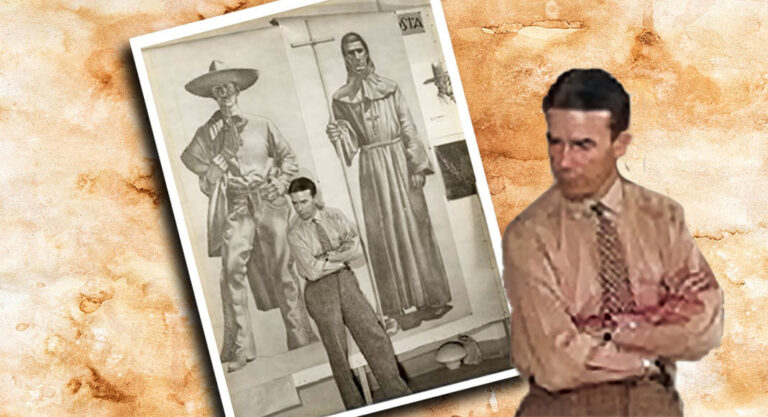
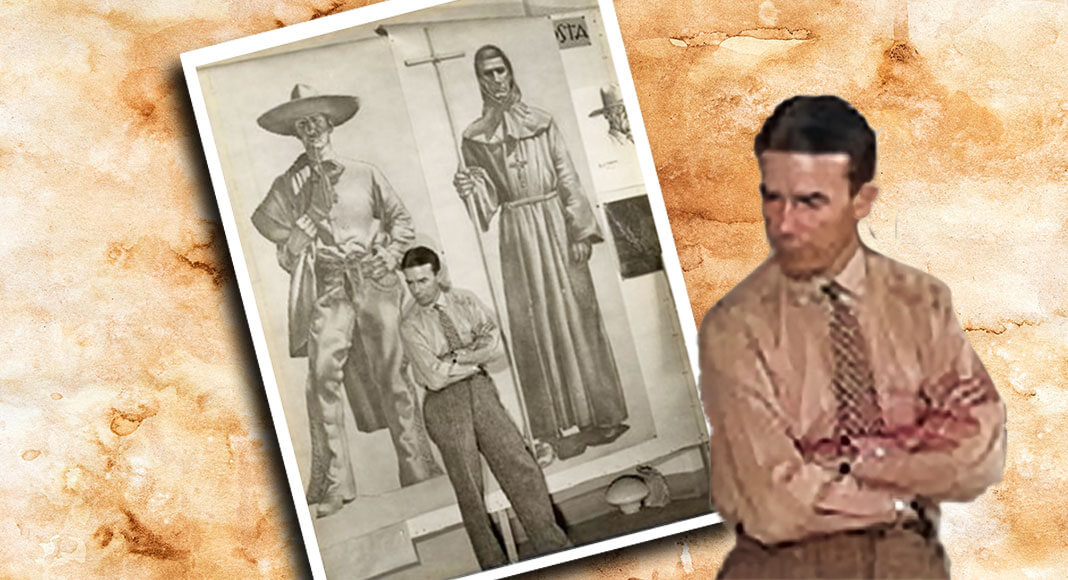
Tom Lea, about 1938. Unidentified photographer, from Forbes Watson papers, courtesy Archives of American Art, Smithsonian Institution.
Texas Border Business
LEA, THOMAS CALLOWAY III (1907-2001) Tom Lea was an artist and writer who excelled as a muralist, illustrator, portraitist, landscapist, World War II artist correspondent, poet, novelist and historian. Born in El Paso, Texas, on July 11, 1907, he was the eldest of three boys of Zola (Utt) Lea and Thomas Calloway Lea, Jr. His mother made sure that he attended the Baptist church and knew the Bible. His father was a populist lawyer who became El Paso’s mayor from 1915 to 1917 during the Mexican Revolution. The bedtime stories Mayor Lea told his sons about Daniel Boone and Davy Crockett were matched by real-life adventures of watching battles on the other side of the Rio Grande in Ciudad Juárez through a telescope and being escorted to elementary school by a policeman after Pancho Villa threatened the Lea family.
Mount Franklin, which stood outside Tom Lea’s boyhood home, remained a familiar presence his entire life. His childhood was happy with parents who supported his desire to be an artist—his father quipped that he’d rather his son be a “good blacksmith” than a “poor preacher.” El Paso’s librarian introduced Lea to art books, his high school art teacher suggested he design the El Paso High School annual, and his English teachers provided the foundation for his becoming a writer. During high school summers Tom Lea traveled to Santa Fe to stay with a federal judge and friend of his father’s. He visited his first museum there and became familiar with Indian cultures. He also met landscape painter Fremont Ellis, the first artist to take his work seriously.
In 1924 Tom Lea graduated from El Paso High School and left for the Art Institute of Chicago where he studied under muralist John Warner Norton and became a paid apprentice on murals in Chicago and other cities. He married fellow art student Nancy Jane Taylor, an aspiring writer, in 1927. Tom and Nancy Lea befriended a couple living in Kenilworth, Illinois, who opened their library and introduced them to books by Ernest Hemingway, Gertrude Stein, F. Scott Fitzgerald, and Aldous Huxley. Lea also worked as a freelance commercial artist doing advertisements and appearing in the Saturday Evening Post. In 1930 he had earned enough money to take Nancy to Europe, where they explored Italian Renaissance murals and other great artistic achievements.
In 1933 Tom and Nancy Lea moved to Santa Fe, New Mexico, where he worked for the Laboratory of Anthropology and painted for the Works Progress Administration (WPA, see WORK PROJECTS ADMINISTRATION). He completed paintings for the Museum of Fine Arts in Santa Fe and murals for the library at New Mexico College of Agriculture and Mechanic Arts (now New Mexico State University). Soon after moving into their one-room adobe home on Fremont Ellis’s Rancho San Sebastian, Nancy suffered an appendicitis attack. After a botched operation in the Santa Fe hospital, infection set in from which Nancy never recovered. She died in El Paso on April 1, 1936. After driving to Santa Fe to recover a few things, Tom Lea left and never returned again.
Work kept Lea going in 1936 when his mother and grandmother’s deaths left him bereft of the most important women in his life. During that time mural painters benefitted from federal government projects through the Treasury Department, Section of Fine Arts. He won the competition for the Ben Franklin Post Office on Pennsylvania Avenue in Washington, D.C., in 1936 with his mural The Nesters, which brought him national attention and led to his selection for the Texas Centennial murals in the Hall of State at Fair Park in Dallas. Of the sixteen murals Tom Lea painted, seven were done for the federal government with the majority painted between 1934 and 1941.
While working on the Pass of the North mural in the El Paso federal courthouse in 1938, he met Sarah Catherine Dighton Beane, a divorcée from Monticello, Illinois, who had come to El Paso to visit a friend. He proposed on the first date, and they were married in July. The union lasted sixty-three years. Sarah’s son, James, from her previous marriage, was adopted by Lea. Tom Lea later said that his portrait of Sarah in the Summertime, which he painted after his return from World War II in 1947, was his favorite painting and the best work he ever did.
Carl Hertzog and J. Frank Dobie were two friends of great import to Tom Lea’s work. Hertzog, a printer and book designer, and Dobie, a writer, sharpened Lea’s attention to the writing and making of books. He illustrated Dobie’s Apache Gold and Yaqui Silver (1939), John C. Duval: First Texas Man of Letters (1939), and The Longhorns (1941), giving him national visibility and bringing him to the attention to the managing editor of Life magazine who read Dobie’s books.
After being awarded a fellowship from the Rosenwald Foundation in 1940 to paint a series of paintings about authentic Southwest figures in authentic Southwest landscapes, Tom Lea received a telegraphed invitation from Life magazine to board a United States Navy destroyer in the North Atlantic as an accredited war artist correspondent. He resigned his fellowship and for four years traveled more than 100,000 miles and documented U.S. and Allied soldiers, sailors, and airmen worldwide. In the North Atlantic he covered the fight against German U-boats in late 1941; he was aboard the carrier USS Hornet during the air and sea battles off Guadalcanal in 1942 and witnessed the sinking of the USS Wasp; he traveled halfway around the world with the United States Army Air Forces transport, fighter, and bomber crews in England, North Africa, and China in 1943; and he landed on Peleliu with the Seventh Marine Regiment of the First Marine Division in 1944. His paintings and writing were featured in ten issues of Life magazine between 1941 and 1945. During the war he also painted a number of notable portraits, including Claire Chennault, Jimmy Doolittle, and Chinese Nationalist leader Chiang Kai-shek and his wife.
Upon returning from war, Tom Lea turned to writing and realized “there are many parts of mankind’s living and dying better expressed with words than with paint.” He wrote The Brave Bulls (1949) about bullfighting in Mexico, a bestseller published in ten foreign editions and turned into a motion picture starring Mel Ferrer. Lea’s The Wonderful Country (1952) about pistol-toting in Chihuahua became a bestseller published in three foreign editions and was made into a film starring Robert Mitchum. His two-volume history The King Ranch (1957) was considered by some scholars to be the greatest ranching history ever written. Lea wrote The Primal Yoke (1960) about mountaineering in Wyoming; The Hands of Cantú (1964) about horse training in sixteenth-century Nueva Viscaya; A Picture Gallery (1968), an autobiographical work about the experiences documented in his paintings; and In the Crucible of the Sun (1974) about King Ranch properties in Australia. He illustrated all of his books in pen and ink, Chinese ink wash, watercolor, or oil on canvas. The majority of his books were published by Little Brown and Company of Boston. The Brave Bulls won the Carr P. Collins Award from the Texas Institute of Letters and The Hands of Cantú won the Texas Institute’s Jesse Jones Award.
During the last decades of his life, Lea’s interest in writing books diminished, and he felt a renewed interest in painting. He and Sarah traveled far and wide, and he painted places as remote as China, Equador, Somoa, and Australia—though most of his subjects were from the vicinities of home. Lea painted portraits, but never for hire; he reserved them for his own pleasure and for friends who could pose in his studio. Only twice did he make exceptions—he once painted a portrait of Sam Rayburn for the Rayburn Building in Washington, D.C. (1966), and he painted Benito Juarez, now in the collection of the U. S. State Department in Washington, D.C. (1948).
Describing himself as an “avowed painter of the Almighty’s own outward and visible handiwork,” Tom Lea’s favorite subjects were the Southwestern landscape he knew so well with authentic Southwestern figures. He wrote that each of his subjects had “its own worthiness, each awaiting summons—upon right occasion—for portrait likeness.” He received numerous honors during his life, including the first Lon Tinkle Award for Lifetime Achievement from the Texas Institute of Letters in 1981. In 1995 the Marine Corps Heritage Foundation presented Lea the Colonel John W. Thomason, Jr. Award for his depictions of Marines during World War II. The El Paso Museum of Art established its Tom Lea Gallery in 1996, and in 1997 he was honored as a Fellow in the Texas State Historical Association.
In accepting the Republican nomination for president in 2000, George W. Bush quoted Tom Lea’s optimistic words about living on the sunrise side of Mount Franklin (quoted from his book A Picture Gallery). “Sarah and I live on the east side of our mountain. It is the sunrise side, not the sunset side. It is the side to see the day that is coming, not the side to see the day that is gone. The best day is the day coming, with the work to do, with the eyes wide open, with the heart grateful.” For eight years, Tom Lea’s painting Rio Grande, on loan from the El Paso Museum of Art, was displayed in the Oval Office of the White House.
On January 29, 2001, Tom Lea died at Sierra Medical Center in El Paso from injuries suffered from a fall. His family was by his side, and the familiar site of Mount Franklin was visible outside his hospital window. Hundreds of people attended his memorial service at First Baptist Church, including First Lady Laura Bush. On May 14, 2005, a commemorative cenotaph was erected for Lea and his wife in the Texas State Cemetery. After Sarah Lea died in 2008, their ashes were scattered over Mount Franklin. His extensive collections of art, papers, and photography are housed in the Harry Ransom Center on the campus of the University of Texas at Austin as well as the Special Collections of the University of Texas at El Paso. His paintings done for Life magazine during World War II are held by the U. S. Army Center of Military History, Fort Belvoir, Virginia. The Tom Lea Institute in El Paso was established to preserve the artist’s legacy. Pulitzer-winning biographer Robert Caro called him “an unsung genius of the twentieth century who made it purely on the quality of his work.” Texas collector and historian J. P. Bryan wrote, “Tom Lea was the greatest artist, illustrator and writer Texas has ever known.”
Biography by Adair Margo, Handbook of Texas Online
Published by the Texas State Historical Association
U.S. Customs and Border Protection (CBP) officers at the Port of Brownsville used their interviewing skills and technology to detect and intercept six separate travelers in connection with alleged attempts to enter the U.S. with entry documents belonging to other people. USCBP Image for illustration purposes
Texas Border Business
BROWNSVILLE, Texas — U.S. Customs and Border Protection (CBP) officers at the Port of Brownsville used their interviewing skills and technology to detect and intercept six separate travelers in connection with alleged attempts to enter the U.S. with entry documents belonging to other people.
“Our frontline CBP officers utilized their training, experience, interviewing skills in technology to uncover six separate alleged attempts to enter the U.S. using entry documentation that did not belong to them,” said Port Director Tater Ortiz, Brownsville Port of Entry.
The first case occurred when a traveler arrived at the port of entry and presented a valid U.S. birth certificate to the primary officer on August 9, 2022. The traveler was referred to passport control secondary for a further examination. While in passport control secondary, officers were able to determine the female traveler was not the true owner of the U.S. birth certificate and was not in fact a United States citizen.
In the second case a traveler presented a valid permanent resident card to the primary officer on August 11, 2022. The traveler was referred to passport control secondary for a further inspection after a primary inspection. While in passport control secondary, officers were able to determine the female traveler was an impostor to the permanent resident card she presented.
The third case transpired when a traveler arrived at the port of entry and presented a valid U.S. birth certificate along with a Texas driver’s license to the primary officer on August 13, 2022. The traveler was referred to passport control secondary for a further examination. While in passport control secondary, officers were able to determine the male traveler was not the true owner of the U.S. birth certificate and driver’s license and was not a United States citizen.
The fourth case emerged when a female traveler arrived at the port of entry and presented a valid U.S. birth certificate along with a Texas driver’s license to the primary officer on August 13, 2022. The traveler was referred to passport control secondary for a further examination. While in passport control secondary, officers were able to determine the male traveler was not the true owner of the U.S. birth certificate and driver’s license and was not a United States citizen but in fact a citizen of Mexico.
The fifth case arose when a traveler arrived at the port of entry and presented a valid U.S. birth certificate for a minor child on August 13, 2022. The traveler and the minor child were referred to passport control secondary for a further examination. While in passport control secondary, officers were able to determine the child traveler was not the true owner of the U.S. birth certificate and was related to the traveler.
In the sixth case, a traveler arrived at the port of entry and presented a valid U.S. passport to the primary officer on August 14, 2022. The traveler was referred to passport control secondary for a further examination. While in passport control secondary, CBP officers were able to determine the traveler was not a United States citizen and not the true owner of the U.S. passport.
All six travelers were arrested in connection with alleged violations of U.S. immigration law and face removal proceedings upon final adjudication of their criminal cases.
Laundry basket used to smuggle drugs. USCBP Image
Texas Border Business
EL PASO, Texas – U.S. Customs and Border Protection officers working at the Paso Del Norte border crossing in El Paso, Texas intercepted methamphetamine and fentanyl concealed within a basket of laundry.
“Money laundering is nothing new however finding drugs in a basket of laundry is out of the ordinary,” said CBP El Paso Port Director Ray Provencio. “A seizure like this serves as a reminder that smugglers will use any and means available in their attempts to introduce contraband into the United States.”
On August 13, CBP officers assigned to the Paso Del Norte border crossing encountered a 26-year-old female U.S. citizen arriving from Mexico via the vehicle lanes. A CBP officer referred the individual for a secondary inspection of the vehicle which included screening by a CBP canine and non-intrusive inspection (x-ray). The secondary search led CBP officers to locate multiple bundles inside of a basket of laundry containing a total of 4.27 pounds of methamphetamine and 0.71 pounds of fentanyl.
The narcotics and vehicle were seized by CBP and the driver was turned over to U.S. Immigration and Customs Enforcement Homeland Security Investigations to face charges in connection with the failed smuggling attempt.
Rio Grande Valley Sector (RGV) Border Patrol agents and Hidalgo County Sheriff’s Office deputies rescued 28 noncitizens from an Edinburg stash house. Two other smuggling events were foiled and resulted in the identification of a foot-guide. USCBP Image for illustration purposes
Texas Border Business
EDINBURG, Texas – Rio Grande Valley Sector (RGV) Border Patrol agents and Hidalgo County Sheriff’s Office deputies rescued 28 noncitizens from an Edinburg stash house. Two other smuggling events were foiled and resulted in the identification of a foot-guide.
On August 15, Hidalgo County Sheriff’s Office requested the assistance of RGV agents after receiving a 911 emergency call from a female non-citizen claiming she was being held against her will at a residence in Edinburg. Deputies and agents responded to the residence and encountered 28 noncitizens from Mexico and Central America in good health. The caretaker departed the location before the teams arrived.
On the same day, RGV agents attempted to initiate an immigration inspection of the occupants of a Toyota Tacoma near Norias, the driver failed to yield and led agents on a vehicle pursuit. The vehicle came to a stop near Raymondville and the occupants bailed out. Agents apprehended six migrants from the surrounding area who were unlawfully present in the U.S. The driver was not located.
On August 14, McAllen Border Patrol Station agents received information of a vehicle picking up a suspected migrant and dropping him off in La Joya. Texas Fish and Wildlife, working with RGV agents, conducted a traffic stop on the vehicle. The driver, a Legally Admitted Permanent Resident, told agents he was being a good Samaritan by providing a ride to the stranger, who was also detained nearby. The passenger, a Mexican national unlawfully present in the U.S., admitted to being a foot guide and has been encountered at least 6 times in the Rio Grande Valley since January 2022. They were both placed under arrest and transported to the station.
TxDOT is working with law enforcement officers around the state to step up efforts to identify and arrest drunk drivers in the weeks leading up to the Labor Day holiday, from August 19 through September 5. TxDOT Image
Texas Border Business
PHARR, Texas — Every year on Texas roads hundreds of people are killed and thousands seriously injured in drunk driving crashes—crashes that are 100% preventable. That’s why as part of its Drive Sober. No Regrets. campaign TxDOT is working with law enforcement officers around the state to step up efforts to identify and arrest drunk drivers in the weeks leading up to the Labor Day holiday, from August 19 through September 5.
Last year Texas saw more than 25,000 DUI-alcohol related traffic crashes, resulting in 1,100 fatalities and 2,560 serious injuries.
On average, 1 person in Texas dies every 7 hours and 57 minutes because of a drunk driver.
CRASH DATA:
Statewide In 2021, there were 346 DUI-alcohol related traffic crashes during the Labor Day time period, resulting in 22 fatalities and 52 serious injuries.
In the *Pharr District during the 2021 Labor Day holiday time period, there were 22 DUI-alcohol related traffic crashes, resulting in 1 fatality and 4 serious injuries.
*The TxDOT “Pharr District” encompasses the 8 southernmost counties of deep south Texas: Cameron, Willacy, Hidalgo, Starr, Zapata, Brooks, Jim Hogg & Kennedy.
AUSTIN – Jessica says her mom used to say that the good die young. Tragically, that saying came true while hermom was teaching her how to drive and a drunk driver failed to yield, killing her instantly and sending Jessica tothe hospital. Stories like this are part of the Texas Department of Transportation’s Drive Sober. No Regrets.campaign and the reason Texas law enforcement officers will increase their efforts to pull over motoristssuspected of drunk driving from August 19 through September 5.
On average, 1 person dies every 7 hours and 57 minutes in Texas because of a DUI-alcohol related traffic crash. Last year, 1,100 people were killed and 2,560 were seriously injured on Texas roads because someone chose to get behind the wheel after drinking.
“If you choose to celebrate the end of summer by drinking and driving, then know that police around the state willbe on the lookout, will pull you over and arrest you,” said TxDOT Executive Director Marc Williams. “When youdrink and drive, you put everyone else on the road at risk too. These crashes are 100% preventable and can havefatal and/or serious physical, emotional and financial consequences.”
Leading up to Labor Day, TxDOT is reminding everyone about the dangers of drunk driving. The campaign coincides with the national increased enforcement period sponsored by the National Highway Traffic Safety Administration.
The Drive Sober. No Regrets. campaign is a key component of #EndTheStreakTX, a broader social media andword-of-mouth effort that encourages drivers to make safer choices while behind the wheel such as wearing aseat belt, driving the speed limit, never texting and driving, and never driving under the influence of alcohol orother drugs. November 7, 2000, was the last deathless day on Texas roadways. #EndTheStreakTX asks allTexans to commit to driving safely to help end the streak of daily deaths on Texas roadways.
Nick Rhodes, President, and CEO of Rhodes Enterprises. Photo by Roberto Hugo Gonzalez
Texas Border Business
NEW YORK, – Today, Inc. revealed that Rhodes Enterprises is No. 4515 on its annual Inc. 5000 list, the most prestigious ranking of the fastest-growing private companies in America. The list represents a one-of-a-kind look at the most successful companies within the economy’s most dynamic segment—its independent businesses. Facebook, Chobani, Under Armour, Microsoft, Patagonia, and many other well-known names gained their first national exposure as honorees on the Inc. 5000.
“We are excited to join the Inc. 5000 and honored to be recognized among so many other influential companies in America,” says Nick Rhodes, President, and CEO of Rhodes Enterprises. “This accomplishment reflects our teams’ continuous hard work and dedication to enhancing lives and building thriving communities across South Texas.”
The companies on the 2022 Inc. 5000 have not only been successful, but have also demonstrated resilience amid supply chain woes, labor shortages, and the ongoing impact of Covid-19. Among the top 500, the average median three-year revenue growth rate soared to 2,144 percent. Together, those companies added more than 68,394 jobs over the past three years.
“The accomplishment of building one of the fastest-growing companies in the U.S., in light of recent economic roadblocks, cannot be overstated,” says Scott Omelianuk, editor-in-chief of Inc. “Inc. is thrilled to honor the companies that have established themselves through innovation, hard work, and rising to the challenges of today.”
Since 2015, Rhodes Enterprises has experienced substantial growth, and has established itself as the largest mixed-use land developer and residential builder in South Texas. For the past 4 consecutive years, it has also moved up in the national rankings of ProBuilder Housing Giants and Builder Magazine’s ‘Top 200 Building Firms in the Country’.
“We established our resilience as a company over twenty-five years ago and it’s been an incredible and rewarding journey getting to where we are today,” says Mike Rhodes, Founder and Vice President of Land Development of Rhodes Enterprises. “Building communities is what we love to do and what keeps us going. I’m looking forward to the future and our continued rapid expansion to serve more areas of South Texas.”
Complete results of the Inc. 5000, including company profiles and an interactive database that can be sorted by industry, region, and other criteria, can be found atwww.inc.com/inc5000. The top 500 companies are featured in the September issue of Inc.magazine, which will be available on August 23.
More about Inc., the Inc. 5000, and Rhodes Enterprises.
Methodology
Companies on the 2022 Inc. 5000 are ranked according to percentage revenue growth from 2018 to 2021. To qualify, companies must have been founded and generating revenue by March 31, 2018. They must be U.S.-based, privately held, for-profit, and independent—not subsidiaries or divisions of other companies—as of December 31, 2021. (Since then, some on the list may have gone public or been acquired.) The minimum revenue required for 2018 is $100,000; the minimum for 2021 is $2 million. As always,Inc. reserves the right to decline applicants for subjective reasons. Growth rates used to determine company rankings were calculated to four decimal places. The top 500 companies on the Inc. 5000 are featured in Inc. magazine’s September issue. The entire Inc. 5000 can be found at http://www.inc.com/inc5000.
About Inc.
The world’s most trusted business-media brand, Inc. offers entrepreneurs the knowledge, tools, connections, and community to build great companies. Its award-winning multiplatform content reaches more than 50 million people each month across a variety of channels including websites, newsletters, social media, podcasts, and print. Its prestigious Inc. 5000 list, produced every year since 1982, analyzes company data to recognize the fastest-growing privately held businesses in the United States. The global recognition that comes with inclusion in the 5000 gives the founders of the best businesses an opportunity to engage with an exclusive community of their peers, and the credibility that helps them drive sales and recruit talent. The associated Inc. 5000 Conference & Gala is part of a highly acclaimed portfolio of bespoke events produced by Inc. For more information, visit www.inc.com.
Celebrating the theme, “South Pole & Beyond,” find out how the entire community can be a part of this year’s parade when it steps off in style from McAllen Veterans Memorial Stadium on Saturday, December 3. Courtesy Image
Texas Border Business
As summer winds down and the chill of fall is in the air (okay, let’s imagine it’s chilly!) organizers for the largest illuminated holiday and helium balloon parade in Texas are gearing up to make this year’s 2002 MHP even better than ever. Celebrating the theme, “South Pole & Beyond,” find out how the entire community can be a part of this year’s parade when it steps off in style from McAllen Veterans Memorial Stadium on Saturday, December 3.
Courtesy Image
The McAllen Holiday Parade is presented by H-E-B and powered by Bert Ogden Auto Group and proudly sponsored by Budweiser, Reliant, McAllen International Airport and South Padre Island CVB. Other sponsors for the 2022 presentation of the McAllen Holiday Parade include McAllen I.S.D.; McAllen International Bridge System; McAllen Public Utility; Matt’s Building Materials; Stripes/Laredo Taco Company; Metro McAllen; University of Texas-RGV; Peña Eye Institute; Linebarger Attorneys at Law; McAllen Chamber of Commerce/MXLAN; PepsiCo.; McAllen Public Works; Mike Rhodes – Tres Lagos; AEP Texas; McAllen Economic Development Corp.; Lacks; Doña Lula; Hermes; Whataburger; Cigna Health Care; Taco Palenque; Carollo Engineers; KSA Engineers; MedCare EMS; Halff Associates; Raba Kistner Consultants, Inc.; S&B Infrastructure; AMR; Cigna; IBC; AEP; United One Cleaning.
WHO: McAllen Mayor Javier Villalobos & McAllen City Commission
City of McAllen
Dr. J. A. Gonzalez, McAllen I.S.D. Superintendent
& McAllen I.S.D. School Board
McAllen Holiday Parade Sponsors and Media Partners
WHAT: Stepping Off in Style Press Conference announcing details of the 2022
presentation of the McAllen Holiday Parade, presented by H-E-B
WHEN & Wednesday, August 17, 2022 • 10:00 a.m.
WHERE: McAllen Veterans Memorial Stadium, 2001 N. Bicentennial Blvd.