







Texas Border Business

The Trump Administration has released new economic reports showing a decline in inflation and a projected reduction in the U.S. agricultural trade deficit next year. Taken together, the reports suggest a turnaround for American consumers and agricultural producers, as the administration describes it.
According to the administration, inflation is now “at its lowest level in nearly five years,” falling by “roughly 70% from its Biden-era peak.” The report states that prices for “gas, groceries, and rent” have eased while “wages rose for blue-collar workers.”
Texas posted powerful figures. Based on the Consumer Price Index, the state recorded a “1.7% inflation rate,” which was “tied for the lowest in the country,” according to the data cited by the administration.

At the same time, the U.S. Department of Agriculture released a forecast showing improvement in agricultural trade. The USDA projects that the agricultural trade deficit will decline from “$43.7 billion in FY2025 to $37 billion in FY2026.” The administration said the forecast “signals progress for both the economy and American producers.”
In recent years, the agricultural trade deficit expanded steadily. The administration said the deficit “grew steadily under the Biden administration,” driven by “rising imports and stagnant exports.” That trend, according to the report, “pressured farm incomes, increased our reliance on foreign food, and weakened rural communities.”
The latest USDA figures suggest that pattern may be starting to change. The administration described the updated forecast as “early progress in reversing this trend and restoring balance to U.S. agriculture.”
A separate federal analysis on inflation trends across states and metropolitan areas supports the idea that inflation has not affected all regions equally. A report dated December 23, 2025, noted that “state and local economic conditions and policies lead to deviations in inflation from the national average.”

The report explained that local factors play a key role, stating that “if local housing supply is relatively inelastic, then monetary or fiscal expansions translate more into local price increases than into quantity increases.” As a result, some areas experience “more inflation in housing rents than in otherwise similar locations with more elastic supply.”
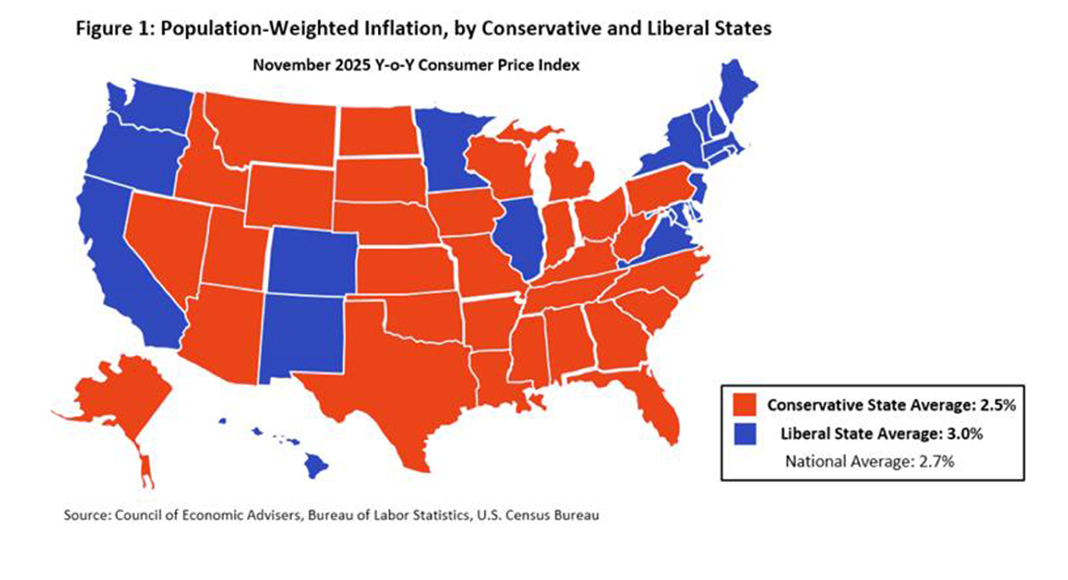
The same analysis found consistent differences based on political geography. It reported that “liberal states as well as cities inside liberal states have observed higher inflation rates in the past year than their conservative counterparts,” across “various measures of inflation, aggregation, and political categorization.”
The administration said the combination of lower inflation and a shrinking agricultural trade deficit point to improving economic conditions nationwide, with Texas’s economy and agricultural production highlighted as leading examples.
The White House has published a state-by-state inflation report, and the USDA has released its quarterly agricultural trade forecast, both of which provide additional detail on the data cited in the administration’s analysis.