






- Texas Records Zero Job Growth in 2025
- AI Investment Drives Texas Economy as Hiring Growth Remains Limited
- Trade With Mexico Remains a Key Driver of Texas Economic Strength
- Mild Growth Expected for Texas Economy in 2026
Texas Border Business

Texas Border Business presents a four-part series featuring economic briefings from Luis Torres of the Federal Reserve Bank of Dallas, offering business and community leaders a data-driven view of the forces shaping Texas and the Rio Grande Valley. The presentations, shared during the RioPlex Leadership event organized by RioPlex and executed by its Executive Director, Mario Reyna, explore key trends including stalled job growth, rising artificial intelligence investment, the strength of trade with Mexico, and the outlook for 2026, helping regional stakeholders better understand the economic conditions influencing workforce demand, investment, and long-term competitiveness across South Texas.
By Roberto Hugo González / Texas Border Business

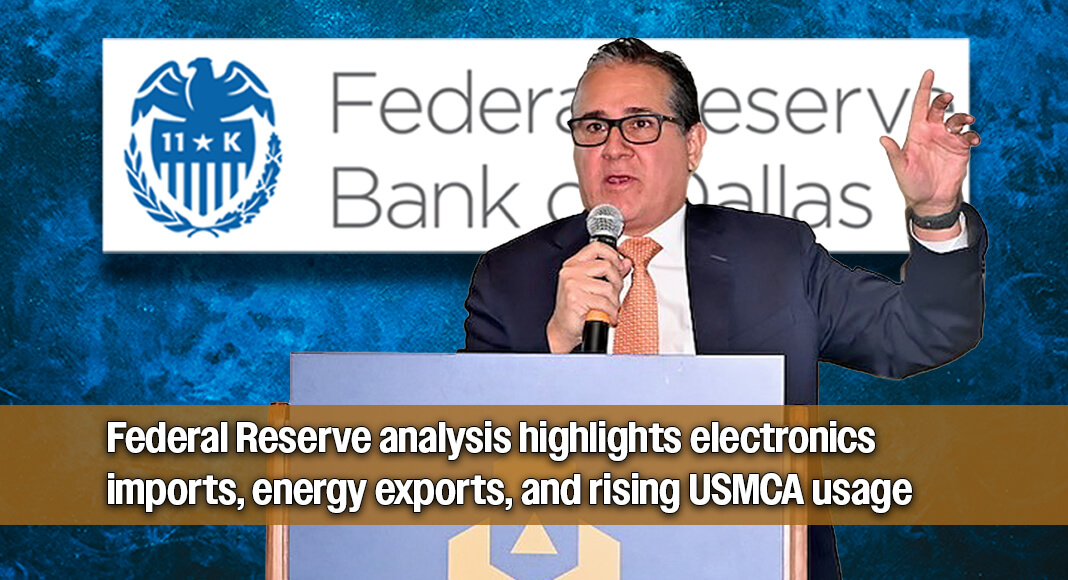
Trade continues to anchor the Texas economy, with cross-border commerce providing stability even as other sectors face uncertainty. Economist Luis Torres of the Federal Reserve Bank of Dallas said the state’s relationship with Mexico remains a major source of economic support.
“People don’t know this, but Texas is the number one export state in the nation,” Torres said, emphasizing the scale of the state’s global reach. “We’re a country by ourselves. I think we’re like eighth in the world in exports.” He added that the relationship with Mexico is particularly important because trade directly supports industry, investment, and regional growth.
Torres delivered the update during the RioPlex Leadership event, where economic development leaders reviewed trends affecting the Rio Grande Valley and South Texas. The gathering was organized by RioPlex and executed by its Executive Director and Board Secretary, Mario Reyna.
Recent data show that imports from several global partners, including Canada and China, have declined, but Mexico remains an exception. “Mexico is still positive,” Torres said, noting that the composition of trade is evolving.

Automotive manufacturing has long dominated cross-border shipments, but Torres explained that growth is now concentrated in computer and electronic products. Many of these goods support servers and digital infrastructure linked to artificial intelligence, reflecting broader technological investment across North America.
Changes in trade policy are also influencing business behavior. Torres said more companies are now operating under the United States-Mexico-Canada Agreement to reduce tariff exposure. “The majority of trade now is under USMCA,” he said, describing the shift as a significant change from prior years when many firms did not fully utilize the agreement.
Energy trade further illustrates the depth of economic integration. Torres reported that about 30 percent of the natural gas consumed in Mexico comes from the United States, largely supplied by Texas. The flow provides what he described as “a cheap supply of reliable energy that fuels those industries and the rest of the country.”
The connection extends beyond fuel. Manufacturing processes often move products across borders multiple times before completion, highlighting the role of logistics networks and border infrastructure in supporting production.
Trade patterns also affected national economic data earlier in the year. Torres noted that many companies increased imports ahead of expected tariff changes, building inventories in a strategy often referred to as front-running. The surge temporarily weighed on U.S. GDP calculations because imports subtract from overall output.
Even with policy uncertainty, Texas businesses report steady expectations for trade activity. Cross-border demand, combined with the state’s transportation capacity and industrial base, continues to position Texas as a central hub for North American commerce.
For South Texas, the implications are direct. Border communities benefit from the movement of goods, the expansion of supplier networks, and the infrastructure required to sustain high trade volumes.
Torres encouraged business leaders to closely monitor policy developments that could affect tariffs, compliance requirements, and supply chains, noting that trade remains one of the most influential factors shaping the state’s economic trajectory.
The discussion emphasized a consistent message for regional planners and industry leaders: while economic cycles change, the partnership between Texas and Mexico continues to provide a durable foundation for growth.
See related stories: