







Texas Border Business

By Roberto Hugo González / Texas Border Business
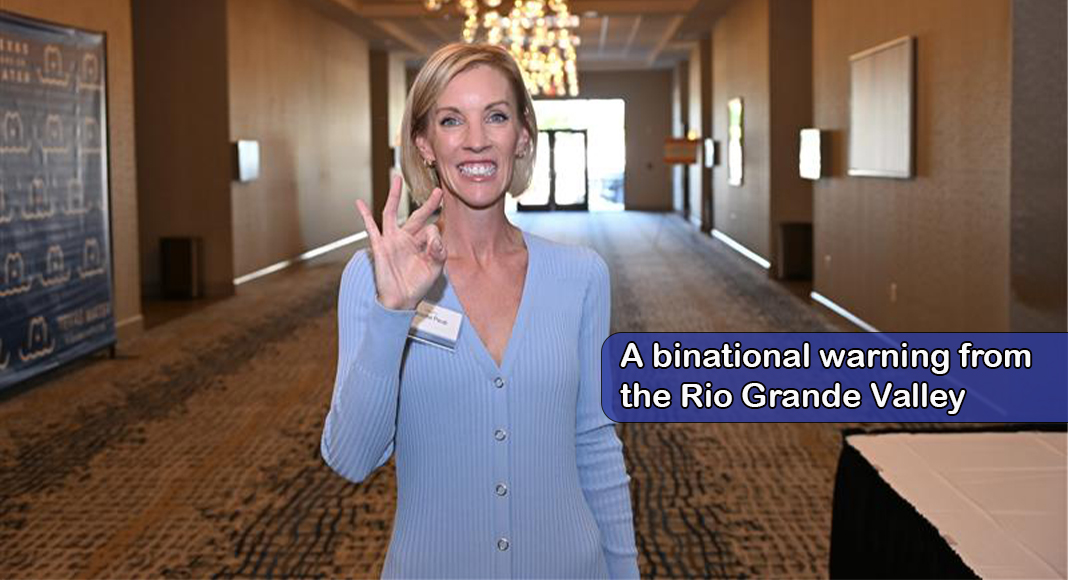
McAllen, Texas – The 2025 Rio Grande/Río Bravo Binational River Symposium opened in November in McAllen, Texas, with a blunt reminder about human survival and public responsibility. Speaking to policymakers, scientists, and water leaders from the United States and Mexico, Brooke Paup placed water at the center of every social, economic, and environmental concern. “Without clean and healthy water,” she said, “a human can only survive for three days. Three days.”
Paup, chairwoman of the Texas Commission on Environmental Quality, framed the fact not as rhetoric but as reality. “Without water, nothing else matters,” she told the audience, emphasizing why the Rio Grande, known in Mexico as the Río Bravo, demands shared stewardship. The river, she said, is not only a boundary but a lifeline that requires cooperation rather than division.

Her remarks came at a time she described as unusually strained. “In today’s world, where everything feels divisive,” Paup said, “every day is another calamity.” She warned that growing political conflict and a weakening commitment to science are colliding with physical limits. “Our supplies are drying up,” she said. “The commitment to science is floundering, and our populations are increasing.” Together, she added, those pressures are placing “incredible pressure on our precious source of water.”
Paup stressed that gatherings like the symposium matter because they bring people together across borders. Addressing attendees from Mexico and Texas, she said there has “never been a more important time” for policymakers and environmental advocates to “actually talk about how we’re going to manage it for the next decades.” The goal, she said, is simple and shared: “How are we going to make sure that this beautiful river survives, and we have the water we need, so our children can have these wonderful opportunities that we have had?”
The speech also highlighted recent policy developments in Texas. Paup pointed to the voter approval of Proposition 4, which establishes long-term funding for water infrastructure. She described it as “a generational investment in water for the state of Texas,” adding, “Our children are going to be better off because of the work that we have done.” The measure commits sustained funding over the coming decades, a step Paup said had been missing despite water being “the most important issue facing the state.”
She emphasized that the benefits of such investment must reach those who need it most. “Everyone deserves clean water,” Paup said. “It should not matter what your economy is like or where you are in the state of Texas.” Reliable water systems, she noted, support public health, economic stability, and long-term growth, especially in communities that have historically lacked resources.
Throughout her remarks, Paup returned to the idea that water policy is inseparable from human survival. “I will die on this hill,” she said. “Water is the most important issue facing our country.” Her message to both nations was direct: the Rio Grande/Río Bravo cannot be managed in isolation, and delay carries real consequences.
As the symposium continued, Paup left the audience with a forward-looking challenge rooted in urgency rather than alarm. The facts, she argued, are already clear. People can live only three days without water. What remains is the collective decision to act together, across borders and institutions, before scarcity and inaction make that reality unavoidable.