













Texas Border Business




Feeding Texas, the statewide network of food banks working to prevent hunger and ensure every Texan has reliable access to nutritious food, hosted a virtual press briefing to outline major changes to the Supplemental Nutrition Assistance Program (SNAP) under HR 1, known as the “One Big Beautiful Bill Act.”
SNAP is a bridge to economic stability for Texas families and plays a vital role in supporting local grocers, retailers and agricultural producers across the state. During the briefing, Feeding Texas leaders shared how the new federal law fundamentally changes SNAP financing for the first time in the program’s nearly 60-year history by requiring states to begin sharing the cost of food benefits if they exceed a federal payment error rate (PER) threshold.
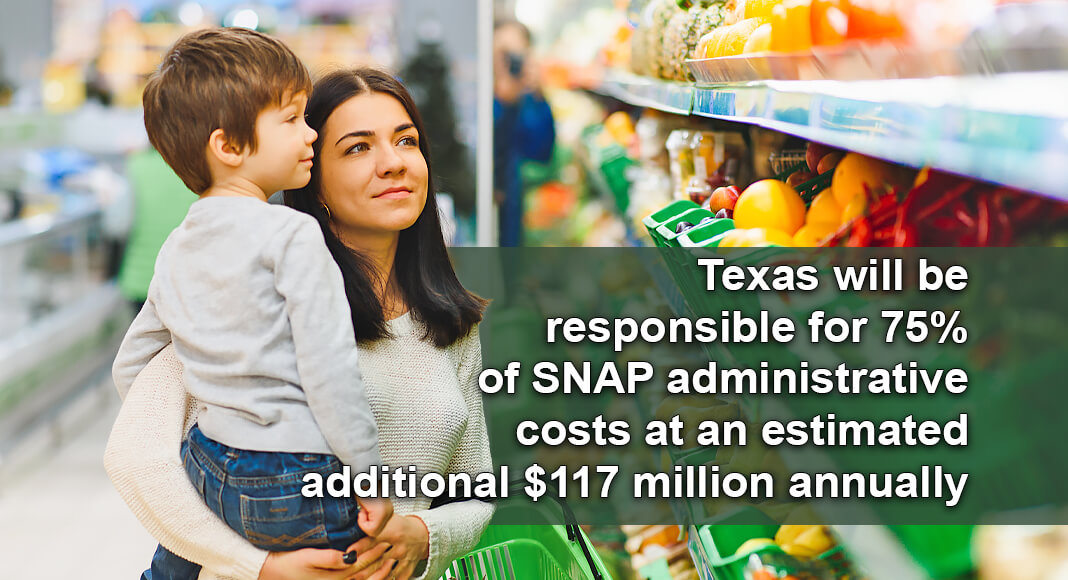
Under the new law, beginning October 1, 2026, Texas will be responsible for 75% of SNAP administrative costs–an estimated additional $117 million annually. Beginning October 1, 2027, states with SNAP payment error rates above 6% will be required to pay between 5% and 15% of SNAP benefit costs. Based on Texas’ current PER of 8.32%, the state could owe approximately $709 million in benefit cost-sharing obligations.



Feeding Texas emphasized the SNAP payment error rate is not a measure of fraud, but rather a statistical measure of how accurately benefits are calculated by the state. The rate includes both overpayments and underpayments and reflects the complexity of program rules and administrative processes. In contrast, SNAP fraud in Texas remains extremely rare, with less than 0.1% of SNAP households found to have committed an intentional program violation in fiscal year 2025.
“SNAP is one of the most effective anti-hunger and economic support programs in the country,” Celia Cole, chief executive officer of Feeding Texas, said. “The program helps more than 3 million Texans purchase food while injecting approximately $7 billion into the state’s agriculture and food sectors annually. Texas is working diligently to get the payment error rate below the 6% threshold, but we’re advocating for a realistic timeline to do so without jeopardizing food access to millions of children, seniors and working families or harming the state’s food economy.”
Feeding Texas noted food banks alone cannot absorb reductions in SNAP support. Texas food banks currently distribute more than 700 million pounds of food annually through a network of more than 4,000 community partners, yet for every meal provided by food banks, SNAP provides nine.
“The best path forward would be for Congress to provide states a two-year delay on the cost-share requirement, a flexibility that has already been granted to Alaska, Florida and others,” Cole said. “Texas has a demonstrated track record of achieving and maintaining lower error rates over time. Technology upgrades, staff training and policy improvements do not happen overnight, but we’re confident Texas can reduce its PER below the federal threshold with a realistic implementation timeline.”
Watch the virtual press briefing HERE.
Information source: Feeding Texas