

















Texas Border Business



Texas Border Business
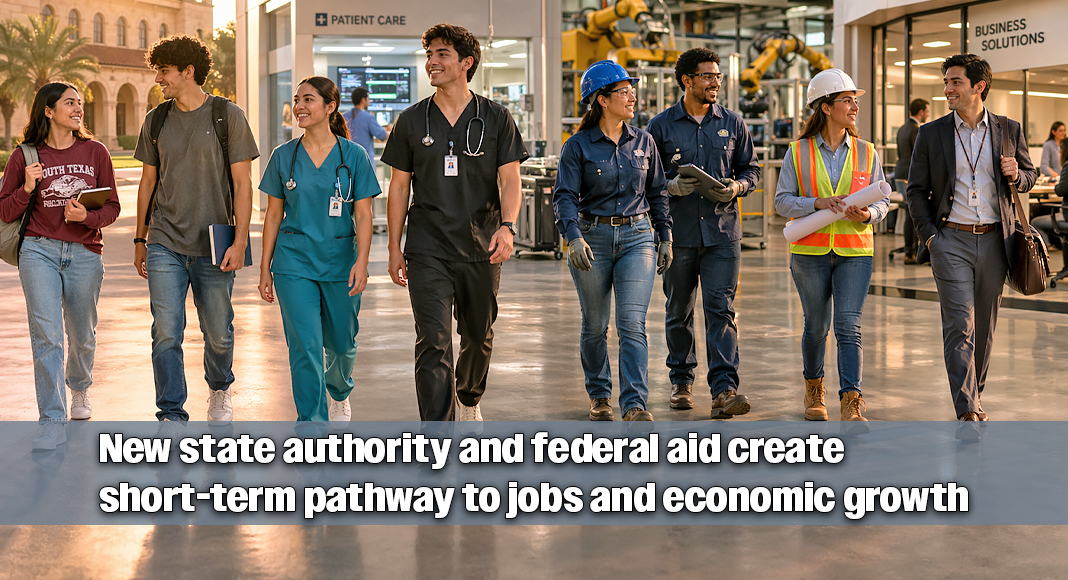
A new alignment between Texas policy and federal funding is creating, officials say, a significant opportunity to reshape workforce training in the Rio Grande Valley. The combination of Texas Senate Bill 37 and the federal Workforce Pell program is expected to expand access to short-term, job-focused education while directly connecting training to employer needs.
Senate Bill 37 allows governing boards at public colleges to align academic programs more quickly with workforce demand, removing barriers that previously slowed curriculum changes. At the federal level, Workforce Pell, scheduled to take effect July 1, 2026, will provide financial aid for short-term, noncredit programs that can be completed in as little as eight weeks. Together, these changes align authority and funding around workforce outcomes.



Local institutions such as South Texas College and Texas Southmost College are positioned to play a central role by developing programs in collaboration with employers in sectors including manufacturing, healthcare, logistics, and energy. Workforce coordination is expected to involve organizations like Workforce Solutions Lower Rio Grande Valley, which can assist with job placement and training alignment.
Participation is expected to include recent high school graduates, working adults seeking higher wages, and underemployed individuals, including bilingual populations. Employers benefit by helping design training programs that produce job-ready workers, reducing hiring risk and training costs while improving retention and operational efficiency.
The implementation timeline is already underway. SB 37 is in effect, allowing institutions to begin aligning programs immediately. However, colleges must have eligible programs ready by mid-2026 to take full advantage of Workforce Pell funding. Analysts describe the next 12 to 24 months as a critical window for planning, coordination, and early adoption.
Challenges remain, including the risk of fragmented responses among institutions, potential resistance to nontraditional credential models, and delays in program development. Education leaders emphasize the need for coordinated action, with community colleges taking a lead role in building workforce pipelines.
Regional stakeholders view the effort as a way to strengthen economic competitiveness by creating a direct link between education and employment. By aligning training with industry demand and scaling programs through federal funding, the region aims to present a unified workforce strategy to attract new investment.
Follow the link below to read SB 37
https://capitol.texas.gov/tlodocs/89R/billtext/pdf/SB00037I.pdf?utm_source=chatgpt.com
Follow the link below for more information on the Federal Pell Grant