





Texas Border Business

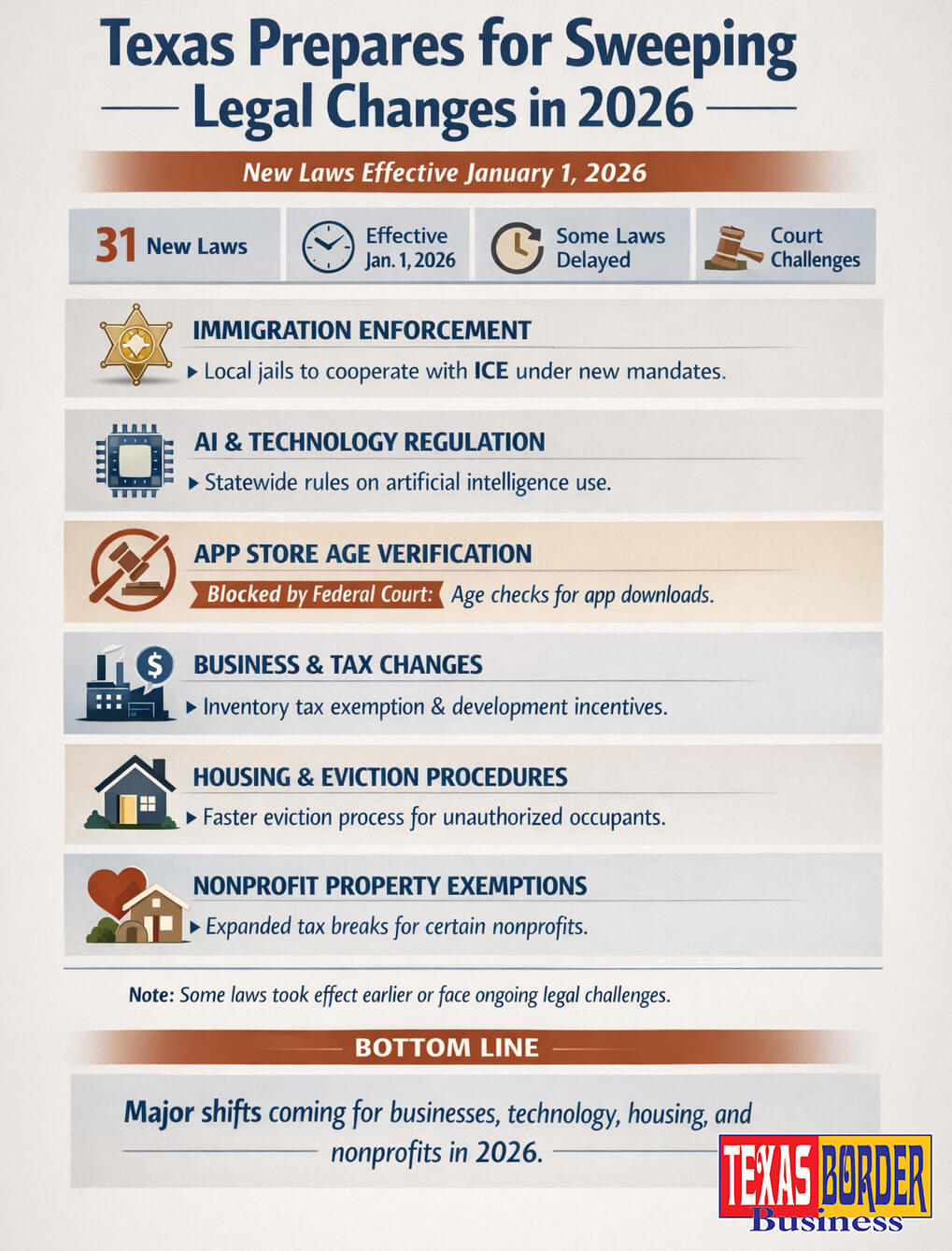
A new set of Texas laws approved by the 89th Texas Legislature in 2025 is scheduled to take effect on January 1, 2026, bringing changes across law enforcement, technology regulation, business taxation, housing, and nonprofit property exemptions. Roughly 31 bills are set to become law on that date unless delayed or blocked by the courts. Many have drawn attention because of their potential statewide impact.
One of the most significant changes affects immigration enforcement. Senate Bill 8 requires county sheriffs who operate jails to enter into agreements with U.S. Immigration and Customs Enforcement to assist with immigration enforcement inside local detention facilities. These agreements, known as 287(g) agreements, allow local officers to work with ICE under federal supervision. The bill also creates a state grant program to offset sheriff costs for training, staffing, and administrative duties.
Technology regulation is another focus. House Bill 149, the Texas Responsible Artificial Intelligence Governance Act, establishes a statewide framework for artificial intelligence systems. The law sets standards for transparency and consumer protection and prohibits certain discriminatory, harmful, or deceptive uses of AI, including some deep-fake content. It also creates a regulatory sandbox, an advisory council, and gives enforcement authority to the Texas Attorney General while preempting local AI regulations.

Another technology law, Senate Bill 2420, addresses age verification for app stores. It requires verification of user age categories and parental consent for minors. Enforcement, however, has been blocked by a federal judge as of late December 2025, and the law may not take effect while litigation continues.
Several laws address business and tax policy. House Bill 9 expands the business inventory tax exemption, allowing businesses to exclude up to $125,000 in inventory value from local property taxes. Senate Bill 14 provides impact fee credits for certain water conservation and reuse projects. Additional measures include Senate Bill 2206, which addresses franchise and research tax credits, and Senate Bill 1968, which updates real estate licensing regulations.
Changes are also coming to housing and property law. Senate Bill 38 modifies eviction procedures for unauthorized occupants, streamlining the process and potentially reducing the time property owners must wait to regain possession.
House Bill 23 affects nonprofit organizations by expanding ad valorem property tax exemptions for certain nonprofit-owned properties used for agriculture, youth support, and community education.

State officials note that many other laws passed in 2025 took effect earlier, including measures related to education, public safety, and social policy.
Together, the January 1, 2026, laws represent a broad policy shift that will affect law enforcement agencies, businesses, developers, technology companies, nonprofits, and residents across Texas.
Download the infographic below.