





Texas Border Business

By Roberto Hugo González / Texas Border Business
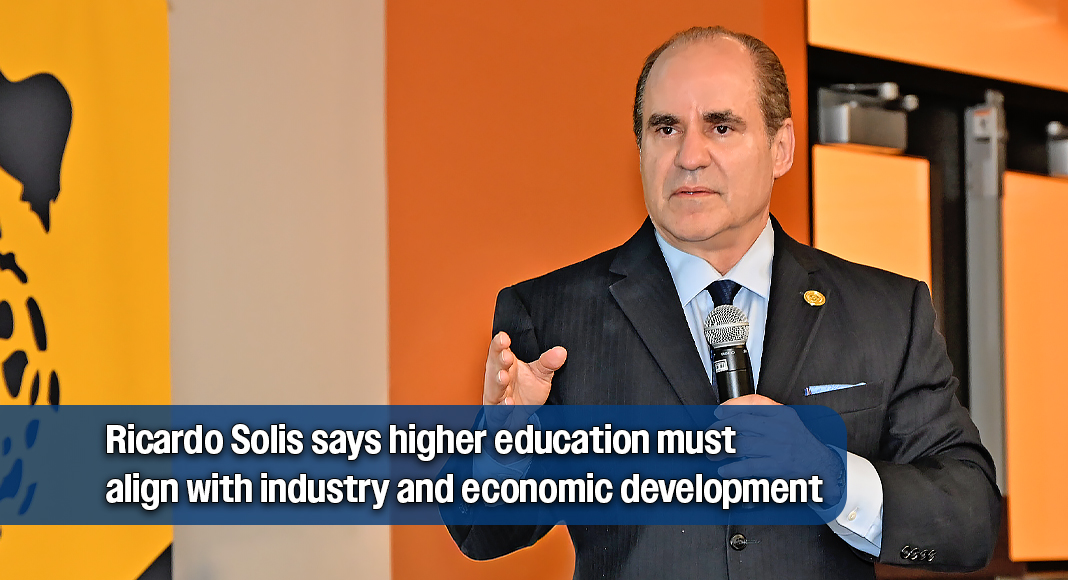
South Texas College President Dr. Ricardo Solis told regional leaders at RioPlex meeting that higher education must continue shifting toward workforce training and career-focused programs as students demand clearer returns on their investment.
Speaking at RioPlex regional economic development meeting in Weslaco, Solis welcomed attendees to one of the college’s six campuses and outlined how STC is adapting to changes in higher education and the workforce.

“Good morning, everybody. My name is Ricardo Solis, president of South Texas College, and welcome to one of the six campuses that we have throughout the valley,” Solis said. “We have over 30,000 students here throughout the region with three campuses in McAllen, one in Pharr, one in Starr County, and of course here in Weslaco.”
Solis said the college’s direction reflects a broader nationwide shift, as students increasingly seek direct connections between education and employment.
“I was reading an article this morning about the whole erosion of higher education,” he said. “In the last five years, 1,671 institutions of higher education have closed in the United States. Most of them are private.”
He said the closures are tied to changing student expectations.

“Students now are focused. They want to come into higher education, and they want to guarantee a pathway of career education to the workforce,” Solis said. “They want to know about the return on their investment.”
Solis compared the decision to enroll in college to paying for a meal without knowing what would be served.
“How would you feel if you go to a restaurant and you have to pay upfront and you don’t know what you’re going to get?” he said. “That’s what students are facing now. They want relevance. They want to know where this is going to take them.”
He said that shift is why South Texas College has emphasized workforce education, certificates, and industry-aligned programs.
“Our focus is to guarantee every student who comes in a viable career path,” Solis said. “That’s why we’re focusing on workforce programs and certificates. That’s where the future is.”
Solis said many students returning to college today are older and more career focused.
“We’re seeing students in their late 20s, 30s, and 40s coming back,” he said. “They want to buy a career. They want something that connects directly to a job.”
He stressed that higher education must work hand in hand with regional economic development efforts, including initiatives like Rioplex.
“For the Rio Grande Valley to be successful, higher education has to be tied to economic development strategies,” Solis said. “That’s how you attract industry and create jobs.”
He pointed to health care and technology programs as examples where students can move directly into the workforce.
“In those areas, we can practically say our students are guaranteed a job when they finish,” he said. “That’s the key.”
Solis also emphasized the importance of collaboration among local institutions.
“You’re going to hear more about certificates, professional development, and professional credit,” he said. “That’s where the solution is, and that’s where institutions like STC, UTRGV, Texas A&M, and others come together.”
He said workforce development is central to regional growth.
“That’s going to be the key to workforce,” Solis said. “The workforce is available. That’s why we’re focusing on it.”
Solis closed by welcoming attendees to the STC campus and reaffirming the college’s role in regional development.
“We’re glad you’re here, and we’re glad you’re using one of our campuses,” he said. “We’re excited to be part of this effort, and we’re committed to supporting this work moving forward.”
See related story: